In the 2026 legislative session, the Kentucky General Assembly will perform its most important job — crafting a two-year state budget that funds education, health, social services and other critical needs. But unlike recent years, when pandemic-era stimulus created robust revenue growth, lawmakers are now facing a serious budget crunch due to the loss of federal funds, a weakening economy and falling revenue because of state income tax cuts. That makes the 2026-2028 Budget of the Commonwealth a critically important moment in which vital public investments could be at risk.
The Budget of the Commonwealth reflects Kentucky’s values and priorities. Adequately, equitably funded schools would mean all Kentucky children, regardless of their zip code, could receive a high-quality education. Well-resourced supports for the elderly, children and people with disabilities would help families thrive. Less spending on incarceration, and more on mental health, infrastructure and college affordability, could enhance well-being across the state. These kinds of policy choices remove barriers to opportunity and security that people face because of race, gender, wealth and where in the state they live. They can also create a state where people want to live, raise a family, work and do business.
Unfortunately, Kentucky falls short because of years of budget austerity that has limited investment in the essential public goods and services needed to support thriving communities. But such austerity is a choice, not a necessity. Even in the face of economic uncertainty, lawmakers can tap the state’s large budget reserves and begin asking the wealthiest Kentuckians to pay what they owe to craft a budget that creates a more affordable Kentucky where families have the freedom to build the lives they want.
Part: 1 Revenue
Kentucky revenues face harm from slowing economy and state tax cuts
Kentucky’s revenue sources for the 2026-2028 biennial budget are severely constrained by falling revenue due to recent state income tax cuts and a slowing national economy. The state does maintain a significant balance in its Budget Reserve Trust Fund (BRTF) that can be used to help fill budget holes and protect critical services in this biennium. However, additional tax cuts in the upcoming session, including if lawmakers conform to new federal tax cuts in their own tax code, would further weaken the state’s position.
Slowing national economy is impacting state revenues while the One Big Beautiful Bill Act’s (OBBBA) cost shifts make states more vulnerable
Job growth and economic confidence have weakened throughout 2025, due in part to higher tariffs, lower net immigration and rising economic uncertainty caused by federal policy decisions.1 High and fluctuating tariffs are raising prices and causing businesses to put off investment decisions. The cost of some Kentucky-made products have gone up when they contain imported raw materials and inputs, and due to retaliatory tariffs from other countries.2 Plus, the administration’s harsh immigration policy is causing an increased number of deportations, leading to a growing labor shortage and overall workforce instability.3 In addition, the OBBBA’s cuts to Medicaid, SNAP, energy and more alongside upcoming shift of costs to states threaten to weaken the economy further.
Kentucky’s revenues will be further compromised by another state income tax cut enacted by the 2025 General Assembly. Beginning Jan. 1, 2026, the income tax rate will decrease from 4.0% to 3.5% and result in an annual reduction in state revenues of $718 million when fully phased in.4 The total cost of successive income tax cuts enacted over the past several years, which dropped the rate from 5% to 3.5%, will result in an annual revenue loss to the commonwealth of $2.1 billion.5 These cuts represent incremental steps in the General Assembly’s “march to zero,” a complete elimination of the state income tax that is now an explicit goal in state law.
Growth in Kentucky’s General Fund revenue plateaued in FY 2025 and is expected to fall in 2026
General Fund revenue growth slowed significantly in FY 2025, increasing just 0.8% from the previous year, following 2.9% growth in FY 2023 and 2.8% growth in FY 2024.
The state ended FY 2025 with a revenue surplus of $131.3 million. Receipts were slightly higher than anticipated due to corporate tax receipts that were over $500 million more than estimated and $585 million more than the prior year. This spike more than offset the underperformance of both the individual income tax and sales tax, which both brought in 4% less than estimated.
Some notes on the major receipt categories for FY 2025 include:6
- As a result of the rate cut from 4.5% to 4% beginning Jan. 1, 2024, individual income tax (IIT) receipts were down 8.4% compared to 2024, which was the largest single year decline on record since 1979. Receipts were also $227 million below the estimate. Sales and use tax receipts increased 4.1% year over year in FY 2024 but only 0.3% in FY 2025, ending an unprecedented streak of double-digit increases in sales tax growth. Sales tax receipts were also $259 million lower than the estimate.
- Combined corporate income tax and limited liability entity tax set new records with a growth rate of 46.9% year over year comparing FY 2024 and FY 2025. This swift growth resulted in business tax receipts increasing from $639.2 million in FY 24 to $1.8 billion in FY25; however, this unprecedented growth is due to an unusual corporate payment that is not expected to continue, with the Office of the State Budget Director (OSBD) calling it an anomaly that will not carry forward.
- Property tax receipts grew 3.9% over FY 2024 following a 4.4% growth in FY 2024 over FY 2023. The increases were driven by strong growth in receipts from general tangible personal property which increased 10.7% year over year, and motor vehicles, which increased 6.0% year over year.
- The “Other” category, which is made up of 60 smaller accounts including less significant taxes, fees and other receipts, continued to grow considerably. Within this category, income from investments based on the extremely large balance in the BRTF has become a significant contributor to General Fund revenue, bringing in receipts of $320 million and $323 million in FY 2024 and FY25, respectively. The “other” category accounts exceeded the revenue estimate by $124 million, primarily because of this higher-than-expected investment income.
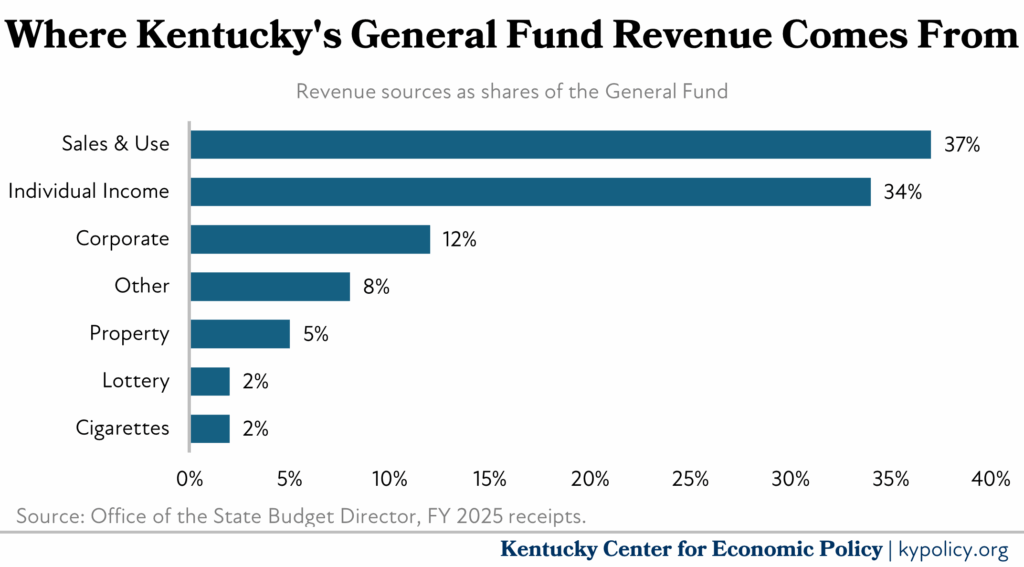
During FY 2025, largely due to income tax rate reductions, sales and use tax surpassed the individual income tax for the first time as the largest revenue source for the General Fund, as illustrated by the graph below. The individual income tax fell from 41% of General Fund revenues in FY 2022, prior to the tax rate reductions, to 34% in FY 2025.
Forecast shows moderate revenue growth that doesn’t keep up with inflation
As additional tax cuts are implemented, revenue from the IIT is projected to continue to fall behind. Reducing the most productive revenue source and doing nothing to replace it squeezes the resources needed to support schools, health care, infrastructure and other public investments. Moving forward, taking these and other tax cuts enacted by the General Assembly into account, revenues are projected to decrease by 1.3% this year, increase by 2.5% next year and another 2.2% in FY 2028. Inflation rates are projected to be 2.9% in 2026, 2.8% in 2027 and 2.3% in 2028.

Income tax cuts continue to provide huge benefits to the wealthiest
An analysis by the Institute on Taxation and Economic Policy (ITEP) shows that the Kentuckians who are struggling the most are not those who have benefited the most from nearly a decade of income tax cuts. The wealthiest 1% of Kentuckians, who make $1.6 million annually on average, will receive an average of $27,482 a year from reductions in the income tax rate since 2018. In contrast, those with incomes in the middle 20% will receive $859 a year on average and the bottom 20% will receive an average of $143 annually, as illustrated in the graph below. The richest 20% of Kentucky residents have received 66% of these tax cuts.7

Because the state has a “family size tax credit” that entirely exempts people below the poverty line from the income tax based on family size, the tax cuts are of no help to Kentuckians most in need of aid. The tax credit also phases out between 100% and 133% of poverty, meaning those individuals already have their income tax liability reduced between 10% and 90% before the tax cut. Thus, a family of four with a modified gross income below $32,150 pays no income tax already and will not benefit from the income tax rate reductions, while a family of four with a modified gross income between $32,150 and $42,760 already has their income tax reduced by the family size credit.8 Most of Kentucky’s 825,850 seniors also do not benefit, as the state already exempts Social Security from the income tax as well as the first $31,110 of other retirement income.
These tax cuts make an already upside-down state and local tax system even more imbalanced. The lowest-earning Kentuckians pay 12.4% of their income in state and local taxes, which is nearly double the 6.6% of income paid by the highest earners.9 These tax cuts also worsen racial inequities in income. According to ITEP, Black Kentuckians make up 13.1% of the bottom 20% of filers, despite being only 9.8% of all filers, making them overrepresented in the lowest income group.10 The Black poverty rate is 23.2% compared to the white poverty rate of 14.2%, meaning nearly a quarter of Black Kentuckians most in need of the additional income will receive nothing from the tax cuts already enacted.11
Kentucky’s BRTF grew during period of pandemic stimulus, and legislative changes make more tax cuts still possible despite declining revenues
Federal pandemic stimulus funding and higher inflation brought in considerable unexpected but temporary revenue to many states in recent years, including Kentucky. The Kentucky General Assembly primarily used these funds to build up the balance in the state’s BRTF and used them as a justification for permanent tax cuts.
In 2022, the General Assembly established a formula that they say allows them to determine whether they can afford to further reduce the income tax rate by 0.5% each year. The formula relied on a one-year, backward-looking snapshot of Kentucky’s fiscal situation, and was comprised of two parts:12
- The BRTF balance must be greater than 10% of General Fund receipts during the fiscal year; and
- Revenues must exceed spending by at least the cost of a 1% cut in the income tax, which at current levels is around $1.3 billion; this prong of the formula was amended during both the 2024 and 2025 legislative sessions and these changes are discussed below.
To meet the trigger the past few years, the General Assembly has left at least $1.3 billion each year in General Fund revenues unappropriated. This money was instead deposited in the BRTF, causing its balance to grow.
The first year after the tax changes went into effect, the conditions were met to hit the trigger. In 2023, however, despite the General Assembly’s decision to budget at levels aimed at hitting the triggers, the difficulty of cutting the budget enough to meet the conditions of the formula became apparent. When spending was needed to provide disaster relief and address other pressing needs, the General Assembly failed to meet the trigger requirements that would have allowed the rate to be reduced from 4.0% to 3.5% in January of 2025.13 Since then, lawmakers have twice amended the formula to make hitting the trigger easier.
Legislators soon recognized that their strategy for constraining spending — depositing over $1 billion a year in the BRTF rather than appropriating it — created an additional challenge. The BRTF balance was ballooning, but if the General Assembly spent any of that money it would increase the expenditure side of the formula and keep the trigger from being met. They were stuck with a huge and growing pot of money and no way to spend it while still hitting the trigger.
In April of 2024 the General Assembly moved the goalposts to make the trigger easier to meet by amending the formula to allow appropriations from the BRTF to not count for purposes of the expenditure trigger.14 This change creates great latitude in the expenditure prong of the formula since lawmakers can avoid the expenditure limit as long as they initially appropriate the money to the BRTF; the funds can then be appropriated for other purposes without counting as expenditures.15
That’s exactly what happened in 2024 when the General Assembly appropriated more than $3 billion over the biennium from the BRTF to fund more than 265 projects and purposes, some of which are one-time expenditures and others are recurring expenditures. Then they deposited an additional $2.9 billion in the BRTF at the close of FY 2025 to make these monies available to spend in the upcoming session without impacting their ability to meet the expenditure prong of the formula.16
The trigger was met in FY 2024, after the formula’s revision, allowing the General Assembly to cut the income tax rate from 4% to 3.5% beginning in January of 2026.17 However, in FY 2025, the General Assembly narrowly missed hitting the trigger by spending $7.6 million above what it would cost to cut the income tax rate 1%.18
Still focused on continuing the “march to zero,” but recognizing their recently revised formula would likely still not allow additional cuts due to stagnating state revenues, the General Assembly revised the formula yet again in 2025. Along with the original provisions, the changes provide even more incremental steps for the upcoming biennium by allowing a 0.25% rate cut if revenues exceed spending by at least the cost of a 0.5% cut in the income tax, but less than the cost of a 1% cut.
Beginning in FY 2027, the formula for the second trigger changes again, allowing cuts of tenths of a percentage point, from 0.1-0.4%, if revenues exceed expenditures by the cost of smaller rate cuts, with the size of the cut dependent on the amount that revenues exceed expenditures.19
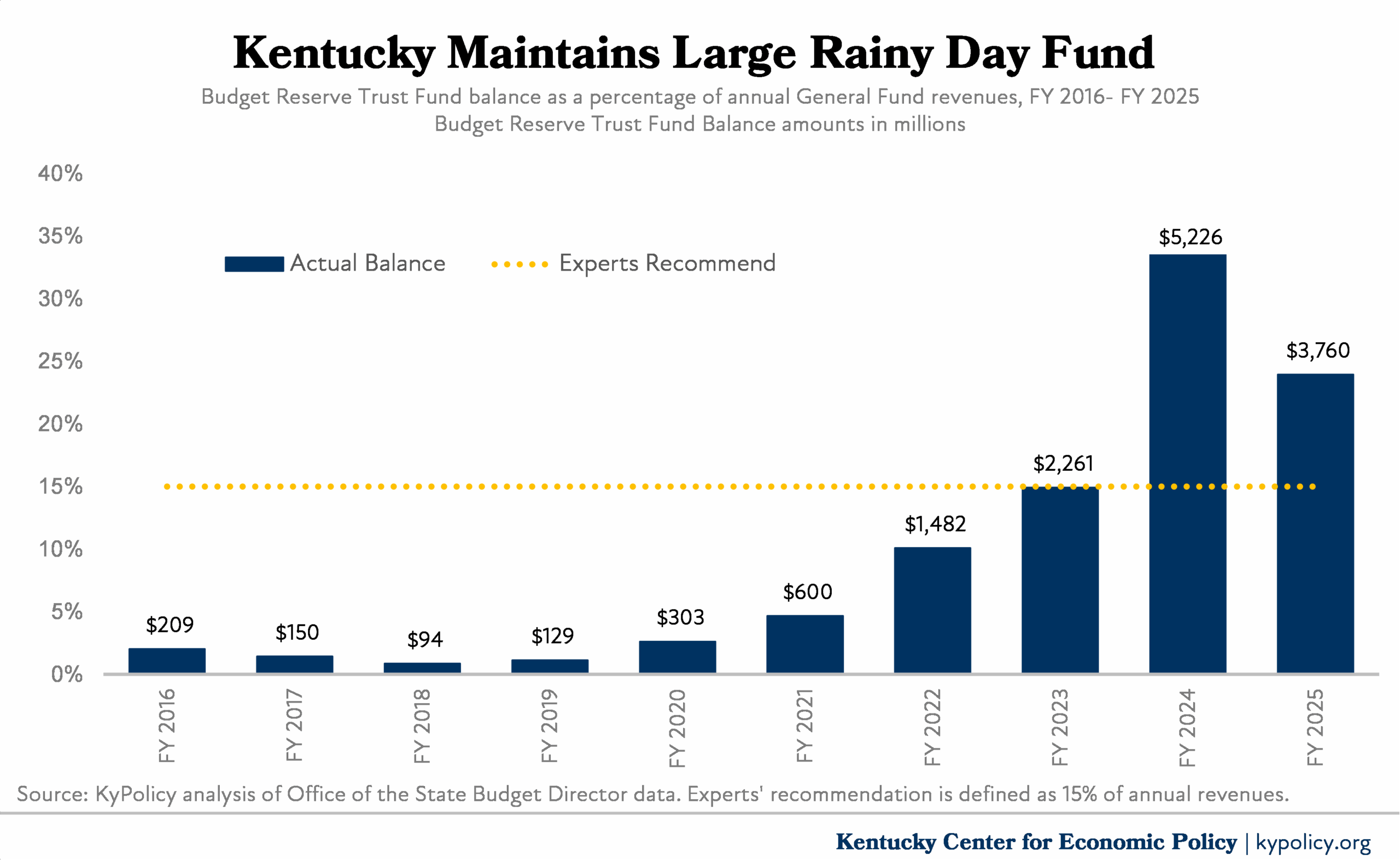
As of the end of FY 2025, Kentucky could operate for 102.3 days on accumulated BRTF reserves alone, as compared to the nationwide median of 46.9 days. Kentucky is one of only seven states with more than 100 days of revenue in reserve, even after appropriations from the BRTF during the 2024-2026 biennium.20 Currently, the BRTF balance exceeds $3.7 billion, or 24% of the state’s expected revenues for FY 2026. That exceeds the balance of about 15% of revenues most experts say is needed to protect against a future recession.21
State’s potential conformity to new federal tax legislation would cost additional needed revenue
Like most other states that have an income tax, Kentucky’s tax code is tied to the Internal Revenue Code (IRC). Kentucky links to the IRC using static conformity, which means that the state tax code references the IRC as of a certain date — currently Dec. 31, 2024 — that is set forth in statute. To include the new federal tax changes included in the OBBBA as part of Kentucky’s code, legislative action is required. Fully considering the impacts of IRC conformity is particularly important in the upcoming session because of the numerous and significant changes that were made at the federal level in OBBBA that could have far-reaching consequences in Kentucky. Many of the changes expand and extend favorable treatment for businesses and, if adopted at the state level, will reduce state revenues.
Other changes, like the exemption of a portion of the tax on tip income and overtime pay, may appear at first glance to help low and moderate-income working people but deserve special consideration. Adopting these provisions in Kentucky would likely provide little to no benefit to the people who need them the most because of the state’s family-sized tax credit, and because a very small portion of working people earn overtime pay. Kentucky has previously rejected conforming to specific provisions of the IRC that would be too costly and should do so again this year because of the significant expenditure and revenue-related concerns the General Assembly faces as it approaches the 2026 legislative session.22
Part 2: Investments
New threats and longstanding inadequacies put critical services at risk
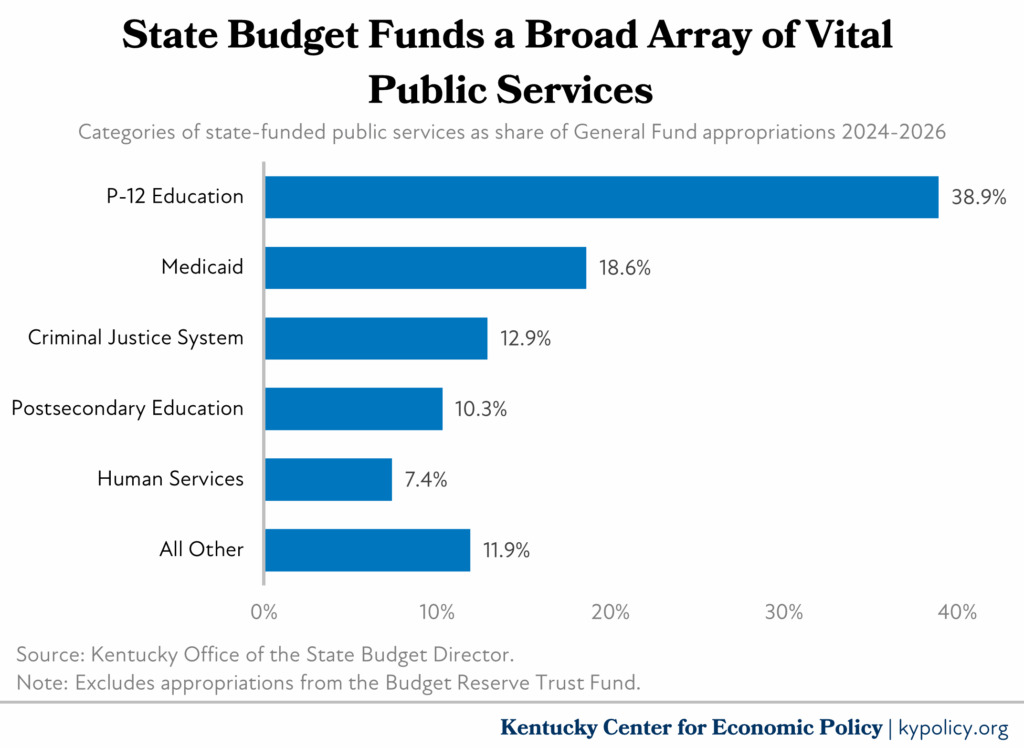
The previous section of this report looked at the revenue context for what is possible in the 2026 General Assembly. This section explores the compounding impact of more than a decade of budget cuts and new federal legislation that will significantly affect the state budget. The chart below provides an overview of the major ways the state’s General Fund is being spent in the current biennium.23
Education
State funding for P-12 education
P-12 education is the largest area of state spending. Despite modest funding increases in recent years, the state has not restored education investments that were cut following the Great Recession. These concerns are exacerbated by uncertainty around U.S. Department of Education (USDOE) funding as well as the recent expiration of federal COVID relief money.
Research shows that funding cuts to public education have a negative impact on student success while funding increases improve outcomes.24 Budget reductions made across the country during the Great Recession led to lower rates of college attendance, lower test scores and larger test score gaps by income and race.25 Federal pandemic relief funding, on the other hand, had positive effects on math and reading in districts with “high-need” student populations (i.e., students from low-income families, English learners and youth in foster care) and on test score gaps between high- and low-poverty districts.26
State support for SEEK funding has deeply eroded
SEEK (Support Education Excellence in Kentucky), the state funding formula through which the state’s 171 public school districts receive the majority of their state funding, is by far the largest Kentucky Department of Education (KDE) budget category. The SEEK budget unit includes base SEEK funding, pupil transportation, Tier I funding, teachers’ retirement contributions and equalized facility funding, as well as vocational transportation, national board and audio/speech pathology salary supplements. In FY 2025, SEEK also includes a special appropriation to support a three-year pilot accelerated learning recovery program called “STAR Academy” at five middle school sites.27 Over the 2024-2026 biennium, overall SEEK funding increased by 5.3% compared to FY 2024, with most of the increases directed to transportation, retirement contributions and Tier I equalization funding discussed later in this section.28
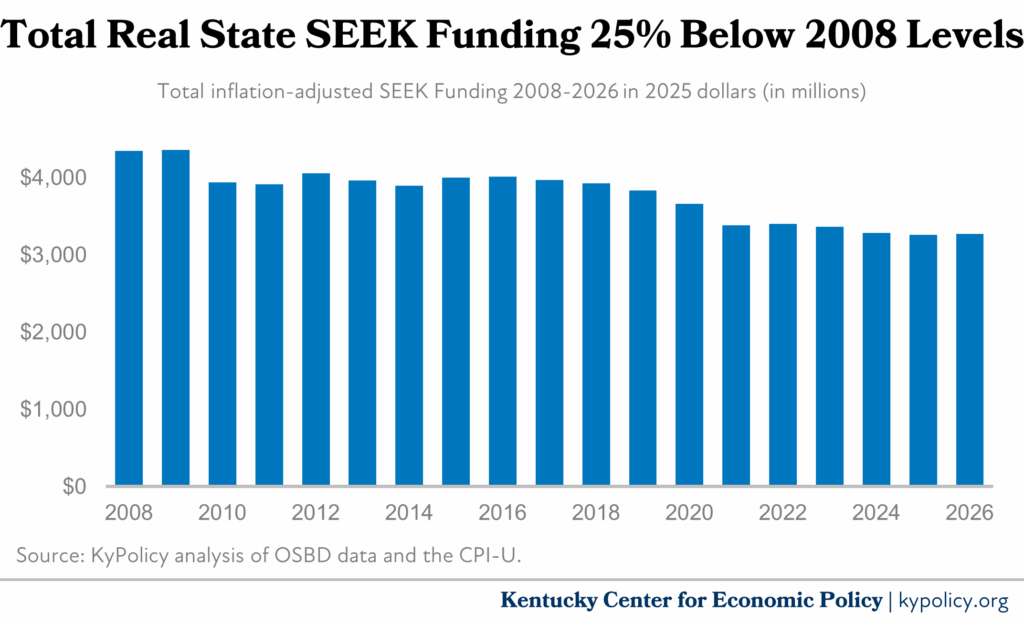
But total SEEK funding in FY 2026 is still 25% below FY 2008 levels in inflation-adjusted dollars. For overall SEEK funding to match 2008 levels in real dollars, The Kentucky Council for Better Education estimates it would take an additional investment of more than $1.3 billion per year.29
The majority of state SEEK dollars are devoted to providing base funding for school districts — which includes a guaranteed amount per pupil and add-ons based on a district’s population of students eligible for free lunches, with disabilities, with “limited English proficiency,” and who receive home and hospital services.
SEEK’s guaranteed base amount per pupil is the minimum amount of funding per student that every district receives. The amount is established in the budget and is funded through a combination of state and local funding. All local districts contribute $0.30 for every $100 of taxable property for the local portion of the per-pupil guarantee, and the state makes up the difference to reach the amount established in the budget, contributing more to districts that have less property wealth to equalize the lack of local capacity.30
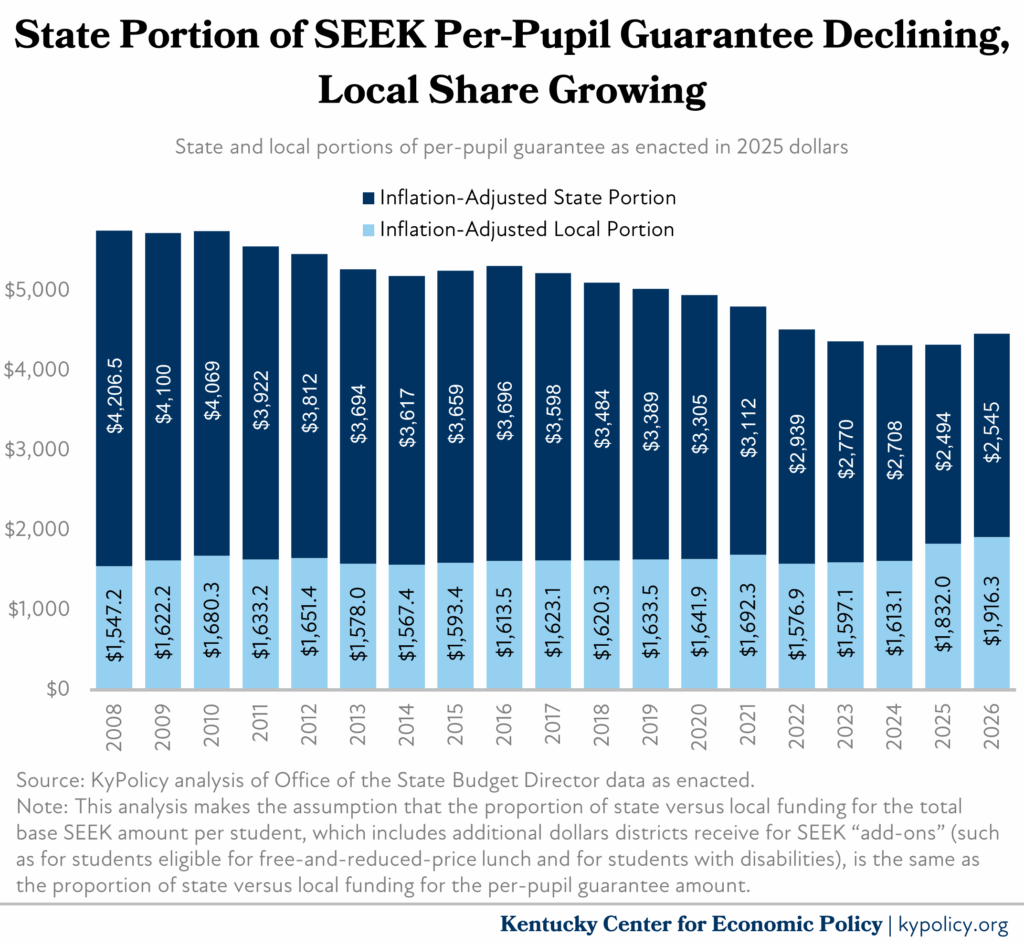
The guaranteed base amount per pupil increased in the 2026-2028 budget, going from $4,200 in 2024 to $4,326 in 2025 and then $4,586 in 2026; that’s a 9.2% increase between 2024 and 2026.31 However, the cost of the increase is being borne primarily by local school districts. Our analysis shows that in nominal terms the state portion went down slightly (by $16) between 2024 and 2026 while the local portion increased by $402.
Between 2008 and 2026, the state portion of base funding per pupil declined by $178 (-6.4%) on a nominal basis, while the local portion grew by $942 (91.6%). And when inflation is factored in, as shown in the graph below, the state portion of the guaranteed base amount per pupil declined by $1,661 (39.5%) while the local portion increased by $369 (23.9%).
Schools across Kentucky have also experienced additional reductions in base SEEK funding due to student attendance declines resulting from post-pandemic absenteeism, an issue that schools across the country continue to face. Kentucky’s “chronic absenteeism” has dropped from 28% in 2023-2024 to 25% in 2024-2025.32 But because the SEEK funding formula is based on average daily attendance, districts receive fewer state funds when students are absent even though overhead and facility costs may be relatively unchanged. The districts most impacted by attendance reductions are in eastern Kentucky. These are also the districts most impacted by the lack of state investment in education because of their relatively low local property tax bases.
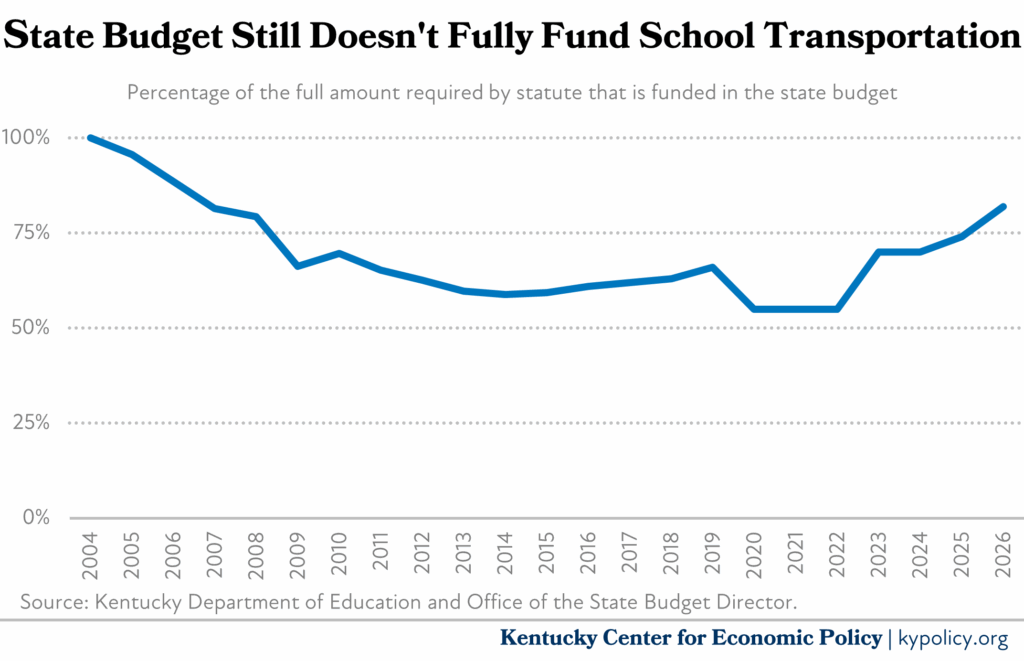
In addition to shouldering more of the burden to support the base SEEK formula, local districts must make up for shortfalls in transportation funding. By law, the state must pay the full cost of transporting students to and from school as calculated by a statewide formula.33 However, the state has not fully funded the transportation formula since 2004. The funding level went up from 70% of the full statutory amount in 2024 to 74% in 2025 and 82% in 2026; this is an improvement from prior years but still short of what the statute requires.34
In addition to the $0.30 per $100 in property tax value that districts must levy to participate in SEEK, districts are permitted to impose local levies to generate more resources. The first additional levy, referred to as Tier 1, provides a state match at 150% of the statewide average property per pupil for districts that impose additional levies. Statutory language establishes the amount that can be raised and matched under Tier I as up to 15% more than the combined SEEK base per-pupil amount plus add-ons. But in the 2024-2026 budget, the General Assembly temporarily increased the amount that can be raised and matched to 17.5% above the combined SEEK base amount plus add-ons. By providing this temporary increase in Tier I rather than increasing the base SEEK funding for all schools, the General Assembly is providing additional state resources to most districts though not for districts with higher property assessments, like Jefferson and Fayette counties.
The second allowable additional levy, referred to as Tier 2, enables districts to raise additional money through local taxation up to 30% above their base funding and Tier 1 funding combined. The state does not equalize Tier 2 funding.
Mechanisms that improved school equity under KERA rely on adequate state funding
The growing shift from state to local funding for public education described above has increased inequities between poor and wealthy school districts. These inequities now surpass those that existed in 1989 when the entire education funding system was declared unconstitutional in Rose v. Council for Better Education.35
In response to the Rose decision, the General Assembly passed KERA and enacted major tax increases that raised over a billion dollars for public education. These revenue increases were key to ensuring the state had sufficient resources to establish and support the SEEK formula and ensure important strides toward equitable funding. Now, more than three decades after Kentucky’s landmark effort to create more equity in education across the commonwealth, that progress has been erased.
KyPolicy analyzed the funding gap between wealthy and poor school districts using a measurement methodology developed and previously utilized by the Office of Education Accountability (OEA). As shown in the graph below, the 2024 per-pupil funding gap between schools in the top and bottom quintiles was $4,247, which is $508, or 13.6%, more than it was in 1990 in inflation-adjusted terms.

The most significant drivers of these inequities are the chronic lack of state investment coupled with the drastically differing abilities of school districts to generate resources locally. In finding the system unconstitutional in 1989, the court explained:
The system of common schools must be adequately funded to achieve its goals… [and] must be substantially uniform throughout the state. Each child, every child, in this Commonwealth must be provided with an equal opportunity to have an adequate education. Equality is the key word here. The children of the poor and the children of the rich, the children who live in the poor districts and the children who live in the rich districts must be given the same opportunity and access to an adequate education. This obligation cannot be shifted to local counties and local school districts.
In January 2025, the Kentucky Student Voice Team filed a lawsuit in Franklin County Circuit Court claiming that “the Commonwealth and its General Assembly have failed to maintain the level of commitment to education required by the Rose decision” and therefore the state is once again out of compliance with its Constitution.36 That lawsuit is currently making its way through the court system.
Budget meant many teachers did not receive raises
The 2024-2026 budget did not provide dedicated funding for employee raises, and the SEEK funding level discussed above is not adequate for all districts to provide needed raises and a classroom environment that supports high-quality teaching and learning.As a result, the typical Kentucky school district increased salaries for teachers and other certified employees by only 2% this school year, with 40 districts providing no raise at all.37 In over 60% of districts increases were below inflation, which rose 2.9% for the year ending in August.38 And districts that provided no raise this year have substantially lower property wealth on average than those that provided raises of 4% or more. Similar wage stagnation has occurred for classified employees like bus drivers and cafeteria workers, who have doubled their salaries on average when leaving for the private sector according to a recent Legislative Research Commission (LRC) report.39
That same report indicated that low pay and a perceived lack of respect for the teaching profession are among the major factors that have contributed to recruitment and retention challenges in Kentucky schools.41
A presentation by KDE to the Interim Joint Education Committee last year highlighted the following concerning vacancy trends resulting from teacher and staff shortages:42
- As of Sept. 1, 2025, only one Kentucky school district was fully staffed.
- For the 2023-2024 school year, 13% of all vacancies statewide persisted until the end of the school year.
- In 2023-2024, positions for speech pathologists and school psychologists had the highest number of unfilled vacancies at the end of the school year.
- Elementary school teachers were by far the certification area where the teacher shortage is hitting hardest, which is resulting in larger class sizes.
- Special education and early childhood educator shortages remain a significant issue for many districts.
- Schools struggle to find bus drivers and teaching aides.
Non-SEEK K-12 education funding includes few additional investments
In terms of funding for education programs outside of SEEK in the most recent budget, there were some increases for Family Resource and Youth Services Centers (FRYSCs), which are administered by the Cabinet for Health and Family Services (CHFS). FRYSCS were established by KERA in 1990 to provide supports for families to help address non-educational barriers to learning in schools where at least 20% of students are eligible for free and reduced-price lunches.43 The 2024-2026 budget added $4 million each year for the operation of additional FRYSCs, on top of the existing 888 that were supporting students at 1,200 schools; however, it decreased the amount that could be spent by FRYSCs on administrative expenses.
Extended school services (afterschool programs) were funded at the same level as in 2019. There are no funds for teacher professional development, which has not been specifically funded since 2018, or for textbooks. There was funding for a pilot program of teacher student loan forgiveness of $4.8 million in 2025 and $10 million in 2026. The biennial budget also included $750,000 for an audit of Jefferson County Public Schools, and $5 million in 2025 for a three-year pilot middle school accelerated learning recovery program, “Star Academy Schools,” at five school sites.44
From 2021 to 2024, the Center for School Safety was funded at $13 million each year, with most of that funding flowing through to school districts. Districts expend these funds for School Resource Officers, alternative education programs, intervention services, security equipment, training programs, in-school supervision and community-based programs.45 In the 2024-2026 budget, the amount was increased to $15 million each year.46 The budget also includes an additional $16.5 million in FY 2025 and $18 million in FY 2026 to assist local districts in funding salaries for school resource officers.47 Between FY 2022 and FY 2025, the number of school resource officers in Kentucky’s public schools have increased from 525 to 842.48
The budget provides $7.4 million each year for school-based mental health positions. This investment is far below the demand for mental health providers in schools. In an Interim Joint Committee on Education meeting, the Kentucky School Counselor Association testified that the state needs to invest $40.4 million a year to provide an additional 628 school counselors across the state.49 Currently there are just over 2,000 counselors and nearly half of districts fall short of the ratio of one counselor per 250 students recommended by experts and included as a goal in state law.
The School Facilities Construction Commission (SFCC) is responsible for extending offers of financial assistance to school districts for approved building or renovation projects.50 In the 2024-2026 budget, the SFCC is authorized to extend $40 million in new offers of debt service assistance as well as the necessary debt service to finance the $85 million authorized for the offers extended in the previous biennium. It also included $146.7 million in bond funds for SFCC to award on a competitive basis to help districts fill gaps in funding necessary to complete school construction projects that have stalled due to increased costs resulting from inflation.51
The capital budget also includes $61.4 million in bond funds for Special Offers of Assistance for School Construction for six schools and more than $31 million for capital grants to five school districts.52 Still, the current unmet facilities need for 2025 going into the 2026 legislative session is approximately $7.2 billion.53
The 2024-2026 budget builds on the prior $245 million investment in Local Area Vocational Education Center Renovation grants during the past two budget cycles by adding $50 million to the funding pool to modernize facilities and provide more up-to-date technical programs.
Schools have lost federal funding and face further uncertainty
Kentucky received over $3.1 billion in funding for K-12 education through COVID relief legislation passed at the federal level. These funds, referred to as ESSER (Elementary and Secondary School Emergency Relief Fund), enabled Kentucky schools to address immediate COVID-specific issues as well as take care of longstanding unmet needs due to state funding cuts and freezes.54 Schools used these funds to increase salaries, provide student supports and hire teachers and other staff; approximately 2,000 staffing positions were newly created with ESSER funds in Kentucky.55 State funding for K-12 education in the 2024-2026 budget wasn’t adequate to stabilize school districts’ financial situations as they faced the expiration of ESSER funds, particularly those with more children who live in poverty.56
The post-ESSER funding cliff has contributed to budget deficits several of the state’s school districts are facing. It was explicitly cited by the Fayette County Schools superintendent as one factor in the $16 million budget deficit the district was initially facing this school year and by an administrator at Jefferson County Public Schools related to their $188 million budget deficit.57 Other school districts with deficits include Newport Independent Schools, which made massive cuts to address its $3.9 million budget deficit; Berea Community Schools, which faced a $1.3 million shortfall that led it to cut over 30 positions, resulting in a student walkout; and Woodford County Public Schools, which ended the 2025 fiscal year with a $2 million deficit.58
Actions by the Trump administration have added pressure on districts. In March 2025, the USDOE rescinded $38 million in unspent/unreimbursed ESSER funds for which extensions were previously approved, impacting 14 school districts. Those districts have signed contracts or obligated spending on construction projects or school buses over the course of the following year, relying on the extended deadline.59 The USDOE also rescinded $18 million previously approved for KDE that was allocated for programming. The recissions are currently on hold pending the outcome of litigation, so for now Kentucky schools and the KDE can continue to expend these funds for which extensions were previously approved.60
As the federal government continues to pursue funding cuts for public education, there is a great deal of uncertainty and the stakes are high.61 With the help of the Department of Government Efficiency (DOGE), the administration closed more than half of the regional offices of the Education Department’s Office of Civil Rights (OCR), including the Philadelphia office that served Kentucky, and laid off more than half of the agency’s employees. That is making it virtually impossible to resolve the growing number of civil rights complaints from students and their families.62 The administration has also attempted to terminate almost all of the Education Department staff who work on key grant programs, including Title I for low-income students, and effectively closed the Office of Special Education and Rehabilitative Services, which is responsible for approximately $15 billion in special education funding and for making sure states provide special education services to children with disabilities.63
Kentuckians rejected the expenditure of public funds to support private schools
In 2024, voters in all 120 Kentucky counties rejected a proposed constitutional amendment, “Amendment 2,” which would have enabled state tax dollars to subsidize private schools.64 The General Assembly enacted a private school voucher program in 2021 with the passage of HB 563, but the Kentucky Supreme Court unanimously struck down it down the following year, ruling it unconstitutional.65 If Amendment 2 had passed and the voucher program had been implemented, state spending on vouchers would have diverted money away from public schools and further reduced education funding adequacy and equity.66
The issue of spending public money on private schools may be before the General Assembly again during the 2026 session, however, this time because of a federal voucher program established in the OBBBA that states can opt into. The federal program, which begins in 2027, provides a dollar-for-dollar tax credit of up to $1,700 for cash contributions made by individuals to scholarship granting organizations in their state. States must affirmatively opt in to participate in the program. The details of the program and what latitude states may have in establishing conditions that differ from the broad parameters of the OBBBA are not clear because guidance has yet to be issued.
Other concerns exist for education funding during the next biennium
In 2017 the Kentucky General Assembly passed legislation that would allow the establishment of charter schools but did not provide an effective funding mechanism to support them.67 In 2022, the General Assembly enacted a funding mechanism for charter schools that diverts public education dollars from the state as well as local dollars from taxes levied by local school boards. The local school boards have no responsibility for or control over the charter schools to which the money would be diverted.68 This legislation was challenged in court, with the lower court holding that it violates the Kentucky constitution. The case has been argued before the Kentucky Supreme Court, which has yet to issue an opinion, but if the Supreme Court reverses the lower court, the decision could have a significant negative impact on our already underfunded public school system.69
Next budget needs to reinvest in public education
Years of erosion in state funding for public education have led to a decline in quality and equitability. The next budget presents an opportunity to address this challenge.
An increase in state funding to public schools of $718 million a year — equal to the cost of a half-point reduction in the state income tax, which lawmakers have passed three times in recent years — would allow an 8% average state-wide raise for educators.70 It would also improve job quality by permitting the hiring of 2,658 more teachers and certified staff to help reduce class sizes, expand mental health services, and more, along with providing additional funds to hire bus drivers, buy needed equipment and restore lost spending for technology, textbooks and professional development. By primarily channeling that funding through the SEEK formula, the poorest districts would disproportionately benefit.
Early childhood education
High quality early childhood care and education is one of the most powerful tools available to improve the trajectory of kids’ educational, economic and social well-being. And yet it is often not considered a meaningful part of the continuum of learning and development, and Kentucky’s budget has consistently underfunded state investments that help all Kentucky kids have a strong start.
Early childhood education can be strengthened by expanding preschool
Participation in preschool is associated with improved academic outcomes for children, and the benefits can even extend to better health and economic stability later in life.71 Universal preschool can help to provide greater economic and racial equity in school by ensuring all kids, regardless of barriers their families may encounter, enter kindergarten with the skills they need to be successful.72
And yet, preschool is not guaranteed to Kentucky’s 4-year-old-children. Eligibility for tuition-free public preschool is currently restricted to 4-year-olds in families with incomes below 160% of the poverty level ($51,440 for a family of four) and 3- and 4-year-old children with developmental delays and disabilities, regardless of income.73
The governor’s Pre-K for All initiative has recommended a phased-in approach for expanding public preschool. A report outlining the Pre-K for All committee’s findings and recommendations propose that Kentucky immediately increase state funding to support existing public preschool programs, but also to begin a multi-year phase-in of a mixed-setting approach that is controlled by school districts but utilizes existing private options which are often in child care provider settings.74
Child care is scarce — and even nonexistent — in parts of Kentucky
Although funding and administration of child care assistance lies within the Cabinet for Health and Family Services (CHFS) and not the KDE, child care can be considered a part of the continuum of education because it has such profound effects on a child’s academic career and outcomes even into adulthood.75 Child care has not historically been a priority of the commonwealth, however, which has contributed to a shortage of child care providers in some communities.
In Kentucky, there are 168,427 existing child care slots among state-regulated child care providers, but there are 318,000 children under the age of 6, and many kids 6 and older who need after school care and summer care.76 While not all families with young children need child care, it is concerning that there are only about half as many child care spots as there are kids who may need them.
In 2013, a budget shortfall led the state to put a moratorium on new entrants to the state’s Child Care Assistance Program (CCAP), which provides help with child care costs for low-income families. Although this moratorium was lifted the following year, it further destabilized what was already a difficult business model for providers, making it impossible for many to keep their doors open.77 The number of providers continued to decline until 2020 when the federal government began pumping a billion dollars into Kentucky’s child care system to stabilize it following the COVID-19 pandemic and consequent economic downturn. The expiration of those funds in September 2024 could have led to a disastrous wave of child care provider closures, but a combination of new state funding and tuition increases helped the industry remain stable for the past two years.78

Still, large portions of the state have too-few child care providers.79 For families in Magoffin County and Martin County, there are no licensed providers at all.80 Additionally, many providers are unable to meet the needs of children with disabilities or behavioral challenges. A recent survey of Kentucky providers and parents found that during a 12-month period more than half of the responding providers had expelled a child (and some had expelled multiple children) for challenging behaviors because they did not have the financial resources needed to hire specially-trained staff who could serve those students.81
Kentucky should continue to build on recent state-funding improvements
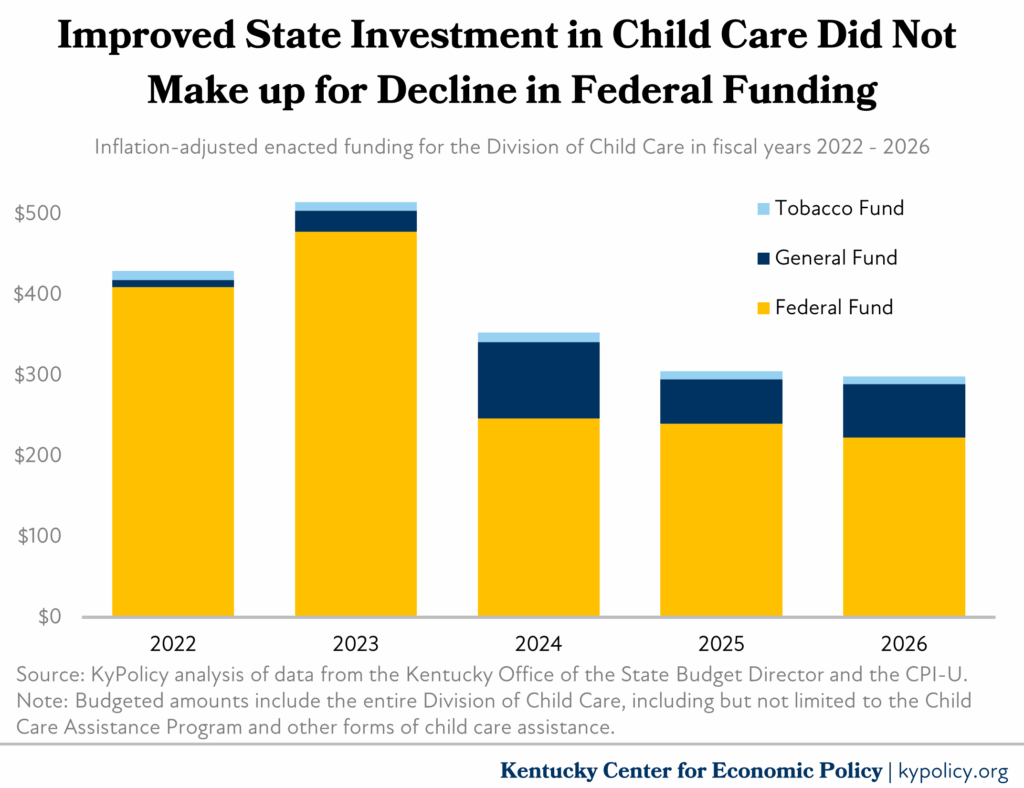
The 2024 expiration of transformative pandemic-era funding for child care in Kentucky left a large budget hole of hundreds of millions of dollars, which the General Assembly mitigated with additional General Fund dollars in the 2024-2026 budget.82 This funding enabled several important policies to continue that were initiated by the federal funds, including:
- Keeping CCAP reimbursement rates at the 80th percentile of market rates (it was previously close to half that level).
- Allowing child care employees to qualify for CCAP regardless of income.
- Retaining a six-month period of assistance after a family no longer qualifies based on its income.
- Paying for background checks for prospective child care employees.
- A new Innovations in Early Childhood Education Delivery Fund that awards grants to child care providers for various initiatives.
The state’s investment in the continuation of these policies, as well as funding for a new employer-based form of child care assistance, amounted to $39.1 million in 2025 and $49.8 million in 2026.83 This investment has made a real difference in providers’ ability to keep open and families’ ability to pay tuition. At the same time, it was not enough to make up for the decline in federal funds, as shown in the graph below.
Increasing CCAP funding is the best way to help families afford child care
Today, nearly 42,000 Kentucky kids benefit from CCAP.84 Beginning in the 2016–2018 budget, the General Assembly included a $10.6 million increase in funding to raise the eligibility threshold for families from 150% of the 2011 federal poverty level (FPL) to 160% of the current FPL.85 Due to the large influx of federal funds in 2020, however, the eligibility limit was increased again in 2022 to 85% of the state median income (SMI), which is around $85,800 for a family of four this year.86 The result of these income eligibility improvements is that CCAP participation has nearly recovered to its pre-2013 levels for the first time.

But the reimbursement rates the state pays child care centers that care for kids participating in CCAP is too low, making it difficult for centers to pay operational expenses. In 2024, the average pay for employees in the child care sector was $25,960, compared to $60,560 for the average private sector employee.87 This average annual salary includes directors and supervisors, so it likely overstates the pay of classroom teachers. Low CCAP reimbursements have historically contributed to difficulty retaining a workforce.88
Additional state funding is needed to raise reimbursement rates for CCAP-participating providers (which in turn makes care more affordable for CCAP-participating families). Pandemic-era federal funds allowed the state to make the most recent reimbursement rate increase, which brought them up to as much as $47 per-child, per-day (although, in some counties, the maximum payment rate still sits at just half that amount).89 While this increase was significant, the maximum daily rate has not been adjusted since October 2022. These increases are important to fostering the availability and viability of child care centers, but are still below what is needed to ensure that all child care in Kentucky is high-quality, which is when the best outcomes for children are achieved.90
Postsecondary education
Kentucky’s investment in public higher education has declined significantly in real dollars since 2008, and the cumulative effect of decreased investment has led to significant challenges in affordability, quality and equity in Kentucky’s system of public higher education.
Despite recent increases, higher education funding is still significantly below inflation-adjusted 2008 levels
In the 2024-2026 budget, after more than a decade of funding cuts to the state’s public postsecondary institutions, the General Assembly increased its investment for the second consecutive biennium. Total state funding for Kentucky’s public universities and community colleges went up by 10.9% between 2024 and 2026.91 Although these are important gains, the need for additional progress is considerable given the funding level in 2026 is still 28.5% or $463.5 million less than in 2008 in inflation-adjusted terms.92

Much of the increased state funding over the past four years has been for performance funding, which was established by legislation in 2017. In the 2024-2026 biennium, $220 million was distributed through the performance funding models for universities and community colleges. While this increase isn’t a big jump from the prior biennium’s $194.6 million for performance funding, it is significantly higher than the 2021-2022 biennial budget, which included just $32 million.
Performance measures for the public universities include student success metrics such as bachelor’s degree attainment with some additional weight given to degrees earned by low-income students and “underrepresented students,” which is being defined as first generation college students; until recently the weighted category was “underrepresented minority students.”93 The community college performance funding model is similar but includes credentials as well as degrees, with additional weight given to those earned by academically underprepared students.
Performance funding was originally designed to eventually apply to all state funding for the public postsecondary institutions even while the General Assembly was still cutting those institutions’ overall state funding. This created the potential for perverse incentives which could lead institutions to compromise quality or become more restrictive with admissions. To address this challenge, the General Assembly made adjustments so that the state’s public postsecondary institutions are guaranteed a minimum amount of base funding — a funding “floor” — that is not subject to the performance funding model.
Historically, performance funding hasn’t benefitted the state’s smaller, regional universities that disproportionately serve low-income students and students of color and are more likely to be located in rural parts of the state. Such institutions are often already under-resourced, and students of color and students with low incomes/from low-income families often face additional structural barriers to academic success.94 In both 2025 and 2026, Kentucky State University (KSU), the state’s only public HBCU (Historically Black Public Colleges and Universities), received no performance funds. Morehead State University (MoSU) located in rural eastern Kentucky, also received no support through the performance funding model in 2026 after receiving only a very small amount in 2025.95
Out of the 16 community colleges in the Kentucky Community and Technical College System, four received no performance funding dollars in 2025 and 2026: Big Sandy, Hazard, Henderson and Southeast Community and Technical Colleges. Several of these institutions are located in some of the poorest communities in the state.96 In 2026, West Kentucky Community and Technical Colleges also received no performance funds.
Kentucky State University was in dire financial need and continued investment and oversight is needed
KSU faces additional financial challenges from years of state underfunding and the limited options school administrators have faced because of constrained resources.97 In 2023, the federal government identified Kentucky as one of 16 states in violation of federal law due to how severely and inequitably it was underfunding the state’s sole public HBCU.98 The federal government found that KSU should have received $172 million more in state funding over the last 30 years. This longstanding underinvestment created financial strains resulting in a revolving door of presidents, challenging working conditions for faculty and staff, and deteriorating buildings.99
KSU has been under state oversight since the General Assembly passed HB 250 in 2022, which allocated $23 million as an emergency loan to help address financial instability from prior year deficits and structural imbalances.100 The legislation placed KSU under a multi-year management improvement plan overseen by the Council on Postsecondary Education (CPE) and appropriated $5 million in 2023 and $10 million in 2024 to be distributed based on meeting goals and benchmarks; in addition, $1.5 million was appropriated to CPE in 2024, and $750,000 in 2025, for costs related to implementation and oversight of the plan.
CPE recently completed its three-year performance analysis of KSU’s progress and concluded that although considerable progress has been made in several areas, there is a need for continued oversight and improvement in the most critical area of finance.101 The Management Improvement Plan Final Report recommends that the university create a financial plan and continue quarterly fiscal reporting and that the General Assembly forgive the $23 million emergency loan.
Bonded projects at universities included in the budget
The 2024-2026 budget contained significant bonded capital projects at universities, including an asset preservation pool at each institution. Other large projects include $260 million for a health sciences center at the University of Louisville, $200 million for an agricultural research facility at the University of Kentucky and $160 million for an academic complex at Western Kentucky University. It also included $5 million to design but not build a health sciences center requested by KSU; in advance of the 2026 legislative session, KSU has requested $54 million to build the center.102
General Assembly made investments to address teacher and nursing shortage
The 2024 Kentucky General Assembly funded higher education initiatives to attract and retain teachers and nurses, professions in which there are serious shortages.
The 2024-2026 budget included $4.8 million in 2025 and $10 million in 2026 for a pilot program of teacher student loan forgiveness. In 2025, $3.3 million was appropriated to 340 recipients of the new Teacher Recruitment Loan Program, which provides a maximum of $5,000 per term that is forgivable if the recipient works one year at a Kentucky public school for each semester funds are received.103 The 2024 Kentucky General Assembly also created the Student Teacher Stipend Program, which provides a maximum stipend of $5,000 during the term student teaching is performed.104 There were 1,250 recipients in 2025.105
The state budget also included $7 million in FY 2025 and $3 million in FY 2026 for the Healthcare Workforce Investment Fund, a public-private partnership administered by CPE. These funds provide health care training scholarships to students and financial incentives to health care programs based on performance.106 CPE reported that for the 2024-2025 academic year, Healthcare Training Scholarship Partnership Proposal Awards were granted to 1,019 students receiving full-tuition scholarships and to 44 different health care training programs across 24 institutions/training sites.107 A $150,000 Healthcare Training Program Incentive Fund Award went to Eastern Kentucky University’s School of Nursing, with the privately funded portion of the award donated by Humana.
Inadequate funding reduces quality and equity in public higher education in Kentucky
As state funding of higher education has declined in real dollars over time, public postsecondary institutions have been cutting costs by reducing faculty and limiting course offerings, among other measures that ultimately impede student success.
A survey of Kentucky’s public higher education workforce conducted by KyPolicy and United Campus Workers (UCW), to which 1,367 faculty and staff responded, found that job quality is worsening on public higher education campuses across the state, resulting in declining student and research outcomes.
Funding pressures are affecting compensation, workload, morale, job longevity and the ability to effectively conduct research, teach and support students, and provide services across Kentucky communities.108 These conditions are not conducive to sustaining high-quality educational programs, a diverse student body, enrollment growth, research activity and academic success, particularly for first generation college students, students from low-income family backgrounds and students of color. Buildings on campus are also deteriorating in some cases, creating unhealthy and even unsafe environments for working and learning.

State budget cuts to public universities and community colleges have reduced college affordability, which will further worsen with recent changes to federal financial aid
Cumulative budget cuts have also contributed to student cost increases at Kentucky’s public universities and community colleges, as institutions have increased tuition and fees to make up for some of the losses. At the same time, fixed and other unavoidable costs, including inflation, have continued to increase. Since 2011, at least half of total public funds for higher education have come from net student tuition and fees, compared to 20.6% in 1980.109 It is important to note that federal COVID relief funds granted to states in 2020 and 2021 — and that expired in 2023 — were counted as state dollars for higher education in this data, which is represented in the graph below.
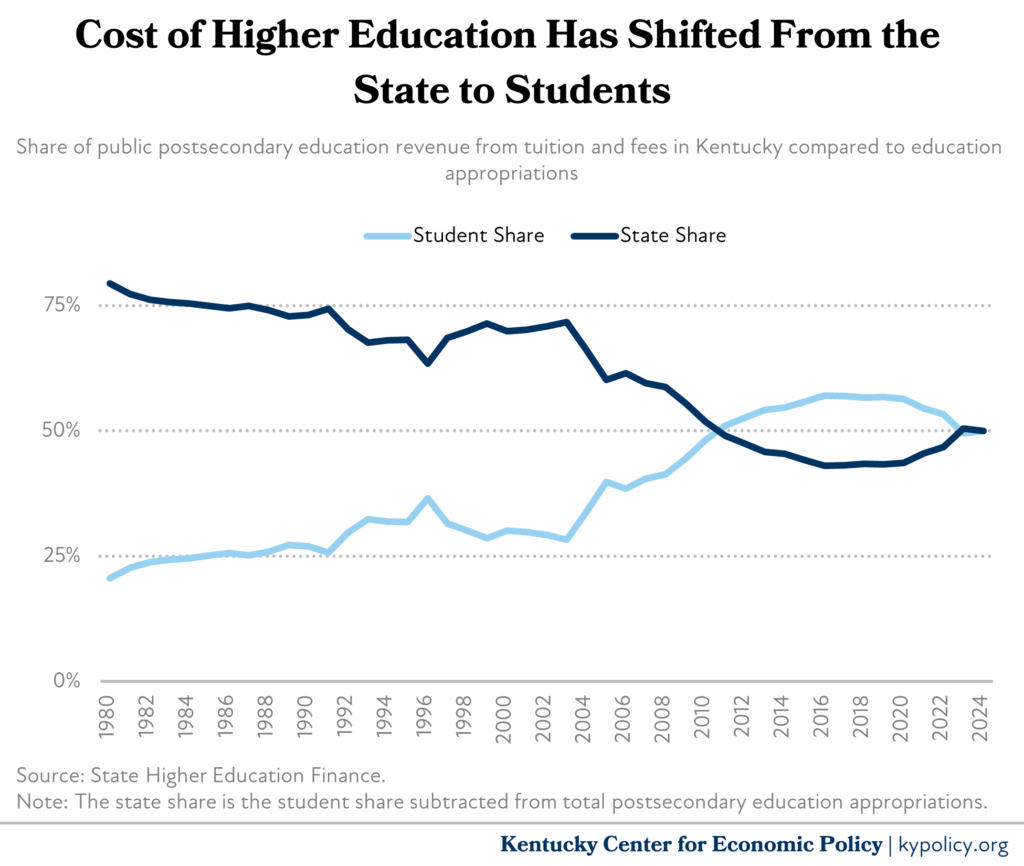
Kentucky was awarded $942.2 million in Higher Education Emergency Relief COVID relief funds.110 The three largest categories of funding awarded were $376.4 million to students, $481.8 million to support public and private higher education institutions and $28.9 million was specifically for HBCUs. This funding expired in June 2023.
Reductions in state funding for higher education have directly led to higher student debt burdens for Kentuckians. Despite relatively small tuition increases in the most recent years, more Kentuckians are taking on student debt as the cost of attending college has grown while wages and Pell Grant amounts have not kept pace.111 Besides taking on greater debt loads, many Kentucky college students struggle to even meet basic needs while attending school.112
The OBBBA made major changes to federal financial aid that will further diminish the ability of Kentuckians to afford to attend college and pay back loans. Fewer students will qualify for Pell Grants, which around a third of Kentucky college students currently receive. The OBBBA narrows the financial need eligibility requirements, and students will no longer qualify if they have other grants and scholarships that cover the calculated cost of attendance, when these students have previously been able to use Pell Grant money to meet basic needs such as transportation, health care and child care. In addition, the OBBBA eliminates the Economic Hardship Deferment and Unemployment Deferment and limits federal student loan borrowing options for Kentuckians pursuing graduate school or supporting their children in doing so.113
Another federal policy change that makes things more difficult for Kentuckians with student debt is that interest started accruing again on Aug. 1, 2025 for the nearly eight million student loan borrowers enrolled in the income-driven repayment plan known as Saving on a Valuable Education (SAVE).114 At least 116,200 Kentuckians — or 19% of people in the state with student loans — saw their balances immediately start growing at the same time that inflation and rising costs are making it harder for people to provide for their families.115
The 2024-2026 biennium continued to include full funding of the lottery-supported, need-based college scholarship programs. Federal financial aid changes in 2021 have resulted in more students becoming eligible for Pell Grants, which meant the number of Kentucky students receiving state need-based College Access Program (CAP) scholarships increased from 55,220 in 2024 to 72,130 in 2025, a 31% increase, with CAP participation growing an additional 10% in 2026.116 The maximum CAP scholarship amount is $2,500 at a two-year institution and $5,300 at four-year. The increase in CAP recipients was anticipated in the budget and resulted in state expenditures for CAP scholarships going up by 27%, growing from $183 million in 2024 to $232 million in 2025.117
Due to the changes to Pell Grants in the OBBBA described previously, the number of students receiving CAP will inevitably drop again in the upcoming biennium as fewer Kentuckians who struggle to afford college will qualify for the need-based scholarships.
Higher education budget request for 2026-2028 would provide a substantial funding increase
CPE’s budget request for higher education for the upcoming biennium would increase funding for the state’s public universities and community colleges by $73.3 million in 2027 and $131.6 million in 2028 compared to 2026 funding levels.118 This proposal includes across-the-board base funding increases applied to each institution’s 2026 net General Fund appropriation of 4.5% ($43.3 million) in 2027 and 9.0% ($86.6 million) in 2028 to help offset longstanding inflationary pressures on institutions’ operational costs.119
The budget request also includes $145 million for performance funding in 2027 and $165 million in 2028, a $30 million and $45 million increase, respectively, compared to what was appropriated for performance funding in 2026.120 In 2027, $20 million of the increase in performance funding requested is to create a “Minimum Distribution Pool” within the Performance Fund to address the issue of some community colleges and universities receiving no performance funds; $1.95 million would go to each university and $4.4 million would go to each KCTCS institution.121 In the event that the General Assembly does not authorize the Minimum Distribution Pool, the request is for one-time direct appropriations of $1.4 million for KSU, $2.1 million for Morehead State University and $2.1 million for the five KCTCS institutions that received no performance funding in 2026 and are unlikely to in 2027.
In addition, CPE’s budget request includes a recommendation to create a new trust fund to support a Tuition Waiver Reimbursement Program, and appropriate $30 million each year of the biennium to it.122 These funds would reimburse institutions for statutorily required tuition discounts and waivers, which result in approximately that amount of forgone revenue annually across the state’s public postsecondary institutions. In 2024, 5,002 Kentuckians received such tuition waivers/reductions, including foster and adopted children, war veterans, and students age 65 or over.
In terms of capital projects, the request includes a total of $700 million over the biennium for an asset preservation pool to support renovation and renewal projects at postsecondary institution campuses.123 Bond funds in the amount of $1.76 billion are also requested to support the highest priority new capital construction projects at each public university and the top 10 new capital construction projects at KCTCS.
Human Services
Child welfare staffing has stabilized, but more intensive needs have led to cash assistance cuts
Kentucky has the fourth-highest rate of abused and neglected children in the nation — 14.2 per 1,000 children — as of 2023 (the most recent year for which data are available).124 Across the commonwealth, 8,732 children live in out-of-home care.125 These alarming statistics demonstrate an immense need for state services for children and families across the commonwealth.
The past two state budgets provided significant new funds to address social worker burnout, turnover and an inexperienced workforce within the Department of Community Based Services (DCBS). The General Assembly included in these budgets pay increases, funds to hire more social workers, including $22.4 million in the 2022-2024 budget, and $15 million in the 2024-2026 biennium to hire 400 more social workers.126 Between 2021 and 2025, the number of social workers and social service clinicians increased by 273, or 22%. At the same time, the number of vacancies decreased by 218, or 80%. As of June 2025, Kentucky had 1,896 Social Workers and Clinicians, of whom 1,279 carry caseloads.127
This reduction in vacancies has meant that the caseloads have also fallen. According to federal data, the number of investigations with substantiated reports of neglect or abuse completed per worker fell from 45 in 2021 to 38 in 2023 (the most recent year data is available). The number of completed investigations during this time remained stable at roughly 38,000.128 Additionally, while Kentucky’s rate of child abuse and neglect is still high, as mentioned previously, the state saw the largest decline in the nation between 2019 and 2023.129
One additional reason caseloads have stabilized is increased federal and state investments in prevention efforts. Between FY 2019 and FY 2024, the various prevention services under the Families First Act implementation resulted in 90% of children remaining in their home at case closure, preventing $40 million in out of home care costs.130
While staffing and caseloads have largely stabilized, Kentucky’s child welfare system has experienced a rise in the number of children that require more intensive out of home care. DCBS, which operates Kentucky’s child welfare system, has reported that this increase has led to a $32 million shortfall in the program this year.131 Because of this shortfall, DCBS diverted federal funds from the Kentucky Transition Assistance Program (KTAP), which is part of the Temporary Assistance for Needy Families (TANF) block grant, to fill the gap.
KTAP provides basic cash assistance and transportation assistance to very low-income families. It served 35,500 Kentuckians including 26,500 children and 9,000 of their parents or guardians as of August 2025.132 In 2023, the participation and benefit amounts in KTAP grew significantly following the first adjustment to benefit calculations and income eligibility levels in 28 years. Benefit levels were doubled, roughly returning to 1995 inflation-adjusted levels, and the transportation benefit was increased from $200 to $300 per month. These changes also improved many other related supports such as transportation assistance, job supports and alternative benefit programs.
Cutting $32 million from this program means reducing the basic cash assistance amount to eligible children and their families by 35% and cutting the transportation benefit in half – below the pre-2023 level.133 This significant decline in cash assistance is a blow to families whose incomes place them at or below half of the federal poverty level – among the poorest children in Kentucky.

Kentucky children who are in out-of-home placements and those participating in KTAP are among those most likely to be exposed to adverse childhood experiences such as emotional abuse, physical abuse, witnessing intimate partner violence, household mental illness or an incarcerated household partner.134 These children have significant economic needs that KTAP and other state programs are effective in improving In the upcoming budget session, the General Assembly will need to appropriate at least $32 million more for DCBS to ensure the most intensive needs of children in its care are met and so that the state can return to the benefit levels outlined in the 2023 administrative regulation.135
Medicaid
The Medicaid program is jointly funded by the federal government and states, and Medicaid is the second-largest General Fund appropriation in the state budget. When the Kentucky Children’s Health Insurance Program (or KCHIP, which is run through the Kentucky Department of Medicaid Services) is included, one in five General Fund dollars and one in three total dollars the state spends goes to Medicaid (with the latter including federal dollars that flow through the state budget).136
Investments in health create long-term dividends in the economy and well-being of the state.137 The state experienced a huge decline in the share of uninsured Kentuckians following the passage of Medicaid expansion, with the rate of uninsured falling from 14.3% in 2013 (the year before Medicaid expansion) to 6.8% in 2024.138 Medicaid’s ability to cover groups that have had historical and structural barriers to coverage has been profound, virtually eliminating the disparity in rates of uninsured between white and Black Kentuckians in 2022, for example, though these disparities have since returned.139

Kentucky’s Medicaid expenditures are almost entirely driven by three factors:
- The share of overall Medicaid expenditures paid by the federal government, known as the Federal Medical Assistance Percentage (FMAP),
- The number of people covered, and
- The cost of providing medical care.
The OBBBA profoundly changed each of these cost drivers in ways that will begin during the upcoming biennial budget but will increase in severity for at least a decade. The ways in which Kentucky pays its share of the Medicaid budget, how much it pays to providers, and the number of Kentucky lives it covers will need to be considered and accounted for by the legislature in light of these changes. Failing to adequately fund policies needed to prepare for these major changes could result in fewer people with health coverage, fewer health services available to all Kentuckians, or, more likely, both.
Kentucky pays for Medicaid through a combination of federal and state dollars
Medicaid is a great deal for the commonwealth because of the FMAP, or the federal share of Kentucky’s Medicaid spending. There are two FMAPs for Kentucky (not including KCHIP):
- The first and more generous is for expanded Medicaid (the eligibility category established by the Affordable Care Act that includes all adults who earn below 138% of the federal poverty line (FPL)).Kentucky pays 10% of those costs, which was $670.8 million in General Fund monies in FY 2025.
- The second is for traditional Medicaid (the eligibility criteria that includes pregnant women, children, people with various disabilities and the elderly, all of whom were eligible prior to the Affordable Care Act), which totaled $1.8 billion in General Fund monies in FY 2025.140
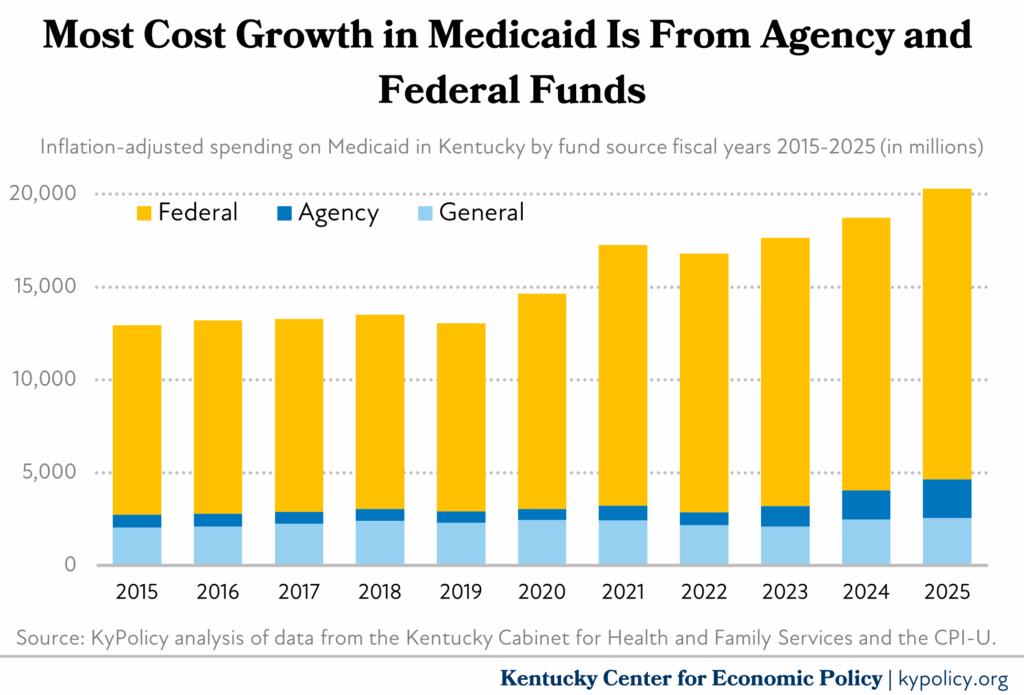
Accounting for state and federal dollars, in FY 2025, Kentucky spent $13.1 billion on traditional Medicaid benefits, $6.7 billion on expanded Medicaid benefits, and $530 million on benefits for the KCHIP for a total of $20.3 billion.141 But the state only paid $4.6 billion in combined General Fund and restricted agency funds (more on restricted agency funds below) while the federal government paid $15.7 billion. This means that for every state dollar invested in Medicaid in FY 2025, the federal government invested $3.38.142
Since Kentucky started paying the full 10% of Medicaid expansion costs in 2016, General Fund spending on Medicaid has risen an inflation-adjusted 21.8%. The major growth in Medicaid spending between FY 2016 and FY 2025 stemmed from an increase in expenditures from agency funds. In the span of those 10 years, there was a 205% increase in agency funds, which were used to draw down 50.5% more in federal funds. The increase in these two fund sources were used to support legislation that directed large, supplemental payments to hospitals (more on this below).
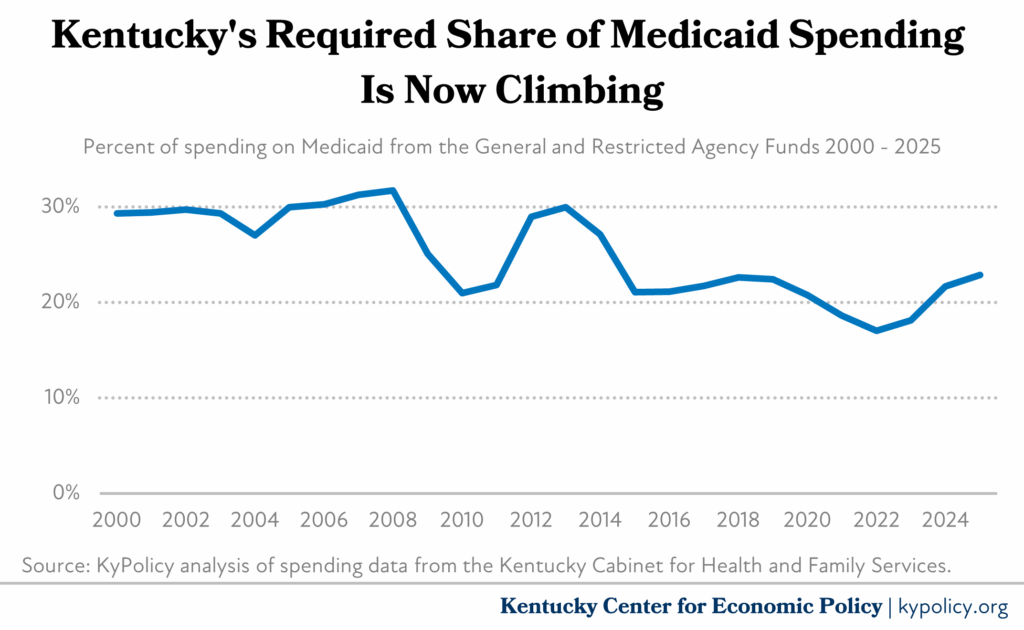
The traditional Medicaid FMAP rate is adjusted annually and is based on the economic conditions in each state. Traditional FMAP rates range from around 50% to just under 75%, with more assistance provided to states with lower economic well-being. Kentucky’s traditional Medicaid FMAP is on the higher end at 71.4% as of federal fiscal year (FFY) 2026.143 Between 2020 and 2024, Kentucky received additional pandemic-related funding that has since expired. In 2025, Kentucky’s blended FMAP (expansion and traditional Medicaid) fell from its peak of 83.0% in 2022 to 77.2% because of the expiration of those federal pandemic funds, with Kentucky’s General Fund and restricted agency funds paying the remaining 22.8%.
While some legislators have raised concerns about the cost of the state’s 2014 expansion of Medicaid eligibility, these expanded benefits actually comprise just 26% of state General Fund spending on Medicaid benefits.144 This relatively small share exists for two main reasons: there are more Kentuckians enrolled in the traditional forms of eligibility than the expansion, and the federal government covers more of the cost of Medicaid expansion compared to traditional forms of eligibility. It’s also true that participants enrolled in Medicaid through the expansion cost less per-person to cover than those enrolled in traditional Medicaid, who are more likely to have a disability requiring medical service or be older. So even if there were cuts to Medicaid aimed at the expansion population, they would have a limited impact on overall Medicaid spending.

OBBBA makes changes to provider reimbursements that could increase costs to the state
One of the most consequential impacts of OBBBA on Kentucky’s Medicaid spending is how it changes provider taxes and state directed payments. These two funding mechanisms have historically been used in combination by states to increase provider reimbursements with the federal government footing a majority of the bill. Under these mechanisms, the state and provider group that is subject to the tax agree to the arrangement and the revenues collected generate funds that make up a portion of Kentucky’s share of Medicaid payments. This additional funding from the tax is then used to draw down federal matching funds so payments to the providers that paid the tax can be increased – those payments are known as state directed payments. These directed payments in turn result in more money to the provider than were paid in taxes.
In 2026, along with a similar, much smaller program for ambulance payments, the state directed payments amount to $5.4 billion of Kentucky’s $20 billion Medicaid program.145 Those payments are above and beyond what providers receive through the standard reimbursements provided by Medicaid.
But OBBBA requires states to cut their provider tax rate to no more than 3.5% and to reduce state directed payments to no more than the Medicare rate, far lower than the current amount which is set to the average rate among commercial insurers. Three provider taxes will be reduced by the OBBBA, leading to lower revenues for the state to run its Medicaid program:
- Hospitals have a combined effective tax rate of 5.1%, most of which is used for the various hospital-specific directed payment programs.
- Supports for Community Living (SCL) providers, which offer home and community based services to individuals with developmental disabilities, currently have a provider tax rate of 5.5%, largely used to increase reimbursement rates.
- Ambulance providers have a provider tax rate of 5.5%, which is used for its directed payment program.
Each of these rates will begin decreasing by 0.5 percentage points each year starting October of 2028 (the beginning of the 2029 FFY) until they reach 3.5%.
The reduction in provider tax rates alone will result in less state-based revenue to support the Medicaid program. But even if the state chose to make up those lost revenues through increased General Fund appropriations, the OBBBA reduces what the state can pay in directed payments as well. Kentucky has four directed payment programs:
- The Hospital Rate Improvement Program (HRIP), which directs Medicaid to pay hospitals the average commercial rate for inpatient care and charge those hospitals an assessment required to meet the state match — $2.8 billion in FY 2026.
- University Directed Payments, which is similar to the HRIP but for university hospitals, which are then not allowed to participate in the HRIP — $2.4 billion in FY 2026.
- The Ambulance Provider Assessment Program (APAP), which provides a quarterly supplemental payment for certain rides given to Medicaid members on an emergency and non-emergency basis — $62 million in FY 2026.
- The Kentucky Trauma Hospital Rate Improvement (KTHRI) program, which was just implemented in 2025 and will direct $149 million to various trauma hospitals in FY 2026.146
The HRIP and URIP programs, which make up nearly all the total state directed payment spending, pay hospitals the difference between Medicaid reimbursement rates and the far higher average commercial rate. The other directed payment programs also substantially increase reimbursements for the participating providers. Starting in FFY 2028, the OBBBA cuts state directed payments that are above the Medicare rate (which they all are) by 10% each year until they reach the Medicare rate.
The combination of these two cuts will result in substantially lower federal investments in Kentucky’s health care sector, and could cut HRIP by 85% and even eliminate URIP.147 Many hospitals already face very thin operating margins, and the various state directed payments have been a lifeline to them, particularly in rural areas.148 The Kentucky Hospital Association estimates that this will result in a 7% negative operating margin for many hospitals, which will lead them to cut services, lay off staff or close entirely. In fact, one University of Louisville hospital already canceled plans to open a birthing center due to cuts in Medicaid.149
Additionally, with the cut in the SCL provider tax, the state will need to use General Fund monies to prevent a dip in reimbursements. Direct care workers that provide SCL services are already paid too little, and further cutting resources to compensate them may leave individuals with developmental and intellectual disabilities without care regardless of the number of waiver spots available.150 Further complicating decisions around how best to compensate Medicaid-participating providers is the provision in the 2024-2026 budget to comprehensively study a “rebasing” of payment rates. Some providers have received rate increases in recent years, particularly nursing homes which have received $370 million in annual rate increases between FYs 2020 and 2025.151 The statutorily-required study of Medicaid rates will need to consider the restrictions and reductions to provider tax rates and directed payments that will be occurring under the OBBBA and the impact on the amount of General Fund monies that will be needed to mitigate the worst of the roll-backs to the state directed payment programs.
Medicaid enrollment has fallen as pandemic-era coverage protections expired
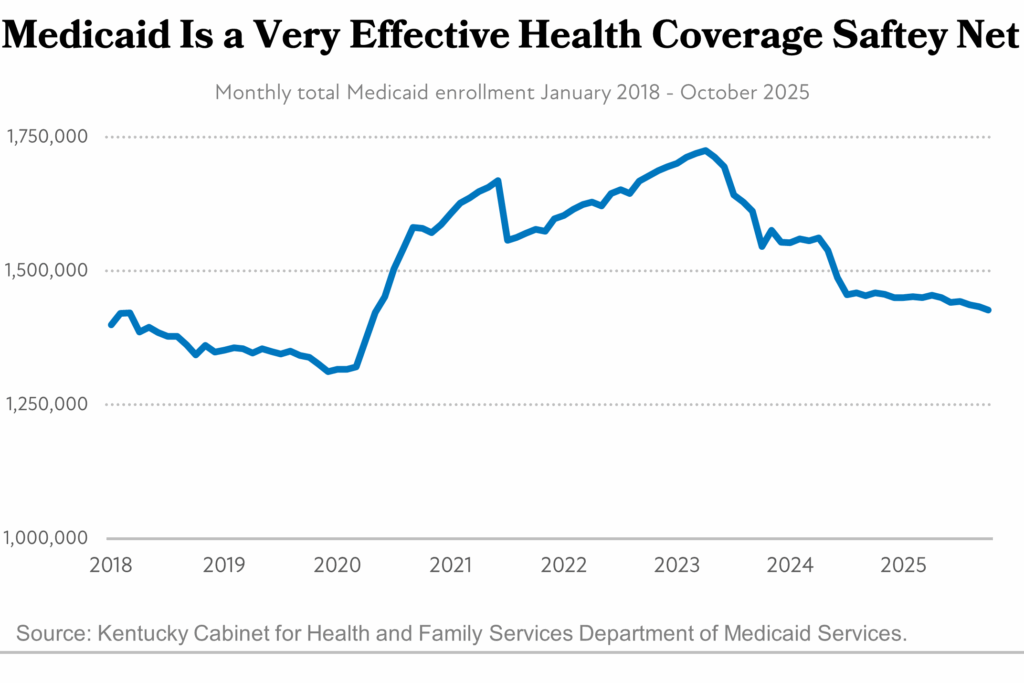
Enrollment is a key driver of how much Kentucky spends on Medicaid, and the recent expiration of pandemic-era coverage protections has significantly reduced enrollment. This expiration, which required that all Medicaid enrollees’ eligibility be redetermined for the first time since 2020, began during the previous biennial budget and concluded in 2024 for all adults enrolled in the program. Beginning in 2025, children had to start the process and by 2026 over 300,000 children will go through redeterminations for the first time since before the COVID-19 Public Health Emergency. The result of these redeterminations is that enrollment in Medicaid has fallen by just under 300,000 Kentuckians, or 17.3% since the high point of April 2023. Barring a new economic downturn, enrollment is expected to generally stabilize after all children have gone through eligibility redetermination.
Many Kentuckians will lose Medicaid and become uninsured because of OBBBA’s new work reporting mandate
Starting in 2027, Kentuckians age 19-64 who do not have a documented disability or children under 14 years old will have to prove they’re working at least 80 hours per month to stay covered by Medicaid through the expansion. This requirement must also be met for the month prior to application and will be assessed at least every six months when eligibility is redetermined. The OBBBA’s work reporting mandate is estimated to reduce federal spending by over $300 billion nationally over the next decade and could result in 150,000 Kentuckians losing their Medicaid coverage by 2034.152
While more than half of Kentucky adults covered by Medicaid are working, according to Census data the vast majority of the remainder are ill or disabled (and therefore not likely subject to a work reporting requirement) or actively engaged in their community in some other way. Specifically, 21% are taking care of a loved one like a child or aging parent, attending school, retired, or looking for work. Only 2% of adults covered by Medicaid in Kentucky are not working for some reason the survey couldn’t identify.153 Presumably this small share is the fraction of Medicaid enrollees who are the target of any “community engagement” requirement. Many of those Kentuckians, however, may have been working recently and/or are dealing with challenges like homelessness or other barriers that taking away healthcare would likely only worsen.154

A long history of rigorous research on work reporting requirements in the Supplemental Nutrition Assistance Program (SNAP) shows that they have no meaningful effect on employment, but large, negative impacts on enrollment, including in Kentucky.155 Adults participating in SNAP, like those covered by Medicaid, are also largely employed, so it stands to reason that the threat of losing food assistance has little to do with whether or not they are working.156 Even if penalties or supports had some impact on a SNAP participant’s willingness to change their employment situation, past experience with extensive work supports showed that the degree to which a worker can do so is almost entirely dependent on the kinds of jobs available where they live.157
These kinds of requirements are also expensive to implement. Georgia’s program spent as much on technology improvements and administrative overhead as it did on actual care for enrollees during its first year and a half of implementation.158 While it is unclear how much it will cost for Kentucky to set up the systems and administration required to track community engagement activities to the degree necessary under OBBBA, the federal support for this purpose is only $200 million for the entire country.159 Kentucky will almost certainly need to supplement these funds to minimize coverage disruptions for Kentuckians seeking to report their qualifying activities.
Improvements needed for programs that provide Kentuckians with care at home and in their community
Traditional Medicaid pays for in-home care for individuals with significant health care needs, such as intellectual or developmental disabilities and brain injuries, through 1915c or Home and Community Based Service (HCBS) waivers. These programs are vital to supporting Kentuckians with disabilities so they can stay in the community rather than in nursing homes or state-run institutions, which are more expensive and less desirable for many people. As of Sept. 2, 2025, Kentucky had 35,537 spots.160
One major issue for these programs is that waiting lists have grown rapidly, despite over 1,900 slots being added in the previous biennial budget.161 This growth was driven entirely by increases in Kentuckians seeking services through the Home and Community Based Services Waiver, the Michelle P waiver (community and home-based care for Kentuckians with intellectual or developmental disabilities) and the Supports for Community Living (SCL) waiver. Not all the Kentuckians who are on a waiting list for waiver services are eligible, and nearly 15% are on more than one waiver’s waiting list, with nearly one in three waitlisted Kentuckians already receiving one waiver service. But because each waiver program offers different benefits, many families are willing to wait to receive them. In the case of SCL, which offers a residential option for individuals with intellectual and developmental disabilities, the average family waits nearly eight years, demonstrating the pressing need for additional slots to be funded.

Public health
The Kentucky Department for Public Health (KDPH) protects and improves health and quality of life of all Kentuckians. In addition to emergency services during pandemics and natural disasters, their regular operations include health promotion, immunizations, regulation of important industries like hospitality and restaurants, and feeding new mothers and infants with the Special Supplemental Nutrition Program Women, Infants and Children (WIC). While the majority of funding for the department is federal, state General Fund dollars play an important role in matching federal funds, managing the core public health services and supporting local health departments across the state. The need for additional state public health funding is also growing with increased risks to public health and recent cuts to federal public health programs.
There are several new state budget needs in the upcoming biennium for public health. KDPH is requesting an additional $8.5 million in 2027 and $10.9 million in 2028 to continue the forward momentum on full transformation to a simplified and focused public health model, ensuring all 61 Local Health Departments can implement core public health services codified in 2020.162 Additional state investments may also be needed to address rising threats to health, including natural disasters, health misinformation, reductions in national public health services, and the rise in vaccine-preventable diseases like measles.163
Increased state investment is also needed:
- To maintain and improve the systematic monitoring of health data to improve Kentucky’s health and keep our communities safe.
- To construct a new KDPH central laboratory, which will cost $10.7 million in 2026 and $21.5 million in 2927. Kentucky’s public health lab played a crucial role in the early response and ongoing monitoring of the COVID-19 pandemic and provides sophisticated data management for other diseases, food safety and environmental health and protection, needs to expand capacity and comply with federal regulations.
- To continue prevention and control of respiratory pathogens and improve readiness for endemic pathogens, such as flu, HIV and Lyme disease, emerging threats and future pandemics. This requires a $2.6 million investment in 2027 and $2.7 million in 2028.
- To fund new, mandated testing requirements for drugs and supplements codified by Kentucky’s medical cannabis law, which will require $2 million in 2027 and $2.8 million in 2028.164
In addition, Kentucky still has one of the highest rates of Opioid Use Disorder (OUD) in the nation. While fatal overdose rates have recently decreased overall, more than 1,400 Kentuckians still lost their lives this way in 2024 and overdose deaths are rising among Black Kentuckians.165
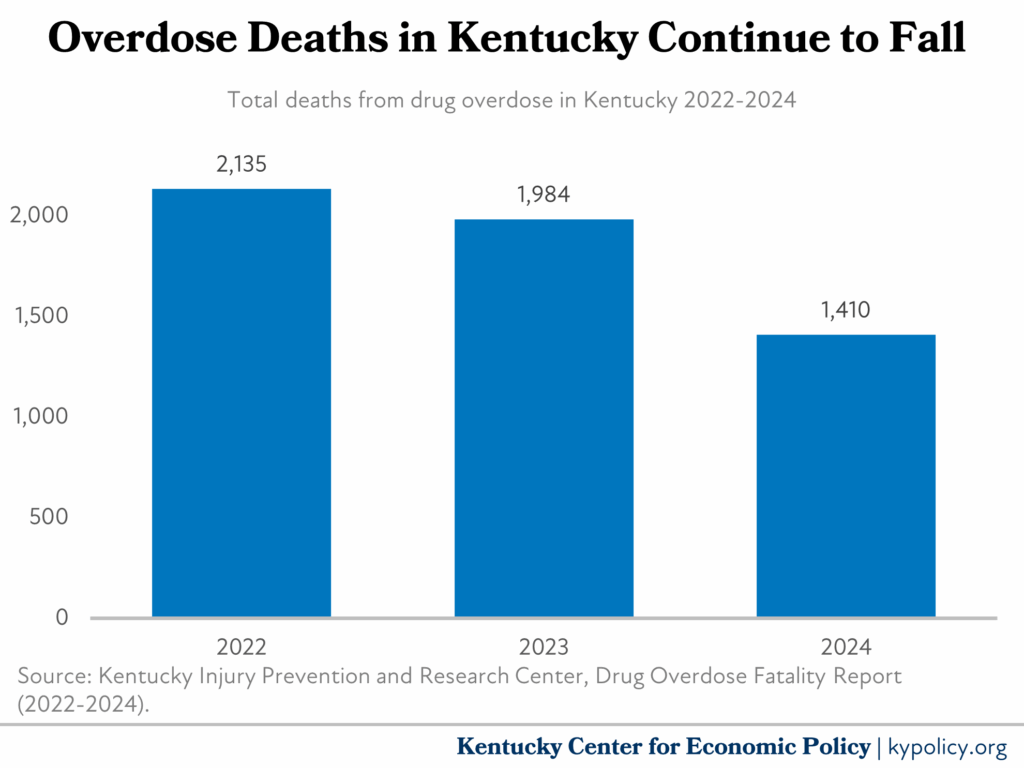
Harm reduction services like naloxone distribution, wound care and drug checking have proven effective at reducing overdose deaths, preventing infectious diseases and providing pathways to recovery and treatment.166 No General Fund dollars have previously been allocated to DPH’s harm reduction program but they will be needed to sustain services given the reduction in federal funding.167 CHFS is requesting with $3.5 million in 2026 and $4.3 million in 2027 et to expand harm reduction services, continue to decrease overdose deaths and reduce the prevalence of substance use disorders (SUDs).168
Food Security
State will need to spend up to an additional $250 million a year to keep Kentuckians fed through SNAP
SNAP is Kentucky’s best tool against hunger, effectively and efficiently providing food assistance to over 560,000 Kentuckians, primarily children and working families.169 Even more Kentuckians qualify, with SNAP reaching only two out of three eligible Kentuckians.170 SNAP is a state-administered program through DCBS, but it has been a fully federally-funded benefit since it was created in the 1960s. With the passage of the OBBBA, however, most states will be required to help pay for benefits and to pay a larger share than they currently do to administer the program. In Kentucky, the OBBBA is estimated to increase the cost of SNAP to the state by as much as $241 million in 2027 and $254 million in 2028.171
The share of the administrative cost that states must pay to run the program will increase from 50% to 75% beginning Oct. 1, 2026. In 2023, Kentucky spent $105.6 million on SNAP administration, with the federal government picking up an additional $100.9 million.172 The state’s responsibility is anticipated to increase by an additional $53 million in 2027 and $66 million in 2028.173
OBBBA ties the amount the state will need to pay for the benefits themselves to a state’s SNAP payment “error rate,” which measures how accurate each state is at determining benefit amounts. What constitutes an error in this context includes awarding households too much or too little in benefits, with a $57 cushion over or under the accurate amount. Importantly, the error rate is not a measure of individual fraud. States have been directed to use the 2025 or 2026 payment error rate in 2028 and for each year after that to use the rate three years prior (e.g. the 2026 error rate for FY 2029 cost sharing) to establish the state’s share of benefit costs. As payment error rates increase, a state’s responsibility for benefit costs increase. This change means Kentucky will have to contribute between $0 and $187.9 million for benefits annually as shown in the table below.

SNAP has one of the most rigorous quality control systems among public assistance programs.174 And yet errors are inevitable, especially as applications and paperwork to establish SNAP eligibility grow increasingly complex for participants, and the OBBBA adds new paperwork requirements for many seeking food assistance. It is administratively complex to manage fluctuating factors like seasonal or inadequate work hours, shelter or custody changes, or having multiple earners in a household qualifying for SNAP. Kentucky’s top two causes of errors relate to shelter deductions and household income.
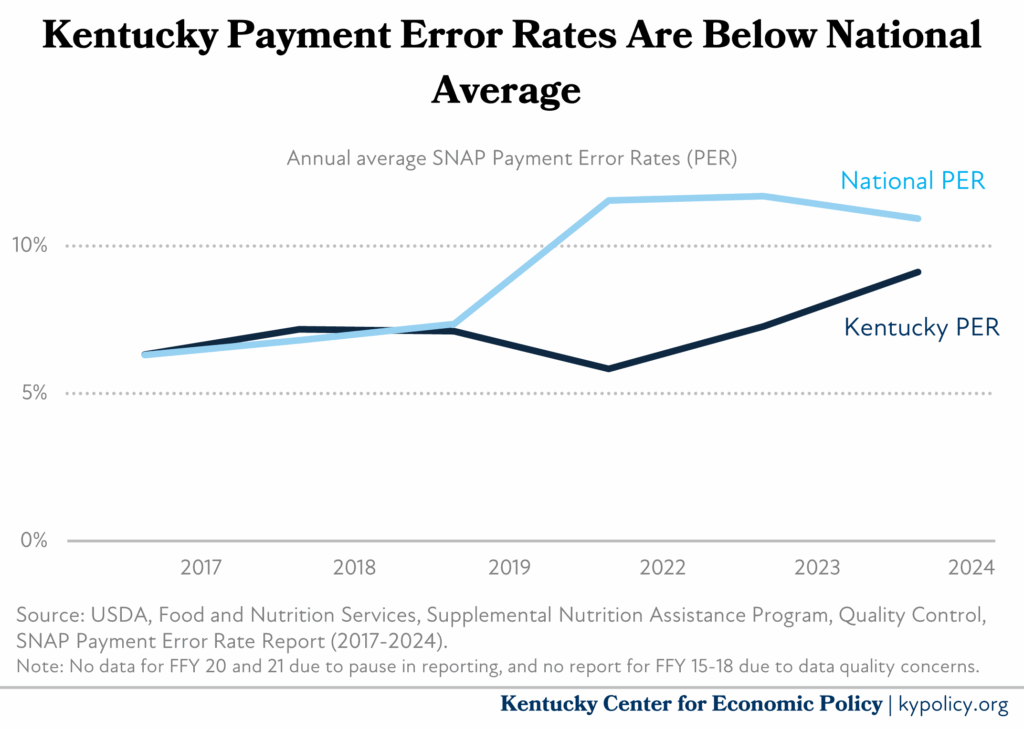
Kentucky’s error rate jumped from 7.3% in 2023 to 9.1% in 2024 and is currently less than 4% for 2025, fluctuations that can be attributed to policy changes in that time.175 Since 2022, Kentucky’s error rate has increased because of:176
- Technology problems – New or frequent systems changes create errors or can overwhelm staff. One example is the reestablishment of kynect, the state’s health benefit exchange, between 2020 and 2022.177
- State policy choices – Stringent or frequently changing regulations create more errors. For example, Kentucky has been required to make many changes like the lost discretionary exemptions include in House Bill 7 in 2022.178
- Federal changes – When the U.S. Department of Agriculture (USDA) revised its Quality Control handbook, its decision to count “technical errors” like missing paperwork even if benefit amounts were correct caused spikes in error rates nationally.179
The OBBBA is set to make even more dramatic changes to the structure of SNAP benefits. The law will require a significant amount of administrative work to implement, and caseworkers will have to be diligent in carrying them out at the application and enrollment phases to try to prevent the state’s error rates from creeping up in the future – a task with hundreds of millions of state dollars in the balance. With hunger increasing and OBBBA policy changes going into effect, several state SNAP programs are requesting state funding to hire additional staff to manage increasing caseloads and to implement updated technology to reduce errors.180 While Kentucky’s DCBS has not yet requested funding for this purpose, it should follow suit. If the state were to invest more General Fund dollars for SNAP administration than the OBBBA requires, Kentucky could improve the likelihood of Kentucky’s SNAP error rate remaining below 6%; this would reduce the overall cost of SNAP to the commonwealth by keeping the state from having to pay between $62.6 million and $187.8 million for SNAP benefits, while preserving this vital anti-hunger tool for one in eight Kentuckians.
Greater investment is needed in Family Resource and Youth Services Centers in schools
Recent federal cuts to various safety net programs have heightened the need for FRYSCs in Kentucky schools. These services meet many direct needs of children in public schools whose families have little-to-no income. Providing snacks, clothing, hygiene products and other basic needs contribute to student success, and address various social stigmas that can severely harm mental health. They are also often a referral source for various programs and supports outside the school for the whole family.
For schools applying for a FRYSC, at least 20% of students must qualify for free and reduced meals for five consecutive years, a benchmark easily met at most schools since 82% of students qualify in Kentucky. The state appropriates funding for FRYSCs to both CHFS and KDE, although KDE passes on the dollars to CHFS for administering the program. To ensure existing centers are able to meet growing needs and to reach additional schools, FRYSCs are requesting an additional $26 million in state funding per year.181
$10 million shortfall results in senior meals waitlists and a $9.1 million reallocation from Medicaid
One in five older adults in Kentucky do not have enough to eat. The Department for Aging and Independent Living (DAIL) administers food assistance programs, including meals in senior centers and meals delivered to home-bound Kentuckians with low incomes, to help meet the needs of Kentuckians over 60.
The General Assembly appropriated $10 million from the General Fund in the 2025 and 2026 fiscal years to DAIL in order to provide these meals. These funds were meant to replace the $14.5 million in federal American Rescue Plan Act (ARPA) monies that were appropriated for this purpose.182 In September 2025, this inadequate allocation resulted in a shortfall of $10 million. Over 5,000 older adults were put on waitlists and over 1,600 older adults lost access to congregate meals in senior centers altogether.183 In October 2025, $9.1 million was reallocated from Medicaid to shore up the program.184 This reallocation will need to be retroactively approved by the General Assembly, and new funds may be needed to backfill the Medicaid funds that were redirected.
The ARPA funds that DAIL received for three years during the pandemic were used to expand the program to over 2.5 million meals, serving 156,700 older adults in 2023. It also allowed Area Development Districts to afford new flexibility in how it delivered these meals, including drive-through meals, deliveries and covering more days, allowing DAIL to eliminate the 36,000-person waitlist in 2023.185
These meals will become even more vital for the seniors that receive them as fewer older adults will be able to use SNAP under the new OBBBA rules. Specifically, an expansion of work reporting required from adults 55 to 64 years old will lead many to lose food assistance, including those over 60 who qualify for senior meals. DAIL is requesting $93,755,100 per year in total Aging and Independent Living services, which includes dollars needed to maintain current senior meals services.186 With the rise in hunger and food prices and a growing aging population, more will likely be needed to ensure older adults in Kentucky are fed.
Housing
State investment is needed to address lack of affordable housing
Access to adequate and affordable housing is imperative for the health, financial stability and overall wellbeing of Kentuckians. Yet the commonwealth is experiencing a severe housing shortage that is especially pervasive for lower-income individuals and families. There are only 43 affordable and available rental homes for every 100 extremely low-income households in Kentucky.187 Without action and policy change, this deficit is expected to grow and Kentucky could be 287,120 homes short of what is needed for every family to be housed by the end of this decade.188 This gap in needed rental and owned housing will only be exacerbated as building costs increase due to tariffs, the construction workforce is restricted due to anti-immigration policies and practices, the frequency and severity of natural disasters increases and federal support for housing affordability shrinks or is cut off entirely.189
The housing shortage also makes existing housing options unaffordable. A 2025 study by the National Low Income Housing Coalition found that the wage needed to afford a Fair Market Rent two-bedroom rental unit is $21.47 an hour, but the estimated mean wage among Kentucky renters is $17.89, meaning the average renter would need 1.2 full-time jobs just to afford a two-bedroom.190 Because the cost of housing has outpaced the rise in wages, and 44.3% of Kentucky renters are now cost-burdened or pay more than 30% of their income on rent.191 Exacerbating the affordability crisis in housing are recent federal changes at the U.S. Department of Housing and Urban Development (HUD). Significant cuts to how grants for housing supports are awarded could put thousands of Kentuckians at risk of homelessness who are currently in permanent supportive housing.192
Kentucky must make strategic investments to mitigate the harmful pressures of housing availability that is driving up rent and homeownership costs. In the 2024-2026 budget, the General Assembly did approve a $5 million appropriation each fiscal year to a new “Rural Housing Trust Fund,” but did not provide funding for disaster housing, emergency rental assistance (a pandemic-era, federally-funded program that had recently expired) or the statewide Affordable Housing Trust Fund. It also provided a one-time $10 million grant to Lexington’s Transformational Housing Affordability Partnership to create 242 new, affordable units in Fayette County.193 There are new investments the state could make, however, that could mitigate the growing shortage of affordable homes.
One such investment is a General Fund appropriation to the statewide Affordable Housing Trust Fund in addition to a modernization of the fee that is typically used to provide for that fund. The Affordable Housing Trust Fund has been in operation since 1994, and provides low-interest loans, forgivable loans and grants to developers who create or preserve housing for households with low incomes. Since that time, the fund has developed or preserved 12,600 units of affordable housing. Housing advocates are calling for an increase in the fee, which has stayed at the same $6 per deed transfer or mortgage origination since 1994, as well as a lump-sum appropriation from either the General Fund or the BRTF.194
Criminal legal system
Unlike other areas of the state budget, where increased investment usually leads to improved quality of life for Kentuckians, spending more to incarcerate and supervise people often has the opposite effect. Incarceration is expensive – the Department of Corrections (DOC) General Fund appropriation for the 2024-2026 biennium was $1.5 billion – money that could be better spent on services communities need and in efforts to prevent crime and the poverty that is often criminalized.195 In addition, the budget reduced the General Fund appropriation by $20 million and replaced it with federal funds Kentucky received through the American Rescue Plan Act of 2021 (ARPA) for prison operations in 2025.196 Given ARPA funds are no longer available, these expenses will need to once again be covered with General Fund dollars in the upcoming biennium.
Kentucky’s system of correctional control is expansive and expensive
If Kentucky were a country, it would be the seventh most incarcerated place in the world per capita.197 Taking into account the state’s total system of correctional control, which includes juvenile incarceration, community supervision such as probation and parole, federal and state prisons and local jails, the state has the fifth-highest “rate of mass punishment,” according to an analysis by Prison Policy Initiative.198
There are over 95,000 adults in Kentucky’s state carceral system on a given day, including:
- More than 13,000 people in state prisons and an additional 7,000 with felony convictions in jails;199
- Nearly 11,000 people in county custody in jail, for the most part either serving a misdemeanor sentence or incarcerated pretrial, with a criminal charge but no conviction because they cannot afford bail;200
- More than 2,500 people in federal custody in county jails for ICE or the U.S. Marshals Service;201
- And more than 60,000 people on probation, parole or another type of community supervision.202
The cost of incarceration in a state prison ranges from $85.92 to $167.07 per day, with an average cost of $116.41 per day ($42,488 per year).203 In contrast, the average amount paid by DOC to incarcerate a person in DOC custody in a local jail is $46.51 per day for people not enrolled in substance use programming and $56.51 for those who are. It is therefore financially beneficial to the state to house Kentuckians convicted of felonies in county jails and to pay the county a per-diem amount set in the state budget (currently $35.34 per day, with higher per-diems available for county jails that offer “evidence-based programs” to reduce a participant’s likelihood of being reincarcerated.)204 The average cost paid by DOC is higher than the per-diem amount because of additional expenses such as for medical care as well as additional funding going to jails that offer programming other than SUD treatment.
Financial pressures from incarceration are mounting at the county level
Counties are required to house and pay for people held in the county jail who are being held pretrial or serving a misdemeanor sentence. And although counties receive per-diem payments to house people for the state, the payments they receive are not sufficient to offset the costs. Recent testimony by the Kentucky Association of Counties (KACo) before the Interim Joint Committee on Local Government indicated that the average daily jail cost per incarcerated person is $63.44, which is 80% higher than the per-diem amount currently paid.205 Because counties must pay for some people they incarcerate, and the amount they receive from the state doesn’t cover their costs, many struggle to make ends meet. Some counties have addressed these issues by building larger jails so they can house more people for whom they receive payments, while others overcrowd their facilities.206 Some jails also have contracts to hold people for ICE and the U.S Marshal Service, and the federal per-diem rates are typically larger than what the state pays. The number of ICE detainees has grown dramatically as the Trump administration implements its anti-immigration agenda, and Kentucky jail data shows a marked increase in the number of people in federal custody in Kentucky jails since the January 20 inauguration — jumping from 1,963 on January 23 to 2,544 on July 31 — a 29.6% increase.207
As part of their recent testimony, representatives from KACo reported that county general fund support for jails grew by 76% between FY 2919 and FY 2025, excluding Fayette and Jefferson Counties which combined contributed over $100 million in general fund dollars to their jails. To address these growing fiscal strains, KACo presented a proposal which they identified as their primary legislative priority for the 2026 session.208 The proposal contains three components:
- Providing incentives to establish regional jails, including one-time funding for regional jail construction, allowing other jails to be used as 96-hour holding facilities, increasing the supplement paid to counties with closed jails, and providing a one-time incentive to encourage regionalization;
- Clarifying responsibility for pretrial felony detainees, including reimbursement to counties for the credit for time served an incarcerated person receives when they are sentenced on a felony charge; and
- Redefining the model for housing individuals in state DOC custody, including a requirement that the DOC have contracts with each fiscal court or regional jail based on actual costs, with jails agreeing in exchange to provide more programming for people they hold for the state. The proposal did not include an estimated cost.
However, an increase in state spending on local jails would further entrench the status quo of mass incarceration when the legislature could instead pass legislation such as pretrial reforms that would reduce jail costs by reducing incarceration.209
Kentucky’s expansive system of probation and parole keeps people in the carceral system
The 2024-2026 budget appropriated $170 million for probation and parole, which includes funding for an additional 20 probation and parole officers to manage an expected caseload increase.210 Kentucky has the 10th-highest per-capita rate of people on community supervision, the majority of whom are on probation, parole or pretrial supervision.211 Prison Policy Initiative’s analysis of parole system policies in all 50 states gave Kentucky a failing grade due in part to its onerous one-size-fits-all conditions of release (such as parole fees and drug testing) that set people up to fail, and its lack of automatic parole for individuals who fall into certain categories (such as type of offense or advanced age) and/or have met certain benchmarks while incarcerated.212 Reincarceration due to violations of the conditions of release, often technical violations such as missing an appointment with a probation/parole officer, contributes to the state’s large jail and prison populations and high rates of incarceration.213
Some support was provided in the 2024-2026 budget to address health needs of incarcerated people
There was additional money in the 2024-2026 budget to address some of the extensive health needs of incarcerated Kentuckians. The budget included $15 million over the biennium to DOC for increased medical services costs and Hepatitis C, HIV and cancer pharmaceutical treatment in prisons.214 In addition, state funding was appropriated to CHFS to implement an 1115 Medicaid demonstration waiver. The waiver will go fully into effect in April 2026 and will provide services to individuals with SUDs or other chronic health conditions who are leaving state prisons or Youth Development Centers; services include connecting them to insurance and providers in the community 60 days before release, providing any needed medication or medical devices upon release, and continuing to provide case management up to a year after release.215 The state General Fund portion of appropriated state funding for this waiver was $10.6 million in 2025 and $27.5 million in 2026.216
General Assembly continues to double down on harsh criminal penalties
Harsh sentences are a major driver of incarceration in Kentucky. The state’s “Persistent Felony Offender” statute” is one of the most extreme mandatory minimums in the country. Since the enactment of major reform legislation in 2011, the General Assembly has passed more than six times as many laws that increase incarceration than laws that reduce it.217
Despite the fact that Kentucky is already one of the most overincarcerated places in the world, the Kentucky General Assembly continued to double down on harsher punishments during the 2024 legislative session by overriding a veto by the governor to pass HB 5, the most regressive criminal legal system legislation in Kentucky in recent memory and possibly even the “cruelest criminal-justice bill in America.”218 Among its most damaging provisions are:
- Criminalization of street camping, which limits where unhoused Kentuckians can sleep or be present with their belongings in public places, putting them at risk of jail time and/or fines. A year after going into effect, there were already 425 “unlawful camping” charges in district court in 30 different Kentucky counties — an average of more than one unhoused person cited or arrested each day.219
- A drastic expansion of the “violent offender statute” to include six new offenses and to lengthen the sentences that those convicted under the statute must serve. That means more people will have to serve longer sentences in prison before being eligible for release.
Implementation of a “drug-induced homicide” law, meaning if someone shares, sells, or distributes fentanyl to someone who then dies because of their consumption of the substance, that person can be charged with manslaughter. Under previous law, such charges were only possible when police could prove money was exchanged. HB 5 will cost the state more than $1 billion in its first 10 years as more people are required to serve very long mandatory minimum sentences.220 It will take time for the impact of HB 5 to be felt as more people each year will be required to serve at least 80% of their sentences without the possibility of parole, and as medical expenses increase as more older people are incarcerated. Counties will also experience negative fiscal impacts as more Kentuckians are expected to be detained pretrial in local jails.221
Research shows increased punishment and longer sentences do not make us safer.222 Involvement in the criminal legal system is harmful to individuals, their families and the greater community. When compared to the general population, individuals who have been incarcerated are in worse physical and mental health and experience a lower life expectancy.223 Regardless of sentence length, people who are incarcerated also experience greater financial instability and higher rates of SUD and overdose upon release.224
These negative consequences disproportionately impact Black Kentuckians, who make up only 8% of the state population but 22% of the prison population.225 Kentucky’s high rate of female incarceration also stands out. If Kentucky were a country, it would have the fifth-highest female incarceration rate in the world, and compared to other states Kentucky has the fourth highest female incarceration rate.226 Most of these women also have minor children, and kids of incarcerated parents face significant consequences including higher risk of future incarceration, reduced economic well-being, issues at school and with mental health.227
Policies that would actually decrease incarceration include:
- Eliminating criminal penalties associated with poverty, such as Kentucky’s recently-passed unlawful camping statute criminalizing homelessness. Resources that would otherwise be used to incarcerate these poor Kentuckians could then be used to expand and strengthen programs that address and reduce poverty in communities.228
- Expanding alternative sentencing opportunities such as the proposed Family Preservation and Accountability Act in the 2025 legislative session (HB 291), which would put more focus on the consideration of an individual’s primary caregiving responsibilities at home during sentencing and is expected to increase opportunities for probation.229 This bill did not pass last session but is expected to be introduced again in the 2026 General Assembly.
- Addressing the onerous fines and fees that plague many poor Kentuckians and often result in incarceration due to inability to pay.230
- Supporting robust reentry initiatives such as the expansion of educational programs for incarcerated people, as proposed by DOC and KCTCS for the upcoming session.231 One of the capital projects at KCTCS in the 2024-2026 budget is a $42 million Prison Education Program Building at the Northpoint Training Center in Boyle County for the provision of postsecondary and technical education and workforce training opportunities for incarcerated individuals who are preparing for parole.232
- Increasing opportunities for individuals with past felony convictions by automating and/or expanding felony expungement.233
Continued underfunding of public defense limits access to justice
While less investment is needed in many areas of the criminal legal system to reduce incarceration and harm, greater state investment is needed in the Department of Public Advocacy (DPA). The DPA is the state-wide system that fulfills Kentucky’s constitutional mandate to provide adequate criminal defense services to Kentuckians charged with a crime who cannot afford a private attorney.
Unlike prosecutors, who received over $46 million in additional funding in the 2024-2026 budget for additional personnel and salary standardization, the DPA did not receive any additional funds for these purposes beyond the extra funding necessary for the DPA to take over the operation of the Jefferson County public defender office as required by legislation passed in 2023 and 2024.
Because of inadequate funding, the DPA continues to struggle with high turnover (averaging 20% over the past five years), high caseloads and staff burnout, making it difficult for the DPA to consistently and effectively fulfill its constitutional mandate. To address these issues the DPA has proposed, as part of its budget request, a $25 million, six-part comprehensive defender reform plan called “Balanced Justice.” The multi-faceted plan proposes $10 million for salary increases to provide a 23% increase in DPA starting salaries, from $57,000 to $70,000. On average, according to the DPA, an unelected prosecutor earns $91,324 per year while a full-time defender earns $73,230, a 25% difference. And these disparities exist even though public defenders and prosecutors have the same court coverage responsibilities. Among other improvements, the plan also includes more than $10 million for new personnel to make workloads more manageable, including supervisor level positions and paralegals.234
There is still more to be done to ensure Kentuckians experiencing substance use disorder receive the help they need rather than prison or jail time
The state’s so-called “tough on crime” approach is particularly harmful when it comes to Kentuckians who are battling an SUD. Incarceration increases the risk of fatal drug overdoses and SUD treatment in the community is more beneficial than in a carceral setting. Investment in drug policy reform and evidence-based treatment is especially critical given the overdose crisis continues to plague the nation and the state. According to one estimate, Kentucky’s high rate of OUD resulted in state and local government expenses of over $2 billion in 2024 alone, primarily made up of criminal legal system expenses and lost tax revenue.235
Senate Bill (SB) 90, passed in 2022, provides an example of a better approach.236 The legislation created a pilot program in select counties that diverts people with mental health and SUDs (who meet eligibility requirements from the court system or the prosecutor agrees to make an exception) from entering the criminal system for a drug offense, and instead provides these individuals with supports and services in the community. The program is currently operating in 18 counties with a 19th to be added at the beginning of 2026. Because of the very restrictive requirements to qualify for the program, between January of 2023 and Sept. 30, 2025, 4,405 people (which constituted 6.5% of people screened for eligibility) met the criteria to participate and 1,212 people entered the program. As of Sept. 30, 2025, 436 people successfully completed the program, 593 remain in treatment and 224 were unsuccessful.237 The results so far are promising and the General Assembly should make the program permanent and statewide while also expanding its eligibility requirements to reduce barriers to participation.
SB 90 is funded in part from state opioid settlement funds, which are an important source for further investing in drug policy improvements and programs across the state. Kentucky will be receiving more than $1 billion for its share of opioid settlement monies in incremental payments over the next six to 18 years from pharmaceutical companies responsible for the opioid crisis. Distribution of the funds is overseen and monitored by the Kentucky Opioid Abatement Advisory Commission, with half going to the state and the remainder going to local governments.238
Investing these funds wisely can save lives and lead to decreased incarceration. Examples of effective spending of opioid settlement dollars include harm reduction programs such as syringe exchanges and investments in social services and other supports known to stabilize communities and promote recovery, such as access to affordable housing for people with SUDs.239
State-level investments are particularly critical in the context of the Trump administration’s efforts to make the criminal legal system more punitive and undermine proven solutions.240 These policy changes include the shuttering the Interagency Council on Homelessness, the leading federal agency behind the evidence-based Housing First model to address homelessness; cancelling or revoking $11.4 billion in HHS grants designed to address SUDs and mental health issues, including in Kentucky; eliminating some violence prevention funding; and cutting Medicaid, which will reduce access to treatment for people with SUDs.241
Juvenile justice system
Increases in funding in the 2024-2026 budget help to address critical needs
In recent years, the Department of Juvenile Justice (DJJ) has suffered from chronic understaffing of its facilities due in large part to an inability to offer competitive salaries to front line staff. Over the past few years, however, the department has received funding to increase youth worker/correctional officer starting salaries from $30,000 to $50,000 per year. DJJ reports a 63% increase in front-line staffing because of these efforts.242 There are still remaining staffing challenges at DJJ, so it is important that these efforts to provide competitive salaries continue as proper operation of DJJ facilities relies on adequate staffing.
The 2024-2026 budget provided new funding to support areas within DJJ that have been under-resourced in the past, including:
- $20 million in FY 2026 to support a medical services contract to provide primary care and mental health services for youth under the care of the department.
- $3.9 million in each fiscal year to support the alternatives to detention programs operated by DJJ in response to courts asking for more placement options besides secure detention. These programs provide oversight, support and resources in the community to prevent youth from being in secure detention. The funding supports 450 additional placements with staff to coordinate the services – more than doubling the placements available prior to the funding. These services are especially important because secure detention can have a devastating impact on the mental health of youth and is very expensive at an average cost of $612 per child per day compared to an average cost of $50 to $150 per day for an alternative program.243
- $3.5 million in each fiscal year (FY) to provide evidence-based programming to justice involved youth, including 21 new staff, screening tools, software and training.244
These expenditures are an important first step in addressing the mental and physical health needs of system-involved youth as well as recognizing the importance of providing community supports and evidence-based programming to help youth and families. They should be continued and enhanced in the 2026-2028 budget.
DJJ receives support for some important capital projects, but additional investment is needed
Jefferson County Youth Detention Centers – Prior to January 2020, Louisville Metro Government operated the Jefferson County Youth Detention Center with some financial support from the state.245 In November of 2019, the mayor of Jefferson County that the detention center would close due to budget cuts. At that time, Jefferson County had an average of 40 youth in detention on any given day, more than any other county.246 The closure of the detention center in Kentucky’s most populous county resulted in Jefferson County youth being detained in facilities more than 100 miles from their homes, in understaffed DJJ facilities, creating a myriad of practical, logistical and fiscal issues. This situation continues today at great cost to the children and their families.
The General Assembly has provided $40 million in funding to renovate the existing facility in downtown Louisville that was previously operated by Louisville Metro, but that project was delayed for over two years and is not expected to open until FY 2027.247 In addition, a facility in Lyndon to house lower-level male juveniles is also currently under renovation and is expected to reopen in the fall of 2026. When both facilities are completed, there will be 35 beds at the Lyndon facility (an increase from 10 beds at the facility previously) and 64 at the downtown facility. Staffing for both facilities is expected to cost over $17 million annually.248
Regional detention system – In 2023, the General Assembly enacted SB 162, legislation requiring DJJ to operate a regional juvenile detention system that allows for youth to be placed in a facility closest to their homes, separates males and females, and separates violent and nonviolent offenders within facilities.249 Implementing these requirements, as the law has been interpreted by DJJ, requires completely separate facilities for males and females (although historically, males and females were housed in separate wings of the same facility within Kentucky’s regional detention system) requiring significant investment and the construction of new facilities.
To date, the General Assembly has provided some funding to support these directives, including funding for DJJ to retrofit and renovate existing detention centers housing males in Fayette, McCracken and Breathitt Counties.
To fully implement its plan to meet the requirements included in SB 162, DJJ requested funding in the 2024 and 2025 legislative sessions for two new 28-bed, female-only detention centers; however, this funding was not provided. Currently, all girls are housed in one facility, and most are placed far from their homes. DJJ has once again requested funding for these facilities in its 2026-2028 budget request, with one to be located in the eastern part of the state and the other in the western part of the state. The request includes bond funding in the amount of $45 million for each facility and annual debt service of $7.4 million.250 In addition to the separate female facilities, DJJ requested funding in 2024 and 2025 that was also not provided to construct a facility to serve high acuity youth. DJJ identifies the establishment of this facility as critically necessary to address a significant gap in the current system that relies on private hospitals and other private providers to provide these services. With no state operated facility that must accept a child with juvenile system involvement and high needs, DJJ often has no placement options available besides secure detention when in-state private providers refuse to accept the child and an out of state placement cannot be found.251 DJJ has again requested funding for this 24 bed facility, which is estimated to cost $35 million, with debt service of $3 million per year and an annual operating expenses of $11.2 million.252
Increases in youth population expected due to recent legislation
Looking ahead, DJJ is expecting more youth to be held in detention and in its post-adjudication facilities, and for those youth to be held for longer periods of time because of the passage of:
- HB 3 (2023), which requires automatic detention of youth charged with offenses categorized as “violent” until the youth can be brought before a judge for a detention hearing;
- HB 5 (2024), which expanded the definition of violent crime, and created new crimes; and
- HB 20 (2024), which requires youth who use a firearm in the commission of a crime to be charged as an adult.253
Rather than enacting legislation that harshens punishment and increases the number of children entangled in the state juvenile system, the General Assembly should provide robust investment in community programs, including funding for short-term placement beds, and the evaluation of and, if warranted, expansion of day treatment programs to prevent the need for more expensive and harmful interventions such as secure detention and commitment to DJJ.254
Public-sector jobs
State workers need another raise In order to attract and retain the well-qualified state employees critical to Kentucky’s ability to provide high-quality public services, the General Assembly needs to improve wages and benefits. Significant raises for state employees included in the last two budget cycles have been beneficial but do not fully compensate for the prior decade of stagnant wages. These too-low salaries coupled with eroding benefits has led to a reduction in the executive branch workforce of 30% since 1991 despite the state population growing 23% during that period.255

The past two budgets included meaningful raises for state workers for the first time since 2007. In 2023, the budget included 8% across-the-board raises with certain positions like social workers and public defenders receiving larger increases. For FY 2024, the budget set aside $200 million for additional raises pending a report from the Personnel Cabinet on how to handle wage compression, salary schedules and other pay-related issues. Then during the 2023 General Assembly, HB 444 allocated $89 million of the $200 million they set aside for a 6% across-the-board raise and an additional $38 million to further boost salaries for DJJ and DOC staff; however, the remaining $72.7 million of that fund remains unspent.256 The 2024-2026 biennial budget included a 3% raise each year.

If the General Assembly were to provide a 5% raise each year of the biennium, as it is statutorily required to do, it would cost $313.7 million over the biennium.257
The Personnel Cabinet’s 2023 report on wages required by the General Assembly provided seven recommendations that would help address some of the issues facing state employees. One of those suggestions was to spend the remainder of the $200 million set aside for these raises specifically to address the wage compression that has led to little pay difference between supervisors and supervisees.258 Though state workers have started to see regular pay increases in recent years, the issues raised in the Personnel Cabinet’s report around wage compression and stagnant starting pay have both gone unaddressed by the General Assembly.
In addition to pay being too low, the General Assembly has moved from a defined benefit pension plan for employees hired before 2014 to a hybrid cash balance plan, which is less generous and provides less security. Health plans have also become less generous over time as premiums have significantly risen over the past decade and cost sharing has steadily shifted toward employees.259 The Governor’s recent implementation of a paid parental and medical emergency leave program was long overdue in terms of keeping Kentucky’s state employee benefits competitive with the private sector and comparable to other states, but the new policy is limited to one use per 10 years of service.260
Pension liabilities remain significant budget costs
In recent years, the Kentucky legislature has provided significant funds over and above the actuarially determined contribution level to the Kentucky Public Pensions Authority (KPPA) state worker funds — which includes the Kentucky Employees Retirement System (KERS) nonhazardous and hazardous plans and the State Police Retirement System — and to the Teachers’ Retirement System of Kentucky (TRS). Those additional contributions are helping build assets in those systems. However, these costs have a substantial impact on the current budget, while the system’s liability problems will ultimately only be solved through the compounding effect of long-term, consistent funding of the actuarially determined amount over time.
In the 2024-2026 budget, the legislature appropriated $600 million on top of the actuarially determined contribution to the KERS non-hazardous fund, which has been funded at a lower level than the hazardous fund. The state police fund received $50 million over the actuarily determined contribution.
Although the overall funded levels for these KPPA plans are still comparatively low, especially the KERS non-hazardous plan, the funded ratios for all five plans are improving and not all are poorly funded.261
A significant budget issue for the next session is the serious need for a cost-of-living adjustment (COLA) for retirees in the KPPA, who have not had such an adjustment since 2011.262 Pensioners who retired prior to 2011 have seen the real value of their pensions decline 43% as a result, and the average KERS non-hazardous retiree receives only $19,716 in pension benefits a year.263
The 2024-2026 budget also included an additional $80 million over the biennium for the Kentucky Teachers Retirement System (KTRS) that is above the actuarially determined contribution. However, that contribution request will still go up in the next two-year budget because the TRS board is lowering the rate of return assumption they use in calculating the contribution level from a 7.5% annual return rate to 7.1%. Total state actuarially determined contributions to TRS in the next budget will rise by $172 million in FY 2027 and an additional $200 million in FY 2028 above 2026 levels.264
Infrastructure funding
Road Fund is the primary source of state money for Kentucky’s transportation system
Kentucky’s transportation infrastructure system is the seventh largest in the nation and the budget contains a $53 billion annual investment totaling over 64,000 lane miles of pavement and 14,000 bridges.265 The Road Fund is the primary source of state funds for the construction, maintenance and operation of Kentucky’s highways, roads and bridges. Revenues that support the Road Fund come from motor fuels taxes (the largest source of Road Fund revenue), motor vehicle usage taxes, license taxes and weight distance taxes.
The Road Fund ended FY 2025 with $1.86 billion in receipts, $38.5 million or 2.1% over the estimate, but $11 million less than the receipts in FY 2024. Motor fuels tax receipts were down due to a 7.6% reduction in the tax rate, which adjusts automatically based on a statutory formula. The reduction in receipts resulted in $12.8 million less being distributed to local governments for roads and bridges they maintain under the state revenue sharing programs.266 Both cities and counties have lobbied for changes to the formula through which they receive state funding for several sessions and are expected to continue these efforts during the 2026 legislative session.267
Motor fuels tax receipts are forecasted to decline further in FY 2026 due to an additional reduction in the tax rate, which will drop total state taxes and fees at the pump from 27.8 to 26.4 cents per gallon.268
Overall, there was a Road Fund surplus of $62 million, which includes revenues over the estimate, revenue sharing adjustments, spending lapses and other adjustments. The Road Fund surplus at the close of FY 2025 was transferred to the State Construction Account in accordance with the Road Fund Surplus Expenditure Plan.269
In December 2025, the Consensus Forecasting Group reduced the official estimate for the Road Fund for FY 2026 to 1.84 billion, a $50.3 million reduction from the prior official estimate. For the 2026-2028 biennium Road Fund Revenues are projected to be $1.84 billion in FY 27 and $1.9 billion in FY 28.270
State’s highway projects often receive federal funding but require state match
The state’s Highway Plan for the 2024-2026 biennium included over $2.2 billion of spending in FY 2025 and $1.7 billion in FY 2026 when including funding from both the federal and state governments.
The 2024-26 budget included $300 million in state matching funds for two large projects for which Kentucky planned to seek funding through the competitive federal Multimodal Project Discretionary Grant program. The first project, referred to as the 1-69 Ohio River Crossing project, is a partnership between Kentucky and Indiana. The states were jointly awarded a $600 million competitive grant to complete the $1.5 billion project connecting Evansville, Indiana and Henderson, Kentucky.271 In October of 2024, Kentucky received $116 million in federal funding for the second project, allowing for the completion of the final segment of the Mountain Parkway. Work began on that project in September of 2025.272
Pilot program provides support for local governments and nonprofits in accessing federal grant funds for infrastructure projects
In 2022, the General Assembly established the GRANT program, a pilot program to provide technical assistance and matching funds to support local governments and nonprofits in 41 rural Kentucky counties seeking federal grant funding. This funding was an important step as federal grants are often lengthy, technical, and difficult to complete for many local governments and nonprofits that have small staff, are often not experienced with those processes and often do not have the matching funds necessary to qualify for federal grants.
The GRANT program was initially funded with just $2 million, far short of the need demonstrated by applications seeking over $78 million in support in the program’s initial year. The 2024 General Assembly responded to this need by expanding the program so other counties could qualify for assistance and providing an appropriation of $200 million in the 2024-2026 budget. The GRANT program began accepting applications on May 15, 2024 and through June 30, 2025. So far the program has obligated matching funds for 257 separate projects (185 from cities/counties, and 72 from 501(c)(3) organizations), with $135.7 million in GRANT program funds matching $391.3 million in federal grants for local project costs totaling over $657 million. Funded projects include supporting water and sewer infrastructure, recreational trails, emergency shelters, parks and broadband availability. Funds were disbursed to 14 projects totaling $6.6 million dollars. Of the original $200 million, $48.8 million remains in the fund for cities and counties, $13.3 million in the fund for 501(c)(3) organizations, and $4.5 million remains in the funds for technical support and operating expenses.273
State high-speed internet funds improve Kentuckians’ access to high-speed internet
Broadband access is an essential infrastructure in today’s economy and state investment can help ensure every Kentuckian has access to high-speed internet.
Kentucky was notified in June of 2023 that it will receive nearly $1.1 billion in federal Broadband Equity Access and Deployment (BEAD) funds based on having 259,258 unserved locations as identified by the Federal Communications Commission.274 The rollout of this program and the receipt of funds has been long and complicated, however, and the state is still waiting for final approval of its proposal. Kentucky’s initial BEAD plan was approved in June of 2024, and Kentucky provisionally selected 21 Internet Service Providers to receive over $376 million in grants to build and upgrade high speed internet service to over 86,000 homes.275
During the last biennium, Kentucky also allocated $300 million received from various COVID relief capital funds to a statutorily established Broadband Deployment Fund overseen by the Office of Broadband Development. These funds were used to expand the deployment of broadband, with priority given to areas with no service where the maximum internet speed available does not exceed 10.1 megabits per second (Mbps). To date, over $75 million in grants have been awarded matching over $98 million in grant recipient funds for a total investment of over $173 million since the fund was established.276 Because of these investments, Kentucky’s internet coverage and speed ranking has improved from 36th in 2023 to 33rd in 2025 according to Broadbandnow.277
Disaster Prevention and Resiliency Task Force issued important recommendations that need state investment
Kentucky has been significantly impacted by natural disasters over the past several years; in fact, eight of the top 10 counties in the nation most impacted by natural disasters between 2011 and 2023 are in Kentucky.278 However, the state currently lacks the centralized organization and infrastructure necessary to proactively identify and implement mitigation efforts and to strategically plan for future natural disasters.279 In recognition of the need for a better approach, the LRC established the Disaster Prevention and Resiliency Task force to study, review and plan how Kentucky can better prepare for disasters. The task force issued a report in November that made several important recommendations, the most critical of which is the establishment — and funding — of a State Resiliency Office to serve as a central coordinating body for preparedness, resilience and mitigation efforts.280
There are currently multiple governmental agencies and entities in Kentucky that have at least cursory responsibility for disaster mitigation, including the state, counties, cities and Area Development Districts. In many cases these different entities compete for the same federal resources without regard to overall state need and risk.281 The recommendations provide that the office shall: “focus on strategies to reduce long-term disaster risks, strengthen communities and infrastructure, promote cost-effective investments, ensure that resilience actions deliver equitable benefits throughout the Commonwealth, and coordinate across executive branch agencies and with local governments, regional entities, the private sector, and academic and nonprofit partners to build and maintain an actionable state resilience plan.” The recommendations also identify the need for consistent long-term funding for the office and the costs of implementing the plan.
Other recommendations include reviewing and possibly establishing state standards for building codes, land use and property disclosures; continuing to support and fund emergency operations and flood detection infrastructure; supporting the training and hiring of a first responder workforce that is ready to step in when a natural disaster occurs; and incorporating flood risk reduction into local and regional transportation and comprehensive plans.
Conclusion
Kentucky faces significant risk and substantial need
Moving forward, it is clear that Kentucky’s budget needs are many. The state faces gaps in critical areas ranging from housing to the educator shortage to child poverty, and new challenges associated with policies in the OBBBA that shift costs to the state. At the same time, rising concerns about the cost of living make even more important the funding of vital public services. It is critical for lawmakers to protect essential public investments including by utilizing a portion of its large reserves to help fill gaps and reversing course on the “march to zero” in the individual income tax. The state should avoid additional tax cuts and begin a conversation about rolling back harmful recent tax cuts and asking those who can afford to pay more to better chip in for the services that benefit us all.
The 2026 Kentucky General Assembly will decide whether to make needed investments or prioritize budgeting in a manner that paves the way for more tax cuts. The individual income tax is a cornerstone of a fair and adequate tax system that allows Kentucky to fund critical services that benefit all Kentuckians. Enabling even more tax cuts that disproportionately benefit the wealthy on top of the $2.1 billion annually that has already been lost from income tax reductions would deepen the hole Kentucky is already in. More tax cuts would deplete revenue that is needed to pay for needs like education and infrastructure that make Kentucky a good place to live and work. Further reduction of the state’s strongest revenue source would create even deeper crises in public services in the future, a path Kentucky cannot afford if it hopes to build a prosperous commonwealth all Kentuckians can afford.

- Congressional Budget Office, “CBO’s Current View of the Economy From 2025 to 2028,” September 2025, https://www.cbo.gov/system/files/2025-09/61236-Economy.pdf.
- Jason Bailey, “Kentuckians Need a New Trade Policy, Not a Chaotic Trade War,” Kentucky Center for Economic Policy, April 7, 2025, https://kypolicy.org/kentuckians-need-a-new-trade-policy-not-a-chaotic-trade-war/.
- Aaron Reichlin-Melnick, “Trump’s Immigration Actions Are Taking a Toll on Local Economies – Here’s What the Data Says So Far,” Aug. 27, 2025, https://www.americanimmigrationcouncil.org/blog/immigration-toll-on-local-economies-what-the-data-says/?emci=8e2ab61a-4984-f011-b484-6045bdeb7413&emdi=08e730c9-7286-f011-b484-6045bdeb7413&ceid=13249208.
- Fiscal note on HB1 25RS, https://apps.legislature.ky.gov/recorddocuments/note/25RS/hb1/FN.pdf.
- KyPolicy analysis of Office of State Budget Director data.
- Kentucky Office of State Budget Director, “Kentucky Office of General and Road Fund Receipts Reported for Fiscal Year 2025,” https://osbd.ky.gov/Publications/Tax%20Receipts%20Reports%20%20Fiscal%20Year%202025/2506TaxReceipt.pdf. John Hicks, “Fiscal Year 2025 Closeout,” presentation at the Interim Joint Committee on Appropriations and Revenue meeting, Aug. 20, 2025, https://apps.legislature.ky.gov/CommitteeDocuments/10/35608/03%20OSBD%20FY%2025%20Year-End%20SNAP%20error%20rate%20Presentation%20to%20AR-8.20.2025.pdf.
- Institute on Taxation and Economic Policy, March 2025.
- U.S. Department of Health and Human Services, Office of the Assistant Secretary for Planning and Evaluation, “2025 Poverty Guidelines: 48 Contiguous States (all states except Alaska and Hawaii),” https://aspe.hhs.gov/sites/default/files/documents/dd73d4f00d8a819d10b2fdb70d254f7b/detailed-guidelines-2025.pdf.
- Institute on Taxation and Economic Policy, “Kentucky: Who Pays? 7th Edition,” https://itep.org/whopays/kentucky-who-pays-7th-edition/.
- Institute on Taxation and Economic Policy, April 2024.
- Patience Martin, “New Census Data Shows Slight Improvement in 2024 Poverty and Incomes In Kentucky, But Recent Federal Budget Law Threatens to Move State Backward,” Kentucky Center for Economic Policy, Sept. 12, 2025, https://kypolicy.org/new-census-data-shows-slight-improvement-in-2024-poverty-and-incomes-in-kentucky-but-recent-federal-budget-law-threatens-to-move-state-backward/.
- HB8 22RS, https://apps.legislature.ky.gov/law/acts/22RS/documents/0212.pdf. Note that the rate is not automatically reduced and action is required by the General Assembly to enact the reduction.
- John Hicks, Letter to the Interim Joint Committee on Appropriations and Revenue, Aug. 14, 2023, https://apps.legislature.ky.gov/AgencyReports/IJC/AR/OSBD/ITRC/FY%202023.pdf.html.
- HB8 24RS, https://apps.legislature.ky.gov/law/acts/24RS/documents/0166.pdf.
- Pam Thomas and Jason Bailey, “Legislature Moved Goalposts to Meet Conditions for Tax Cuts Whose Bill Is Now Coming Due,” Kentucky Center for Economic Policy, Aug. 23, 2024, https://kypolicy.org/legislature-moved-goalposts-to-meet-conditions-for-tax-cuts-whose-bill-is-now-coming-due/.
- Kentucky Office of State Budget Director, “2024-2026 Budget of the Commonwealth: Budget in Brief,” https://osbd.ky.gov/Publications/Documents/Budget%20Documents/2024-2026%20Budget%20of%20the%20Commonwealth/2024-2026%20Budget%20of%20the%20Commonwealth%20-%20Budget%20in%20Brief.pdf.
- John Hicks, Letter to the Interim Joint Committee on Appropriations and Revenue, Aug. 21, 2024, https://apps.legislature.ky.gov/AgencyReports/IJC/AR/OSBD/ITRC/FY%202024.pdf.html.
- John Hicks, Letter to the Interim Joint Committee on Appropriations and Revenue, Aug. 15, 2025, https://apps.legislature.ky.gov/AgencyReports/IJC/AR/OSBD/ITRC/FY%202025.pdf.html.
- 141.020 KRS, https://apps.legislature.ky.gov/law/statutes/statute.aspx?id=56339.
- Pew, “Fiscal 50 State Page: Kentucky,” https://www.pew.org/en/research-and-analysis/data-visualizations/2014/fiscal-50/state-page?state=ky, accessed Nov. 23, 2025.
- Harry Stein and Lauri Pontari, “How Rainy Day Funds Can Support Progressive Budgets to Grow State Economies,” Center for American Progress, Aug. 3, 2016, https://www.americanprogress.org/article/how-rainy-day-funds-can-support-progressive-budgets-to-grow-state-economies/.
- Alicia Parlapiano and Andrew Duehren, “An Illustrated Guide to Who Really Benefits From ‘No Tax on Tips’,” June 4, 2025, https://www.nytimes.com/interactive/2025/06/04/upshot/no-tax-on-tips.html. The Budget Lab, “No Tax on Overtime” Raises Questions About Policy Design, Equity, and Tax Avoidance,” Sept. 17, 2024, https://budgetlab.yale.edu/news/240917/no-tax-overtime-raises-questions-about-policy-design-equity-and-tax-avoidance.
- The OSBD’s broad “All Other” category covers every budget item that falls outside of P-12 education, Medicaid, criminal justice, postsecondary education and human services, which includes spending on a wide range of government functions including infrastructure, business subsidies and catch-up contributions for state employee pension liabilities, among others.
- Learning Policy Institute, “How Money Matters: Education Funding and Student Outcomes,” Learning Policy Institute, April 2025,
https://learningpolicyinstitute.org/product/how-money-matters-factsheet. C. Kirabo Jackson and Claudia Persico, “Point Column on School Spending: Money Matters,” Journal of Policy Analysis and Management, Aug. 22, 2023, https://onlinelibrary.wiley.com/doi/10.1002/pam.22520. C. Kirabo Jackson and Claire L. Mackevicius, “What Impacts Can We Expect from School Spending Policy? Evidence from Evaluations in the United States,” American Economic Journal: Applied Economics, 16(1) January 2024, pp. 412-46, https://www.aeaweb.org/articles?id=10.1257/app.20220279.
- C. Kirabo Jackson, Cora Wigger and Heyu Xiong, “Do School Spending Cuts Matter? Evidence From the Great Recession,” American Economic Journal: Economic Policy, 13(2) May 2021, pp. 304-35, https://www.aeaweb.org/articles?id=10.1257/pol.20180674.
- Dan Dewey, Erin Fahle, Thomas J. Kane, Sean F. Reardon and Douglas O. Staiger, “Federal Pandemic Relief and Academic Recovery,” Education Recovery Scorecard, Center for Education Policy Research at Harvard University and The Educational Opportunity Project at Stanford University, June 2024, https://educationrecoveryscorecard.org/wp-content/uploads/2024/06/June2024ERS-Report.pdf. Dan Dewey, Erin Fahle, Thomas J. Kane, Sean F. Reardon and Douglas O. Staiger, “Pivoting From Pandemic Recovery to Long-Term Reform: A District-Level Analysis,” Education Recovery Scorecard, Center for Education Policy Research at Harvard University and The Educational Opportunity Project at Stanford University,
2025, https://educationrecoveryscorecard.org/wp-content/uploads/2025/02/Pivoting-from-Pandemic-Recovery-to-Long-Term-Reform-A-District-Level-Analysis.pdf.
- Kentucky Office of State Budget Director, “2024-2026 Budget of the Commonwealth: Budget in Brief.”
- Office of the State Budget Director, “2024-2026 Budget of the Commonwealth – Volume I,” https://osbd.ky.gov/Publications/Documents/Budget%20Documents/2024-2026%20Budget%20of%20the%20Commonwealth/2024-2026%20Budget%20of%20the%20Commonwealth%20-%20Volume%20I.pdf.
- Kentucky Council for Better Education, “Getting SEEK Back on Track Statewide Report,” accessed Nov. 25, 2025, https://irp.cdn-website.com/e2cd9335/files/uploaded/*Statewide+Report.pdf.
- The Prichard Committee, “The SEEK Formula,” April 14, 2025, https://cdn.prod.website-files.com/663be5fade0f1eefa5d46904/67fd4499395a4e6ee3dbcbb0_SEEK%20Explainer.April142025.pdf.
- Office of the State Budget Director, “2024-2026 Budget of the Commonwealth – Volume I.”
- Kentucky Department of Education, Report Card Dashboards, School Year 2024-2025, https://reportcard.kyschools.us/kysrc?organization=20242025:999:999000&sid=067d36f5-dbfe-4fc8-3b2c-3a1288364f74&gid=d5f2ecc4-43c3-44c2-cf3a-3a1288370ce3&vizIndex=0.
- KRS 157.370, https://apps.legislature.ky.gov/law/statutes/statute.aspx?id=3320.
- Jason Bailey, Pam Thomas, Dustin Pugel, Ashley Spalding and Kaylee Raymer, “Budget Agreement Maintains Modest Spending for Education and Other Needs Despite Funds Available to Do More,” Kentucky Center for Economic Policy, April 16, 2024, https://kypolicy.org/budget-agreement-maintains-modest-spending-for-education-and-other-needs-despite-funds-available-to-do-more/.
- Jason Bailey, Dustin Pugel, Pam Thomas and Ashley Spalding, “The Funding Gap Between Kentucky’s Wealthy and Poor School Districts Is Now Worse Than Levels Declared Unconstitutional,” Kentucky Center for Economic Policy, Aug. 23, 2023, https://kypolicy.org/kentucky-school-funding-returns-to-pre-kera-levels/#easy-footnote-bottom-16-21118. Rose v. Council for Better Education, 790 S. W.2d 186 (Ky. 1989), https://nces.ed.gov/edfin/pdf/lawsuits/Rose_v_CBE_ky.pdf.
- McKenna Horsley, “Students Sue KY for Failing to Provide ‘Adequate and Equitable Public Education,’” Kentucky Lantern, Jan. 14, 2025, https://kentuckylantern.com/2025/01/14/students-sue-ky-for-failing-to-provideJ-adequate-and-equitable-public-education/#:~:text=By:%20McKenna%20Horsley%20%2D%20January%2014,has%20been%20assigned%20the%20case.
- Jason Bailey, “State Report Shows Educators in Most Kentucky School Districts Received Little or No Raise,” Kentucky Center for Economic Policy, Sept. 24, 2025, https://kypolicy.org/state-report-on-teacher-raises-kentucky/.
- Bureau of Labor Statistics, “Consumer Price Index Summary,” Economic News Release, Oct. 24, 2025, https://www.bls.gov/news.release/cpi.nr0.htm.
- Department of Education, “2025 Compensation Reporting Final,” Interim Joint Committee on Appropriations and Revenue, Agency Reports, https://apps.legislature.ky.gov/AgencyReports/IJC/AR/ELC/DeptE/CIH6/index.html. Sabrina Cummins, Allison M. Stevens, Albert Alexander, Deborah Newlson, Christopher Riley and Bart Liguori, “Kentucky Public School Employee Staffing Shortages,” Legislative Research Commission, Nov. 1, 2023, https://legislature.ky.gov/LRC/Publications/Research%20Reports/RR486.pdf.
- Sabrina Cummins et al., “Kentucky Public School Employee Staffing Shortages.”
Kentucky Association of School Superintendents, “Addressing the Teacher Shortage Through Funding and Accountability,” Feb. 20, 2025, https://www.kysupts.org/kids-first-kentucky-addressing-the-teacher-shortage-through-funding-and-accountability./efn_note] The new policy in effect this year that restricts teacher and staff communications with students is adding to working condition frustrations.40Aaron Mudd, “4 New KY Laws Will Change School for Students This Year,” Lexington Herald-Leader, Aug. 13, 2025, https://www.kentucky.com/news/local/education/article311679315.html.
- Kentucky Department of Education, “Vacancy Data,” presentation to the Interim Joint Committee on Education, Oct. 24, 2024, https://apps.legislature.ky.gov/CommitteeDocuments/28/30685/15Oct24%20KDE%20KEPS%20and%20vacancy%20presentation%20Amended%20FINAL.pptx.
- KRS 156.496, https://apps.legislature.ky.gov/law/statutes/statute.aspx?id=48784#:~:text=(2)%20Family%20resource%20centers%20shall,other%20days%20when%20school%20is. Mary Hellen Miller, “A Guide to the Kentucky Education Reform Act of 1990,” Kentucky Legislative Research Commission,” 1990, https://eric.ed.gov/?id=ED327352.
- Kentucky Office of State Budget Director, “2024-2026 Budget of the Commonwealth: Budget in Brief.”
- Kentucky Center for School Safety, “Keeping Pace With Behavioral Trends Through Intensified Safety Practices in Kentucky’s K-12 Schools,” 26th Annual Report, 2024, https://kycss.org/ns/wp-content/uploads/2025/06/REP-2024-KCSS-ANNUAL-REPORT.pdf.
- Pam Thomas, Dustin Pugel, Ashley Spalding, Kaylee Raymer and Jessica Klein, “The Money Is There and So Are the Needs,” Dec. 14, 2025, httpsf://kypolicy.org/the-money-is-there-kentucky-budget-preview-2024-2026/.
- Kentucky Office of State Budget Director, “2024-2026 Budget of the Commonwealth: Budget in Brief.”
- Kentucky Center for School Safety, 26th Annual Report.
- Kentucky School Counselor Association, presentation to the Interim Joint Committee on Education, Nov. 3, 2025, https://apps.legislature.ky.gov/CommitteeDocuments/28/35689/KYSchoolCounselorAssoc.pdf.
- In order to be eligible for an offer of financial assistance, a school district must have demonstrated a reasonable local effort to provide adequate school facilities but still have unmet building needs.
- Kentucky Office of State Budget Director, “2024-2026 Budget of the Commonwealth: Budget in Brief.”
- Kentucky Office of State Budget Director, “2024-2026 Budget of the Commonwealth: Budget in Brief.” Special Offers of Assistance for School Construction went to Breckinridge County Middle School, Campbellsville Middle School, Cumberland County Elementary School, Ludlow High School, Inez Elementary School and Rockcastle County Middle School. “Appropriations and Revenue Bills,” 2024-2026 Budget of the Commonwealth, https://osbd.ky.gov/Publications/Documents/Budget%20Documents/2024-2026%20Budget%20of%20the%20Commonwealth/2024-2026%20Budget%20of%20the%20Commonwealth%20-%20Budget%20Bills.pdf. Capital grants went to Butler, Logan, Lincoln, Garrard, Christian and McCreary.
- Email response to KyPolicy from SFCC Executive Director Kristi Russell on Dec. 1, 2025 stated that the unmet need for 2025 is $7,153,851,296.
- Ashley Spalding, Dustin Pugel and Patience Martin, “Kentucky School Districts Brace for Expiration of Federal Funds That Sustained Schools for Several Years,” Kentucky Center for Economic Policy, Aug. 14, 2024, https://kypolicy.org/kentucky-school-districts-brace-for-expiration-of-federal-funds-that-sustained-schools-for-several-years/.
- Sabrina Cummins et al., “Kentucky Public School Employee Staffing Shortages.”
- Bailey et al., “Budget Agreement Maintains Modest Spending for Education and Other Needs.”
- Valarie Honeycutt Spears, “Teachers Union, Fayette Schools Trade Barbs Over $16M Budget Shortfall,” Lexington Herald-Leader, May 14, 2025, https://www.kentucky.com/news/local/education/article306399406.html. Madison Elliott, “Get the Facts: How Did JCPS End Up in a $188M Deficit?,” WLKY, Sept. 26, 2025,https://www.wlky.com/article/get-the-facts-jcps-deficit-millions/68081910.
- Brady Williams, “School District Makes Massive Cuts Due to $3.9M Budget Deficit,” Fox 19 Now, May 14, 2025, https://www.fox19.com/2025/05/15/school-district-makes-massive-cuts-due-39m-budget-deficit/. Alyssa Williams, “Students Walk Out of Class to Protest Staffing Cuts,” WKYT, March 19, 2025, https://www.wkyt.com/2025/03/19/students-walk-out-class-protest-staffing-cuts/. Valarie Honeycutt Spears, “FCPS: Painful Cuts Ahead for Fayette Schools Without New Money,” Lexington Herald-Leader, July 30, 2025, https://www.kentucky.com/news/local/education/article311504424.html. Madison Carmouche, “Woodford Co. Schools Facing $2 Million Deficit,” WKYT, Aug. 7, 2025, https://www.wkyt.com/2025/08/08/woodford-co-schools-facing-2-million-deficit/.
- Beth Musgrave and Valarie Honeycutt Spears, “Update: Federal Officials Want to Take Back $56 Million From Kentucky Schools,” Lexington Herald-Leader, May 2, 2025, https://www.kentucky.com/news/local/education/article305395186.html.
- U.S. Department of Education, “Education Stabilizing Fund Liquidation Extensions,” accessed Dec. 1, 2025,https://www.ed.gov/grants-and-programs/formula-grants/response-formula-grants/covid-19-emergency-relief-grants/education-stabilization-fund-liquidation-extensions#:~:text=As%20announced%20in%20the%20Department’s,28%20letter%20to%20all%20States.
- Collin Binkley, “Schools Fear Disruptions as White House Begins Dismantling Department of Education,” PBS News, Nov. 21, 2025, https://www.pbs.org/newshour/education/schools-fear-disruptions-as-white-house-begins-dismantling-department-of-education.
- Mia Ives-Rublee and Casey Doherty, “The Trump Administration’s Recent Special Education Layoffs Will Have Major Long-Term Impacts on Disabled Children and Students,” Center for American Progress, Nov. 4, 2025, https://www.americanprogress.org/article/the-trump-administrations-recent-special-education-layoffs-will-have-major-long-term-impacts-on-disabled-children-and-students/. Cory Turner, “Federal Special Education Staff May Get Their Jobs Back. But for How Long?,” NPR, Nov. 13, 2025, https://www.npr.org/2025/11/13/nx-s1-5608038/shutdown-special-education-department-layoffs.
- Cory Turner, “Amid Shutdown, Trump Administration Guts Department Overseeing Special Education,” NPR, Oct. 13, 2025, https://www.npr.org/2025/10/13/nx-s1-5572489/trump-special-education-department-funding-layoffs-disabilities. Mark Lierberman, “Education Department Layoffs Would Affect Dozens of Programs. See Which Ones,” https://www.edweek.org/policy-politics/education-department-layoffs-would-affect-dozens-of-programs-see-which-ones/2025/10. Cory Turner, “Federal Special Education Staff May Get Their Jobs Back. But for How Long?,”https://www.npr.org/2025/11/13/nx-s1-5608038/shutdown-special-education-department-layoffs.
- Hannah Pinski, “Amendment 2 Failed in Every Kentucky County. Where’s Why,” Courier Journal, Nov. 8, 2024,https://www.courier-journal.com/story/news/politics/elections/2024/11/08/2024-election-results-kentucky-why-amendment-2-failed/76110589007/.
- HB563 21RS, https://apps.legislature.ky.gov/law/acts/21RS/documents/0167.pdf. Commonwealth ex re. Cameron v. Johnson, https://law.justia.com/cases/kentucky/supreme-court/2022/2021-sc-0518-tg.html.
- Jason Bailey, Dustin Pugel, Joanna LeFebvre, “The Impact of Diverting Public Money to Private School Vouchers in Kentucky,” Kentucky Center for Economic Policy, July 15, 2025,https://kypolicy.org/the-impact-of-diverting-public-money-to-private-school-vouchers-in-kentucky/.
- HB520 17RS, https://apps.legislature.ky.gov/law/acts/17RS/documents/0102.pdf.
- HB9 22RS, https://apps.legislature.ky.gov/law/acts/22RS/documents/0213.pdf.
- Alexandra Goldberg, “Kentucky’s Highest Court Hears Case on Funding Charter Schools,” WHAS 11, Sept. 11, 2025,https://www.whas11.com/article/news/education/kentucky-charter-school-funding-bill-supreme-court-decision/417-71e29648-2498-46ea-9ed7-13a4fd8503c7#:~:text=Legal%20background,and%20LaFontaine%20appealed%20the%20decision.
- Jason Bailey, “For the Same Cost as a Half-Point Income Tax Cut, Kentucky Could Meaningfully Reinvest in Public Education,” Kentucky Center for Economic Policy, Sept. 5, 2025,https://kypolicy.org/kentucky-reinvest-in-public-schools/. Kentucky Center for Economic Policy, “Prioritizing Kids Would Make a Big Difference in Your District,” 2024, https://kypolicy.org/prioritizing-kids-would-make-a-big-difference-for-your-district/?fbclid=IwY2xjawNreUhleHRuA2FlbQIxMABicmlkETFOMzdlUzRTbjY0ZHoyekRIAR7m7Ohnrbp4ud11EMmc52vihK5yz_In-sO8q5DWLiHmI9FdP9LvPeUny22lww_aem_6WNNXhkSojtUw1BjZUiktA. Jamie Lucke, “Charter Schools in KY Aren’t Dead Yet. Supreme Court Hears Arguments Pro and Con,” Kentucky Lantern, Sept. 11, 2025,https://kentuckylantern.com/2025/09/11/charter-schools-in-ky-arent-dead-yet-supreme-court-hears-arguments-pro-and-con/.
- Ashley Spalding, “Critical Investments for a Healthier Kentucky,” Kentucky Center for Economic Policy, June 3, 2019, https://kypolicy.org/critical-investments-for-a-healthier-kentucky/.
- Allison Friedman-Krauss, W. Steven Barnett and Milagros Nores, “How Much Can High-Quality Universal Pre-K Reduce Achievement Gaps?,” Center for American Progress, April 2016, https://nieer.org/wp-content/uploads/2017/01/NIEER-AchievementGaps-report.pdf.
- Kentucky Department of Education, “Early Learning: Preschool,” accessed Dec. 5, 2015, https://www.education.ky.gov/specialed/earlylearning/Pages/default.aspx. KyPolicy analysis of 2025 Federal Poverty Guidelines from the U.S. Department of Health and Human Services, https://aspe.hhs.gov/sites/default/files/documents/dd73d4f00d8a819d10b2fdb70d254f7b/detailed-guidelines-2025.pdf.
- Pre-K for All Advisory Committee, “Advisory Committee Report: Pre-K for All Findings and Recommendations,” 2025, https://prek4all.ky.gov/BannersHomePagePDFs/Pre-K%20for%20All%20Advisory%20Committee%20Report_31Oct2025.pdf.
- Josh Bivens, Emma García, Elise Gould, Elaine Weiss and Valerie Wilson, “It’s Time for an Ambitious National Investment in America’s Children,” Economic Policy Institute, April 2016, https://www.epi.org/publication/its-time-for-an-ambitious-national-investment-in-americas-children/.
- kynect, Child Care Assistance Program, accessed Oct. 13, 2025, https://kynect.ky.gov/benefits/s/child-care-program?language=en_US&interpreterLang=. U.S. Census Bureau, 2023 1-year American Community Survey public use microdata sample.
- Dustin Pugel, “Child Care in Kentucky Is Crucial and in Dire Need of Public Investment,” Kentucky Center for Economic Policy, Nov. 11, 2021, https://kypolicy.org/report-child-care-in-kentucky-is-crucial-and-needs-public-investment/.
- Dustin Pugel, “Kentucky Child Care Faces a $330 Million Fiscal Cliff, the General Assembly Can Help,” Kentucky Center for Economic Policy, Jan. 25, 2024, https://kypolicy.org/child-care-funding-2024-2026-budget/.
- Kentucky Center for Statistics, “Child Care Proximity Map,” accessed Nov. 20, 2025, https://kystats.ky.gov/Latest/ChildCareProximity.
- Kentucky Division of Child Care, “KY Counties Child Care Deserts by County,” accessed Nov. 20, 2025, https://www.chfs.ky.gov/agencies/dcbs/dcc/Documents/childcaredesserts.pdf.
- Sarah Vanover, “Ensuring Quality Child Care for Children With Disabilities and Their Families,” Kentucky Youth Advocates, Sept. 3, 2025 https://kyyouth.org/ensuring-quality-child-care-for-children-with-disabilities-and-their-families/.
- Pugel, “Kentucky Child Care Faces a $330 Million Fiscal Cliff.
- Dustin Pugel, “Final State Budget Should Do More for Child Care to Protect Families and Jobs,” Kentucky Center for Economic Policy, March 20, 2024, https://kypolicy.org/final-state-budget-should-do-more-for-child-care-to-protect-families-and-jobs/.
- Data from an open records request to the Kentucky Division of Child Care for August 2025 received on Oct. 10, 2025.
- Office of State Budget Director, “2016-2018 Budget of the Commonwealth,” April 2016, https://osbd.ky.gov/Publications/Documents/Budget%20Documents/2016-2018%20Budget%20of%20the%20Commonwealth/BOC%20Appropriation%20Bills%20-%207-1-16.pdf. Office of the State Budget Director, “2021-2022 Budget of the Commonwealth,” https://osbd.ky.gov/Publications/Documents/Budget%20Documents/2021-2022%20Budget%20of%20the%20Commonwealth/2021-2022%20BOC%20Volume%20I%20-%20FINAL.pdf.
U.S. Department for Health and Human Services, 2021 Poverty Guidelines, https://aspe.hhs.gov/topics/poverty-economic-mobility/poverty-guidelines/prior-hhs-poverty-guidelines-federal-register-references/2021-poverty-guidelines. - Kentucky Department for Community Based Services, “Child Care Assistance Program Tip Sheet,” accessed Oct. 13, 2025, https://www.chfs.ky.gov/agencies/dcbs/dcc/Documents/ccapprogramtipsheet.pdf.
- KyPolicy analysis of data from the Quarterly Census of Employment and Wages.
- Joanne Rojas, “2024 Kentucky Cost Model for Licensed Centers,” Child Care Aware of Kentucky, Human Development Institute and the University of Kentucky, June 25, 2024, https://www.childcareawareky.org/wp-content/uploads/2024/07/Cost-of-Care-in-Kentucky-Part-2-Cost-Model-2024.pdf.
- Kentucky Cabinet for Health and Family Services, “Kentucky Child Care Maximum Payment Rate Chart: DCC-300,” https://chfs.ky.gov/agencies/dcbs/Documents/dcc300kymaxpayment.pdf.
- Cory Curl, “Building Blocks: The Kentucky Early Childhood Cost of Quality Study,” Prichard Committee, November 2017, http://www.prichardcommittee.org/library/wp-content/uploads/2017/11/Cost-of-Quality-Brief-November-2017.pdf. Center on the Developing Child, “The Science of Early Childhood Development (In Brief),” Harvard University, 2007, https://developingchild.harvard.edu/resources/inbrief-science-of-ecd/. Taryn Morrissey, “The Effects of Early Care and Education on Children’s Health,” Health Affairs, April 25, 2019, https://www.healthaffairs.org/do/10.1377/hpb20190325.519221/full/.
- KyPolicy analysis of OSBD documents.
- KyPolicy analysis of OSBD documents.
- “Underrepresented Minority Students” was defined by administrative regulation as “Students who categorized themselves as a) Hispanic or Latino, b) American Indian or Alaska Native, c) Black or African American, d) Native Hawaiian or Other Pacific Islander, or e) Two or more Races.” This was changed with the passage of SB 91 in 2024, when the final version of the legislation removed race-based metrics from the formula in response to the state Attorney General releasing an opinion that using the race-based definition “Underrepresented Minority Students” in institutional performance targets for degree completion is unconstitutional. KAR, Title 013 Chapter 002, https://apps.legislature.ky.gov/law/kar/titles/013/002/120/REG/. Monica Kast, “’Race-Based Metrics’ No Longer Included in State Funding Model for Kentucky Public Colleges,” Lexington Herald-Leader, May 1, 2024, https://www.kentucky.com/news/local/education/article287972340.html. SB191 24RS, https://apps.legislature.ky.gov/law/acts/24RS/documents/0196.pdf.
- Ashley Spalding, “Performance Funding in Kentucky Should Promote successful Outcomes for All Students,” Kentucky Center for Economic Policy, July 18, 2016, https://kypolicy.org/performance-funding-kentucky-promote-successful-outcomes-students/. Justin C. Ortagus, Kelly Ochs Rosinger, Robert Kelchen, Garam Chu and Mitchell Lingo, “The Unequal Impacts of Performance-Based Funding on Institutional Resources in Higher Education,” Research in Higher Education, Vol. 64, pp. 705-739, November 2022, https://link.springer.com/article/10.1007/s11162-022-09719-2?fromPaywallRec=true.
- Kentucky Council on Postsecondary Education Business Meeting, June 21, 2024, https://cpe.ky.gov/aboutus/records/cpe_meetings/agenda-2024-06-21.pdf. Kentucky Council on Postsecondary Education Business Meeting, June 13, 2024, https://cpe.ky.gov/aboutus/records/cpe_meetings/agenda-2025-06-13.pdf.
- Kentucky Council on Postsecondary Education Finance Committee Meeting, June 10, 2024, https://cpe.ky.gov/aboutus/records/finance_committee/agenda-2024-06-10-fc.pdf. Kentucky Council on Postsecondary Education Business Meeting, June 13, 2024.
- Miguel Cardona (U.S. Department of Education) and Thomas J. Vilsack (United States Department of Agriculture), Letter to State Governors, Sept. 18, 2023, https://sites.ed.gov/whhbcu/files/2023/09/Secretary-letter-1890.pdf?utm_content=&utm_medium=email&utm_name=&utm_source=govdelivery&utm_term=.
- Cardona, Letter to State Governors.
- Sarah Ladd, “No Money to Build New Nursing School Raises Old Question: ‘When Will It Be Kentucky State’s Time?,’” Kentucky Lantern, April 8, 2024, https://kentuckylantern.com/2024/04/08/no-money-to-build-new-nursing-school-raises-old-question-when-will-it-be-kentucky-states-time/.
- HB250 22RS, https://apps.legislature.ky.gov/law/acts/22RS/documents/0183.pdf.
- Kentucky Council on Postsecondary Education Business Meeting, Nov. 7, 2025, https://cpe.ky.gov/aboutus/records/cpe_meetings/agenda-2025-11-07.pdf.
- Sarah Ladd, “Kentucky’s Historically Black Public University Again Seeking New Building for Nursing School,” Kentucky Lantern, July 9, 2025, https://kentuckylantern.com/2025/07/09/kentuckys-historically-black-public-university-again-seeking-new-building-for-nursing-school/.
- Kentucky Higher Education Assistance Authority, “Scholarships and Grants,” accessed Dec. 5, 2025, https://www.kheaa.com/web/scholarships-grants.faces. Kentucky Higher Education Assistance Authority, “Student Financial Assistance Programs,” presentation to the Interim Budget Review Subcommittee on Education, Aug. 20, 2025, https://apps.legislature.ky.gov/CommitteeDocuments/11/35607/August%2020%2C%202025%20KHEAA.ppsx.
- HB377 24RS, https://apps.legislature.ky.gov/law/acts/24RS/documents/0139.pdf.
- Kentucky Higher Education Assistance Authority, “Student Financial Assistance Programs.”
- Kentucky Council on Postsecondary Education, “HB 200: Kentucky’s Healthcare Workforce Investment Fund,” accessed Dec. 10, 2025, https://cpe.ky.gov/ourwork/documents/hwif-overview.pdf.
- Kentucky Council on Postsecondary Education, “Healthcare Workforce Investment Fund (HWIF) 2025 Annual Report,” December 2025, https://cpe.ky.gov/ourwork/documents/2025-cpe-hwif-rpt.pdf.
- Kentucky Center for Economic Policy and United Campus Workers, “When Higher Ed is a Lower Priority: Kentucky Campus Workers Sound the Alarm,” Dec. 13, 2023, https://kypolicy.org/kentucky-higher-education-worker-survey/.
- State Higher Education Finance, “State Profile: Kentucky,” accessed Dec. 5, 2025, https://shef.sheeo.org/state-profile/kentucky/.
- U.S. Department of Education, Education Stabilization Fund, Kentucky, Sept. 30, 2023, https://covid-relief-data.ed.gov/profile/state/KY.
- Over the past seven years, tuition grew at an average rate of 2%, compared to 4.1% between 2013 and 2019. Council on Postsecondary Education, “Selected Components of the 2026-2028 CPE Postsecondary Education Budget Recommendation,” presentation to the Interim Budget Review Subcommittee on Education, Nov. 5, 2025, https://apps.legislature.ky.gov/CommitteeDocuments/11/35696/BR%20Sub%20on%20Education_%20CPE_%2011.5.25.pptx. Ashley Spalding, “Student Debt Forgiveness Would Benefit Hundreds of Thousands of Kentuckians, Help With Economic Recovery and Improve Race Equity,” Kentucky Center for Economic Policy, April 6, 2021, https://kypolicy.org/student-debt-forgiveness-would-benefit-hundreds-of-thousands-of-kentuckians-help-with-economic-recovery-and-improve-race-equity. More than 615,000 Kentucky residents have outstanding federal student loans, roughly 18% of all Kentuckians over the age of 18 (slightly higher than the national rate). The median amount owed in federal student loan debt in Kentucky is around $18,000, but more than 125,000 Kentucky residents owe more than $50,000.
- The Kentucky Student Success Collaborative, Kentucky Council on Postsecondary Education and the Lumina Foundation, “Kentucky’s Strategies and Recommendations to Address Students’ Basic Needs,” 2023, https://cpe.ky.gov/data/reports/2023-SBNreport.pdf.
- Kamaron McNair, “3 Ways Trump’s ‘Big Beautiful’ Bill Will Change How Students and Families Pay for College,” CNBC, July 10, 2025, https://www.cnbc.com/2025/07/10/how-trumps-big-beautiful-bill-will-change-college-financing.html.
- According to an estimate by the Student Borrower Protection Center, a typical borrower affected by this policy change will incur more than $3,500 in unnecessary interest charges per year, or roughly $300 per month. Student Borrower Protection Center, “More Broken Promises to Working Families With Student Debt,” July 9, 2025, https://protectborrowers.org/wp-content/uploads/2025/07/Memo-SAVE-Forb-Rising-Costs-and-Executive-Action.pdf.
- The White House, “President Joe Biden Announces Student Debt Cancellation for 3,780 More Borrowers in Kentucky, Pursuing Every Path Available to Cancel Student Debt,” April 2024, https://bidenwhitehouse.archives.gov/wp-content/uploads/2024/04/Kentucky-4.12.pdf. Ashley Spalding, “Student Debt Forgiveness Would Benefit Hundreds of Thousands of Kentuckians, Help With Economic Recovery and Improve Race Equity,” April 6, 2021, https://kypolicy.org/student-debt-forgiveness-would-benefit-hundreds-of-thousands-of-kentuckians-help-with-economic-recovery-and-improve-race-equity/.
- Kentucky Higher Education Assistance Authority, “Student Financial Assistance Programs.”
- Kentucky Higher Education Assistance Authority, “Student Financial Assistance Programs.” KyPolicy calculations.
- Council on Postsecondary Education, “Selected Components of the 2026-2028 CPE Postsecondary Education Budget Recommendation.”
- Kentucky Council on Postsecondary Education Finance Committee Meeting, Sept. 8, 2025, https://cpe.ky.gov/aboutus/records/finance_committee/agenda-2025-09-08-fc.pdf.
- Council on Postsecondary Education, “Selected Components of the 2026-2028 CPE Postsecondary Education Budget Recommendation.”
- Council on Postsecondary Education, “Selected Components of the 2026-2028 CPE Postsecondary Education Budget Recommendation.”
- Council on Postsecondary Education, “Selected Components of the 2026-2028 CPE Postsecondary Education Budget Recommendation.”
- Council on Postsecondary Education, “Selected Components of the 2026-2028 CPE Postsecondary Education Budget Recommendation.”
- U.S. Department of Health & Human Services, Administration for Children and Families, “Child Maltreatment 2023,” Jan. 8, 2025, https://acf.gov/cb/report/child-maltreatment-2023.
- Accessed Nov. 10, 2025, this document is regularly updated by DCBS and will change from month to month, https://www.chfs.ky.gov/agencies/dcbs/dpp/Documents/fcfactsstatewide.pdf.
- Office of State Budget Director, “2024-2026 Budget of the Commonwealth of Kentucky.”
- Department for Community Based Services, “06 30 Social Worker Positions Quarterly Report,” Interim Joint Committee on Appropriations and Revenue, Agency Reports, https://apps.legislature.ky.gov/AgencyReports/IJC/AR/HFS/DeptCBS/SWFP/2025%2006%2030%20Social%20Worker%20Positions%20Quarterly%20Report.xlsx.html.
- U.S. Department of Health & Human Services Administration for Children and Families, “Child Maltreatment, 2021,” Feb. 9, 2023, https://acf.gov/sites/default/files/documents/cb/cm2021.pdf. U.S. Department of Health & Human Services Administration for Children and Families, “Child Maltreatment, 2023,” Jan. 8, 2025, https://acf.gov/cb/report/child-maltreatment-2023.
- U.S. Department of Health & Human Services Administration for Children and Families, “Child Maltreatment, 2023.”
- Department of Community Based Services testimony to the Oct. 22, 2025 Interim Joint Committee on Families and Children, https://apps.legislature.ky.gov/CommitteeDocuments/369/30830/3.%20CHFS%20%20Presentations.pdf.
- Department of Community Based Services testimony to the Oct. 22, 2025 Interim Joint Committee on Families and Children, https://apps.legislature.ky.gov/CommitteeDocuments/369/30830/3.%20CHFS%20%20Presentations.pdf.
- Kentucky Cabinet for Health and Family Services, Department for Community Based Services, PA-264 report, Public Assistance in Kentucky, August 2025.
- Department for Community Based Services presentation to the Interim Joint Committee on Families and Children, Oct. 22, 2025.
- Elizabeth Swedo, et. al., “Prevalence of Adverse Childhood Experiences Among U.S. Adults – Behavioral Risk Factor Surveillance System, 2011-2020,” Morbidity and Mortality Weekly Report (MMWR), Jun. 30, 2023, https://www.cdc.gov/mmwr/volumes/72/wr/mm7226a2.htm.
- 921 KAR 002:016, https://apps.legislature.ky.gov/law/kar/titles/921/002/016/.
- KyPolicy analysis of the revised 2024- 2026 Budget of the Commonwealth.
- Dustin Pugel, “Medicaid at Risk Part 1: Medicaid Provides Critical Health and Economic Benefits Across Kentucky” Kentucky Center for Economic Policy, Feb. 27, 2025, https://kypolicy.org/medicaid-benefits-in-kentucky/.
Dustin Pugel, “Medicaid is Crucial to Kentucky’s Economy,” Kentucky Center for Economic Policy, April 24, 2025, https://kypolicy.org/medicaid-is-crucial-to-kentuckys-economy/.
- Patience Martin, “New Census Data Shows Slight Improvements in 2024 Poverty and Incomes In Kentucky, But Recent Federal Budget Law Threatens to Move State Backward,” https://kypolicy.org/new-census-data-shows-slight-improvement-in-2024-poverty-and-incomes-in-kentucky-but-recent-federal-budget-law-threatens-to-move-state-backward/.
- KyPolicy analysis of 2013 and 2022 American Community Survey 1-year estimates. In 2022, the uninsured rate for Black Kentuckians was 5.7% with a 1.1% margin of error, while for white Kentuckians it was 4.9% with a 0.3% margin of error, which was not statistically significantly different from the Black uninsured rate.
- KyPolicy analysis of “Medicaid Yearly Comparison,” document from an Oct. 13, 2025 open records request to the Cabinet for Health and Family Services.
- 2024-2026 Budget of the Commonwealth of Kentucky.
- Kentucky Department of Medicaid Services, “Medicaid Yearly Comparison” report, received from an open records request on Oct. 10, 2025.
- U.S. Department for Health and Human Services, “Federal Financial Participation in State Assistance Expenditures; Federal Matching Shares for Medicaid, the Children’s Health Insurance Program, and Aid to Needy Aged, Blind, or Disabled Persons for Oct. 1, 2025, Through Sept. 30, 2026,” Nov. 29,2024, https://www.federalregister.gov/documents/2024/11/29/2024-27910/federal-financial-participation-in-state-assistance expenditures-federal-matching-shares-for.
- KyPolicy analysis of “Medicaid Yearly Comparison” document from an Oct. 13, 2025 open records request to the Cabinet for Health and Family Services.
- KyPolicy correspondence with the Kentucky Cabinet for Health and Family Services July 2025.
- Data from an open records request to the Cabinet for Health and Family Services received July 7, 2025.
- KyPolicy correspondence with the Kentucky Cabinet for Health and Family Services July 2025.
- Dustin Pugel and Ember Jones, “Kentucky Faces the Nation’s Highest Number of Rural Hospitals at Risk of Closure if Congress Cuts Medicaid,” Kentucky Center for Economic Policy, Jun. 17, 2025, https://kypolicy.org/35-kentucky-hospitals-at-risk-of-closure-due-to-medicaid-cuts/.
- Reyna Katko, “UofL Health Pauses Plans for Birthing Center in South Louisville After Medicaid Cuts,” WDRB, Aug. 6, 2025, https://www.wdrb.com/news/business/uofl-health-pauses-plans-for-birthing-center-in-south-louisville-after-medicaid-cuts/article_857e2439-3506-4c9a-aaed-32ff0f12653d.html.
- Claire Connacher, “Direct Care Worker Pay and Benefits Are Low Despite High Demand for Services,” Center for American Progress, Dec. 8, 2023, https://www.americanprogress.org/article/direct-care-worker-pay-and-benefits-are-low-despite-high-demand-for-services/.
Priya Chidambaram et. al, “Experiences of Direct Care Workers and Family Caregivers of Home-and Community-Based Services (HCBS), Kaiser Family Foundation, Oct. 30, 2024, https://www.kff.org/medicaid/experiences-of-direct-care-workers-and-family-caregivers-of-home-and-community-based-services-hcbs/#abc138e7-3137-4ba3-9f31-93b9120ecdf8–caregivers-in-both-groups-reported-struggling-to-make-ends-meet-and-compensation-did-not-match-the-demands-of-the-work.
Barbara Lyons and Jane Andrews, “Direct Care Workers Play a Vital Role in Providing Care but Need Support and Recognition,” The Commonwealth Fund, Mar. 19, 2024, https://www.commonwealthfund.org/blog/2024/direct-care-workers-play-vital-role-providing-care.
- Lisa Lee and Steve Bechtel, “Budget Overview for the Department for Medicaid Services: Prepared for the Budget Review Subcommittee on Health and Family Services,” Cabinet for Health and Family Services, Sept. 17, 2025, https://apps.legislature.ky.gov/CommitteeDocuments/372/35636/Sept%2017%202025%20CHFS%20Medicaid%20PowerPoint.pdf
- Elizabeth Hinton, Amaya Diana, and Robin Rudowitz, “A Closer Look at the Work Requirement Provisions in the 2025 Federal Budget Reconciliation Law,” Kaiser Family Foundation, Jul. 30, 2025 https://www.kff.org/medicaid/a-closer-look-at-the-work-requirement-provisions-in-the-2025-federal-budget-reconciliation-law/.
Elizabeth Zhang and Gideon Lukens, “Medicaid Work Requirements Will Take Away Coverage from Millions: State and Congressional District Estimates,” Center on Budget and Policy Priorities, July 22, 2025, https://www.cbpp.org/research/health/medicaid-work-requirements-will-take-away-coverage-from-millions-state-and.
- KyPolicy analysis of 2023 Current Population Survey Annual Social and Economic Supplement public use microdata extract from IPUMS.
- Dustin Pugel, “Taking Medicaid Away Through Work Reporting Requirements Would Harm Kentucky,” Kentucky Center for Economic Policy, March 21, 2025, https://kypolicy.org/taking-medicaid-away-through-work-reporting-requirements-would-harm-kentucky/.
- Congressional Budget Office, “Work Requirements and Work Supports for Recipients of Means-Tested Benefits,” June 2022, https://www.cbo.gov/publication/57702#data.
Jason Cook and Chloe East, “The Disenrollment and Labor Supply Effects of SNAP Work Requirements,” National Bureau of Economic Research, May 2025, https://www.nber.org/system/files/working_papers/w32441/w32441.pdf.
Lauren Hall, “The ABAWD Time Limit in Maryland: Impacts on Employment and SNAP Participation,” University of Maryland School of Social Work Public Policy Research, August 2022, https://archive.hshsl.umaryland.edu/handle/10713/22420.
Laura Wheaton et. al, “The Impact of SNAP Able-Bodied Adults Without Dependents (ABAWD) Time Limit Reinstatement in Nine States, Urban Institute and the U.S. Food and Nutrition Service, June 2021, https://www.fns.usda.gov/research/snap/impact-snap-abawd-time-limit-reinstatement.
Chima Ndumele, Hannah Factor and Matthew Lavallee, “Supplemental Nutrition Assistance Program Work Requirements and Safety-Net Program Participation, JAMA Internal Medicine, Nov. 4, 2024, https://jamanetwork.com/journals/jamainternalmedicine/article-abstract/2825357.
Colin Gray, et. al, “Employed in a SANP? The Impact of Work Requirements on Program Participation and Labor Supply,” American Economic Journal: Economic Policy, February 2023, https://www.aeaweb.org/articles?id=10.1257/pol.20200561.
Leighton Ku, Erin Brantley and Drishti Pillai, “The Effects of SNAP Work Requirements in Reducing Participation and Benefits From 2013 to 2017,” National Library of Medicine National Center for Biotechnology Information, October 2019, https://pubmed.ncbi.nlm.nih.gov/31415201/.
LaDonna Pavetti, “Work Requirements Don’t Cut Poverty, Evidence Shows,” Center on Budget and Policy Priorities, June 7, 2016, https://www.cbpp.org/research/test-work-requirements-dont-cut-poverty-evidence-shows.
Kye Lippold and Remy Levin, “The Effects of Transfer Programs on Childless Adults: Evidence From Food Stamps,” SSRN, Sep. 23, 2020, https://papers.ssrn.com/sol3/papers.cfm?abstract_id=3655794.
Dylan Craig, “Red Tape, Empty Plates: An Analysis of the SNAP Work Requirement in Kentucky,” Kentucky Center for Economic Policy and the University of Virginia Frank Batten School of Leadership and Public Policy, May 9, 2025, https://kypolicy.org/wp-content/uploads/2025/05/Dylan_Craig_Technical_Report_Final.pdf.
Elaine Waxman and Nathan Joo, “Reinstating SNAP Work-Related Time Limits: A Case Study of Able-Bodied Adults Without Dependents in Kentucky,” Urban Institute, March 29, 2019, https://www.urban.org/research/publication/reinstating-snap-work-related-time-limits.
- Laura Wheaton, “The Impact of SNAP Able-Bodied Adults Without Dependents (ABAWD) Time Limit Reinstatement in Nine States,” June 2021, https://www.urban.org/sites/default/files/publication/104451/the-impact-of-snap-able-bodied-adults-without-dependents-abawd-time-limit-reinstatement-in-nin_0.pdf.
- Gretchen Rowe et. al, “Expanding Opportunities & Reducing Barriers to Work: Kentucky Final Report,” U.S. Department of Agriculture, May 2022, https://fns-prod.azureedge.us/sites/default/files/resource-files/SNAP-ET-FinalReport-Kentucky.pdf.
- Leah Chan, “Georgia Pathways to Coverage Program: The First Year in Review,” Georgia Budget and Policy Institute, Oct. 29, 2024, https://gbpi.org/georgias-pathways-to-coverage-program-the-first-year-in-review/.
- Kaiser Family Foundation, “Health Provisions in the 2025 Federal Budget Reconciliation Bill,” Updated Jul. 8, 2025, https://www.kff.org/medicaid/tracking-the-medicaid-provisions-in-the-2025-budget-bill/.
- Leslie Hoffmann and Carmen Hancock, “Medicaid Oversight & Advisory Board Meeting: Update on 1915(c) Home and Community Based Waivers,” Kentucky Cabinet for Health and Family Services, Sept. 9, 2025, https://apps.legislature.ky.gov/CommitteeDocuments/396/40060/09%2009%202025%203.DMS1915%28c%29MedicaidWaiversUpdate.pdf.
- Bailey et al., “Budget Agreement Maintains Modest Spending for Education and Other Needs.”
- KRS 211.185-187, https://apps.legislature.ky.gov/law/statutes/statute.aspx?id=49813.
- Penny Gusner, ”Natural Disasters Facts and Statistics,” Forbes, Jan. 3, 2025, https://www.forbes.com/advisor/homeowners-insurance/natural-disaster-statistics/. Murthy, Vivek. M.D. “Confronting Health Misinformation: The U.S. Surgeon General’s Advisory on Building a Healthy Information Environment.” U.S. Surgeon General Misinformation Advisory, 2021, www.hhs.gov/sites/default/files/surgeon-general-misinformation-advisory.pdf. Staff, “Tracker: How the White House and DOGE are Cutting Kentucky Jobs and Services,” Kentucky Center for Economic Policy, July, 14, 2025, https://kypolicy.org/doge-cuts-in-kentucky/. World Health Organization,” Increases in Vaccine Preventable- Disease Outbreaks Threaten Years of Progress,” April 24, 2025, https://www.who.int/news/item/24-04-2025-increases-in-vaccine-preventable-disease-outbreaks-threaten-years-of-progress–warn-who–unicef–gavi.
- KAR 915 Chapter 1 Regulation 060, https://apps.legislature.ky.gov/law/kar/titles/915/001/060/.
- Kentucky Injury Prevention and Research Center, ”2024 Drug Overdose Fatality Report,” Justice and Public Safety Cabinet, 2024, https://odcp.ky.gov/Reports/2024%20Drug%20Overdose%20Fatality%20Report.pdf.
- Centers for Disease Control and Prevention, “Overdose Data to Action Case Studies: Harm Reduction. National Center for Injury Prevention and Control,” U.S. Department of Health and Human Services, 2022, https://www.cdc.gov/overdose-prevention/media/pdfs/OD2A-Case-Studies-Harm-Reduction-508.pdf.
- Corey Davis, “The July 2025 Executive Order and the State of Harm Reduction in the US,” Network for Public Health Law, Aug. 22, 2025, https://www.networkforphl.org/news-insights/the-july-2025-executive-order-and-the-state-of-harm-reduction-in-the-us/.
- Department of Community Based Services, Cabinet for Health and Family Services Budget Request, 2025.
- “Supplemental Nutrition Assistance Program Demographic Data Dashboard,” Cabinet for Health and Family Services, Oct. 6, 2025, https://www.chfs.ky.gov/agencies/dcbs/dfs/nab/Pages/demographicsummary.aspx.
- Karen Cunnyngham, “Reaching Those in Need: Estimates of the Supplemental Nutrition Assistance Program Participation Rates in 2022,” Mathmatica for U.S. Department of Agriculture, Feb. 5, 2025, https://www.mathematica.org/publications/reaching-those-in-need-estimates-state-supplemental-nutrition-assistance-program-participation-2022.
- Miguel Villa and Stephanie Scott, ”SNAP Changes Wil Upend State Budgets,” Georgetown Law Center on Poverty and Inequality, Sept. 29, 2025, https://www.georgetownpoverty.org/issues/snap-changes-will-upend-state-budgets/.
- U.S. Department of Agriculture, “SNAP State Activity Report FY 2023,” Food and Nutrition Service, May 2025, https://fns-prod.azureedge.us/sites/default/files/resource-files/snap-sar-fy23.pdf.
- Lesa Dennis and Roger McCann, “TANF Budget Realignment and SNAP H.R.1 Updates,” Department of Community Based Services, Cabinet for Health and Family Services, presentation at Interim Joint Committee on Families and Children on Oct. 22, 2025, https://apps.legislature.ky.gov/CommitteeDocuments/369/35683/10%2022%202025%203.%20TANF-SNAP%20Updates%20Presentation.pdf.
- U.S. Department of Agriculture, “SNAP: Four Steps to Quality Control,” Food and Nutrition Service, June 6, 2023, available at https://www.fns.usda.gov/snap/infographic-four-steps-quality-control.
- U.S. Department of Agriculture,“SNAP Payment Error Rates,”Food and Nutrition Service, June 30, 2025, available at https://www.fns.usda.gov/snap/qc/per.
- U.S. Department of Agriculture , “SNAP Payment Accuracy: Effective Practices and Promising Initiatives and Helpful Resources,” Food and Nutrition Service, Oct., 20, 2025, https://www.fns.usda.gov/snap/qc/payment-accuracy-tips.
- Kentucky Health Benefit Exchange, “kynect State-Based Marketplace kynector FAQ”, 2023, https://khbe.ky.gov/Agents-kynectors/Documents/kynector-FAQ.pdf.
- HB7 22RS, https://apps.legislature.ky.gov/record/22rs/hb7.html.
- U.S. Department of Agriculture , “Policy Memo: Updates to the FNS Handbook 310, Supplemental Nutrition Assistance Program (SNAP) Quality Control (QC) Review Handbook QC Policy Memo: 25-01, Oct. 28, 2024, https://www.fns.usda.gov/snap/qc/handbook310#:~:text=This%20memo%20transmits%20technical%20updates%20to%20the%20FNS,and%20errors%20in%20text.Reformatting%20of%20bullets%20and%20lists.
- Iowa Department of Human Services, “Business Process Redesign: Strengthening Eligibility Redetermination,” https://www.legis.iowa.gov/docs/publications/SD/1286856.pdf.
- Department of Family Resource Centers and Volunteer Services, Cabinet for Health and Family Services Budget Request 2025.
- Office of State Budget Director, “2022-2024 Budget of the Commonwealth,” 2022, https://osbd.ky.gov/Publications/Documents/Budget%20Documents/2022-2024%20Budget%20of%20the%20Commonwealth/2022-2024%20Budget%20of%20the%20Commonwealth%20-%20Volume%20I%20-%20Operating%20Budget.pdf.
- Memo from Cabinet for Health and Family Services to Area Development Districts, Sept. 8, 2025.
- Scottie Ellis, “Gov. Beshear : $9.1 Million Reallocated to Fund Senior Meals ; State to Provide Temporary Relief for Kentuckians During Federal Shutdown,” Office of the Governor, Oct. 20, 2025, https://www.kentucky.gov/Pages/Activity-stream.aspx?n=GovernorBeshear&prId=2607&m=296.
- Pam Thomas et al., “The Money is There and So Are the Needs.”
- Department for Aging and Independent Living, Cabinet for Health and Family Services, Budget Request 2025.
- National Low Income Housing Coalition, “Housing Needs by State,” https://nlihc.org/housing-needs-by-state/kentucky.
- Bowen National Research and the Kentucky Housing Corporation, “Kentucky Housing Supply Gap,” September 2024, https://www.kyhousing.org/Data-Library/Housing-Gap-Analysis/Pages/default.aspx.
- Elena Patel, Robert McClelland, and John Wong, “Recent Tariffs Threaten Residential Construction,” Brookings, Oct. 3, 2025, https://www.brookings.edu/articles/recent-tariffs-threaten-residential-construction/.
Sydney Ember, “New Tariffs Could Worsen America’s Housing Crisis,” New York Times, Oct. 2, 2025, https://www.nytimes.com/2025/10/02/business/tariffs-lumber-furniture-housing-crisis.html
Kentucky Center for Economic Policy, “Immigrants Are a Vital Part of Kentucky Communities,” Jan. 17, 2025, https://kypolicy.org/immigrants-are-a-vital-part-of-kentucky-communities/.
Mark Treskon and Diane K. Levy, “The Trump Administration Has Proposed $27 Billion in Cuts by Block Granting Housing Assistance. That Could Worsen the Housing Affordability Crisis,” Urban Institute, May 28, 2025, https://www.urban.org/urban-wire/trump-administration-has-proposed-27-billion-cuts-block-granting-housing-assistance.
- National Low Income Housing Coalition, Kentucky, 2025, https://nlihc.org/sites/default/files/oor/2025_OOR-Kentucky.pdf.
Note that within this study, they provide the operational definitions of Housing Wage and Fair Market Rent as follows: “the ‘Housing Wage,’ estimates the hourly wage a full-time worker must earn to afford a modest rental home at the U.S. Department of Housing and Urban Development’s (HUD) Fair Market Rent, without spending more than 30% of their income. Fair Market Rents estimate what a household moving today could expect to pay for a modest, decent-quality rental home — not luxury housing.
- Lauren Berlin et. al, “The State of the Nation’s Housing,” Joint Center for Housing Studies of Harvard University, 2025, https://www.jchs.harvard.edu/state-nations-housing-2025.
- Deborah Yetter, “Many Kentuckians at Risk of Returning to Homelessness Because of Federal Funding Switch,” Kentucky Lantern, Nov. 24, 2025, https://kentuckylantern.com/2025/11/24/many-kentuckians-at-risk-of-returning-to-homelessness-because-of-federal-funding-switch/.
- Andi Johnson, “Lexington’s Transformational Housing Affordability Partnership” Commerce Lexington presentation to the 2025 Kentucky Housing Task Force, Oct. 21, 2025, https://apps.legislature.ky.gov/CommitteeDocuments/395/37914/10%2021%202025%20LexHousingPartnershipOverview%20Commerce%20Lexington.pdf.
- Representative Steve Bratcher, Adrienne Bush, Scott McReynolds, “Modernizing the Affordable Housing Trust Fund,” presentation to the Kentucky Housing Task Force, September 2025, https://apps.legislature.ky.gov/CommitteeDocuments/395/37913/Sep%2022%202025%20Modernizing%20the%20Affordable%20Housing%20Trust%20Fund.pdf.
- Office of State Budget Director, “2022-2024 Budget of the Commonwealth.”
- Office of State Budget Director, “2022-2024 Budget of the Commonwealth.”
- Emily Widra, “States of Incarceration: The Global Context 2024,” Prison Policy Initiative, June 2024, https://www.prisonpolicy.org/global/2024.html.
- Leah Wang, “Punishment Beyond Prisons 2023: Incarceration and Supervision by State,” Prison Policy Initiative, May 2023, https://www.prisonpolicy.org/reports/correctionalcontrol2023.html. Note that there are five federal prisons located in Kentucky with over 6,500 people housed in them. In this report, other than in this statistic, we focus only on people incarcerated in state and local facilities. Federal Bureau of Prisons, Inmate Statistics, accessed Dec. 5, 2025, https://www.bop.gov/about/statistics/population_statistics.jsp.
- Department of Corrections, Weekly Jail Population Reports, https://corrections.ky.gov/public-information/researchandstats/Pages/WeeklyJail.aspx. Department of Corrections, “Daily County Sheet,” https://corrections.ky.gov/public-information/researchandstats/Pages/dailycount.aspx.
- Department of Corrections, Weekly Jail Population Reports, https://corrections.ky.gov/public-information/researchandstats/Pages/WeeklyJail.aspx.
- Department of Corrections, Weekly Jail Population Reports. https://corrections.ky.gov/public-information/researchandstats/Pages/WeeklyJail.aspx
- Department of Corrections, Weekly Jail Population Reports, https://corrections.ky.gov/public-information/researchandstats/Pages/WeeklyJail.aspx.
- Kentucky Department of Corrections, “Cost to Incarcerate – FY25,” https://corrections.ky.gov/public-information/researchandstats/Documents/Annual%20Reports/FY25%20Cost%20to%20Incarcerate.pdf.
- Kayla Carter Smith, “Understanding the County Jail Per Diem,” Kentucky Association of Counties, Dec. 13, 2024, https://kaco.org/articles/understanding-the-county-jail-per-diem/.
- Kentucky Association of Counties, “2026 Legislative Focus: Reshaping the Shared Responsibility of County Jails in Kentucky,” presentation to the Interim Joint Committee on Local Government, Nov. 20, 2025, https://apps.legislature.ky.gov/CommitteeDocuments/26/35706/Nov%2020%202025%20KACo2026%20Legislative%20Priorities.pdf.
- Kentucky Association of Counties, “2026 Legislative Focus.”
Ashley Spalding, Pam Thomas and Dustin Pugel, “The Golden Key: How State-Local Financial Incentives to Lock Up Kentuckians Are Perpetuating Mass Incarceration,” Kentucky Center for Economic Policy, Oct. 21, 2021, https://kypolicy.org/the-golden-key-how-state-local-financial-incentives-to-lock-up-kentuckians-are-perpetuating-mass-incarceration/.
- Ashley Spalding, Patience Martin, Ember Jones and Dustin Pugel, “ICE Arrests Are Surging in Kentucky as Local Law Enforcement Joins Troubling Mass Deportation Effort,” Kentucky Center for Economic Policy, Oct. 6, 2025, https://kypolicy.org/ice-arrests-in-kentucky/.
- Kentucky Association of Counties, “2026 Legislative Focus.” Brenna Angel, “KACo Presents Major Jail Proposal for 2026 Legislative Session,” Kentucky Association of Counties, Nov. 21, 2025,https://kaco.org/articles/kaco-presents-major-jail-proposal-for-2026-legislative-session/.
- Ashley Spalding, Pam Thomas and Dustin Pugel, “The Golden Key: How State-Local Financial Incentives to Lock Up Kentuckians Are Perpetuating Mass Incarceration,” Kentucky Center for Economic Policy, Oct. 21, 2021, https://kypolicy.org/the-golden-key-how-state-local-financial-incentives-to-lock-up-kentuckians-are-perpetuating-mass-incarceration/.
- Kentucky Office of State Budget Director, “2024-2026 Budget of the Commonwealth.”
- Danielle Kaeble, “Probation and Parole in the United States, 2023,” U.S. Department of Justice, July 2025, https://bjs.ojp.gov/document/ppus23.pdf.
- Jorge Renaud, “Failure Should Not Be an Option: Grading the Parole Systems of All 50 states,” Appendix A, Prison Policy Initiative, Feb. 26, 2019, https://www.prisonpolicy.org/reports/parole_grades_table.html.
- Bea Halbach-Singh, Jack Norton, Stephen Jones, and Jessica Zhang, “The Criminalization of Poverty in Kentucky: How Economic Crises and Flawed Reforms Fueled an Incarceration Boom,” Vera Institute of Justice, 2023, https://www.vera.org/downloads/publications/the-criminalization-of-poverty-in-kentucky-report.pdf.
- Kentucky Office of State Budget Director, “2024-2026 Budget of the Commonwealth: Budget in Brief.”
- Center for Medicare & Medicaid Services, Letter to Commissioner Lisa Lee at Kentucky’s Department for Medicaid Services approving a protocol for the TEAMKY 1115 demonstration waiver, https://www.medicaid.gov/medicaid/section-1115-demonstrations/downloads/ky-teamky-dmnstn-appvl-12312024.pdf. Kentucky Voices for Health, Kentucky 1115 Demonstration Waiver – Reentry, accessed Dec. 5, 2025, KY 1115 Healthy Reentry Waiver KVH Sept 27 2025.pdf – Google Drive.
- Kentucky Cabinet for Health and Family Services, KY Section 1115 Authorities, accessed Dec. 5, 2025, https://www.chfs.ky.gov/agencies/dms/Pages/Medicaid-SUD-1115-Waiver.aspx. Kentucky Office of State Budget Director, “2024-2026 Budget of the Commonwealth.” KyPolicy calculation of total state funds appropriated minus restricted funds.
- Carmen Mitchell, Pam Thomas, Ashley Spalding and Dustin Pugel, “In Decade Since Major Criminal Justice Reform, the Kentucky General Assembly Has Passed Six Times as Many Laws Increasing Incarceration as Decreasing It,” Kentucky Center for Economic Policy, Dec. 9, 2021, https://kypolicy.org/2022-kentucky-general-assembly-passed-more-bills-increasing-incarceration-and-failed-to-make-needed-justice-changes/. Between 2011 and 2024, there were 87 laws passed that increase incarceration and only 14 that reduce it according to analysis by KyPolicy.
- HB 5 (2024), https://apps.legislature.ky.gov/law/acts/24RS/documents/0174.pdf. Paige Oamek and Rohan Montgomery, “Kentucky Is About to Pass the Cruelest Criminal-Justice Bill in America,” The Nation, March 15, 2024, https://www.thenation.com/article/society/kentucky-crime-bill/.
- Ashley Spalding, Kungu Njuguna, George Eklund, Jennifer Twyman and Ember Jones, “One Year Of House Bill 5: Hundreds of Unhoused Kentuckians Have Been Cited for ‘Unlawful Camping,’” Kentucky Center for Economic Policy, July 15, 2025, https://kypolicy.org/house-bill-five-unlawful-camping/.
- Pam Thomas, Kaylee Raymer, Jason Bailey and Ashley Spalding, “House Bill 5 Would Cost Kentucky More Than $1 Billion Over a Decade,” Kentucky Center for Economic Policy, Feb. 27, 2024, https://kypolicy.org/house-bill-5-would-cost-kentucky-more-than-1-billion-over-the-next-decade/.
- Vera Institute of Justice, “House Bill 5 Will Harm Kentucky Counties,” Fact Sheet, February 2024, https://vera-advocacy-and-partnerships.s3.amazonaws.com/BJI_Kentucky%20HB%205%20Fact%20Sheet.pdf#:~:text=Vera%20works%20to%20end%20mass%20incarceration%2C%20protect,county%20specific%20report%2C%20contact%20Monica%20Smith%2C%20associate.
- Don Stemen, “The Prison Paradox: More Incarceration Will Not Make Us Safer,” Vera Institute of Justice, July 2017, https://www.vera.org/downloads/publications/for-the-record-prison-paradox_02.pdf.
- Jennifer Bronson and Marcus Berzofsky, “Indicators of Mental Health Problems Reported by Prisoners and Jail Inmates. U.S. Department of Justice, Bureau of Justice Statistics,” June 2017, https://bjs.ojp.gov/content/pub/pdf/imhprpji1112_sum.pdf. Elias Nosrati, Jacob Kang-Brown, Michael Ash, Martin McKee, Michael Marmot, and Lawrence P. King, “Incarceration and Mortality in the United States, September 2021, https://www.sciencedirect.com/science/article/pii/S2352827321001026#:~:text=A%20 standard%20 deviation%20 increase%20 in,001).
- Terry-Ann Craigie, Ames Grawert, and Cameron Kimble, “Conviction, Imprisonment, and Lost Earnings: How Involvement with the Criminal Justice System Deepens Inequality,” Brennan Center for Justice, September 2020, https://www.brennancenter.org/our-work/research-reports/conviction-imprisonment-and-lost-earnings-how-involvement-criminal?ms=gad_prisons%2520in%2520america_465051828443_8626214133_111612472200. Elias Nosrati, Jacob Kang-Brown, Michael Ash, Martin McKee, Michael Marmot, and Lawrence King, “Economic Decline, Incarceration, and Mortality from Drug Use Disorders in the USA Between 1983 and 2014,” Lancet Public Health, July 2019, https://www.thelancet.com/journals/lanpub/article/PIIS2468-2667(19)30104-5/fulltext.
- Kentucky Department of Corrections, “2024 Annual Report,” https://corrections.ky.gov/public-information/researchandstats/Documents/Annual%20Reports/DOC%202024%20Annual%20Report%20-%20Final.pdf. U.S. Census Bureau American Community Survey 2019-2023 5-Year Estimates.
- Emily Widra and Aleks Kajstura, “States of Women’s Incarceration: The Global Context 2025,” Prison Policy Initiative, September 2025, https://www.prisonpolicy.org/global/women/2025.html.
- Halbach-Singh et al., “The Criminalization of Poverty in Kentucky: How Economic Crises and Flawed Reforms Fueled an Incarceration Boom.” Eric Martin, “Hidden Consequences: The Impact of Incarceration on Dependent Children,” National Institute of Justice Journal, no. 278 (2017), https://nij.ojp.gov/topics/articles/hidden-consequences-impact-incarceration-dependent-children. See also the Annie E. Casey Foundation, A Shared Sentence: The Devastating Toll of Parental Incarceration on Kids, Families and Communities (Baltimore, MD: The Annie E. Casey Foundation, 2016), https://perma.cc/XEU3-TSGJ/.
- Halbach-Singh et al., “The Criminalization of Poverty in Kentucky: How Economic Crises and Flawed Reforms Fueled an Incarceration Boom.”
- HB 291 (2025), https://apps.legislature.ky.gov/record/25rs/hb291.html.
- Ashley Spalding, Pam Thomas, Patience Martin, Scott West and Kaylee Raymer, “The Hidden Web of Criminal Legal System Fines and Fees in Kentucky,” Kentucky Center for Economic Policy, July 8, 2025, https://kypolicy.org/the-hidden-web-of-criminal-legal-system-fines-and-fees-in-kentucky/.
- Kentucky Community and Technical College System, “KCTCS Prison Education Expansion,” presentation to the Interim Joint Committee on Judiciary, Nov. 6, 2025, https://apps.legislature.ky.gov/CommitteeDocuments/8/35699/5.%20The%20Corrections%20-%20KCTCS%20Reentry%20Program.pdf.
- Kentucky Council on Postsecondary Education Special-Called Business Meeting, Sept. 29, 2025, https://cpe.ky.gov/aboutus/records/cpe_meetings/agenda-2025-09-29.pdf.
- Kaylee Raymer, “Companion Bills to Automate Expungement Would Give Hundreds of Thousands of Kentuckians a Second Chance,” Kentucky Center for Economic Policy, March 5, 2024, https://kypolicy.org/companion-bills-to-automate-expungement-would-give-hundreds-of-thousands-of-kentuckians-a-second-chance/.
- Kentucky Department of Public Advocacy, “Budget Request for the 2026-2028 Biennium for the Department of Public Advocacy,” Sept. 30, 2025. Supplementary materials that provide additional information about each portion of DPA’s “Balanced Budget” plan were provided directly by DPA.
- “The Cost of Opioid Addition: Opioid Use Disorder in the United States,” Avalere Health, May 2025, https://advisory.avalerehealth.com/wp-content/uploads/2025/05/Avalere-Health-White-Paper_The-cost-of-opioid-addiction_OUD-in-the-United-States.pdf
- SB 90 (2022), https://apps.legislature.ky.gov/law/acts/22RS/documents/0230.pdf.
- Administrative Office of the Courts, “SB 90: The Behavioral Health Conditional Dismissal Program,” presentation to the Interim Joint Committee on Judiciary, Nov. 6, 2025, https://apps.legislature.ky.gov/CommitteeDocuments/8/35699/4.%20Update%20on%2022%20RS%20SB%2090.pdf.
- Kentucky Association of Counties, “Opioid Settlement Funds in Kentucky,” accessed Dec. 7, 2025,https://kaco.org/county-information/opioid-settlement/.
- Johns Hopkins Bloomberg School of Public Health, “Primer on Spending Funds From the Opioid Litigation,” April 2022, https://opioidprinciples.jhsph.edu/wp-content/uploads/2022/04/Primer-on-Spending-Funds.pdf.
- Prison Policy Initiative, “Tracking How the Trump Administration Is Making the Criminal Legal System Worse,” accessed Dec. 4, 2025, https://www.prisonpolicy.org/federaltracker.html.
- Joy Girgis and Ashley Spalding, “Federal Funding Cuts to Medicaid and Public Health Will Worsen Kentucky’s Opioid Crisis,” Kentucky Center for Economic Policy, April 21, 2025, https://kypolicy.org/federal-funding-cuts-to-medicaid-and-public-health-will-worsen-kentuckys-opioid-crisis/. Prison Policy Initiative, “Tracking How the Trump Administration Is Making the Criminal Legal System Worse.”
- Randy White and Mona Womack, “Update from the Kentucky Department of Juvenile Justice,” presentation before the Juvenile Justice Oversight Council, Aug. 29, 2025, https://apps.legislature.ky.gov/CommitteeDocuments/373/35623/5.%20Department%20of%20Juvenile%20Justice%20Update.pdf.
- Department of Juvenile Justice Budget Request for 2026-2028, received by Kentucky Center for Economic Policy on Oct. 14, 2025, in response to an open records request; Pam Thomas, Ashley Spalding, Kaylee Raymer, and Dustin Pugel, “Children in the Balance: Kentucky Reforms Successfully Diverted More Kids from Detention, but Now Those Gains Are at Risk,” Kentucky Center for Economic Policy, Jan. 23, 2025, https://kypolicy.org/children-in-the-balance/.
- “2024-2026 Budget of the Commonwealth”, Office of State Budget Director, https://osbd.ky.gov/Publications/Documents/Budget%20Documents/2024-2026%20Budget%20of%20the%20Commonwealth/2024-2026%20Budget%20of%20the%20Commonwealth%20-%20Volume%20I.pdf.
- At the time the regional detention system operated by DJJ was established, Jefferson County elected to continue to operate its own facility, with financial support from the state. Fayette County also made the same decision initially but unlike Jefferson County, it closed its facility with sufficient notice to allow DJJ to construct a state-operated facility in Fayette County before closure of the Fayette County operated facility.
- Gilbert Coursey, “Closing of the Jefferson Co. Youth Detention Center about more than money’” WDRB, June 28, 2019, https://www.wdrb.com/in-depth/closing-of-the-jefferson-co-youth-detention-center-about-more-than-money/article_e796c6d6-99dc-11e9-9d2d-cb773590cc73.html.
- Department of Juvenile Justice Budget request for 2026-2028.
- Department of Juvenile Justice Budget request for 2026-2028.
- SB162 23RS, https://apps.legislature.ky.gov/law/acts/23RS/documents/0106.pdf.
- Department of Juvenile Justice budget request for 2026-2028.
- Legislation to establish the requirements and provide funding for a better system to address high acuity youth was introduced in both the 2024 and 2025 legislative sessions. SB242 24RS, https://apps.legislature.ky.gov/record/24rs/sb242.html and SB 111 25RS, https://apps.legislature.ky.gov/record/25rs/sb111.html. Both bills failed to gain passage. Randy White and Mona Womack, “Update from the Kentucky Department of Juvenile Justice,” presentation before the Juvenile Justice Oversight Council, Aug. 29, 2025, https://apps.legislature.ky.gov/CommitteeDocuments/373/35623/5.%20Department%20of%20Juvenile%20Justice%20Update.pdf.
- Randy White and Elzie Burgher, “High Acuity Mental Health Treatment Facility Proposal,” Kentucky Department of Juvenile Justice presentation before the Budget Review Subcommittee on Justice and Judiciary, June 4, 2025, https://apps.legislature.ky.gov/CommitteeDocuments/17/35534/Jun%204%202025%20DJJ%20White%20PowerPoint.pdf. Department of Juvenile Justice Budget request for 2026-2028.
- White and Womack, “Update from the Kentucky Department of Juvenile Justice.”
- Pam Thomas, Ashley Spalding, Kaylee Raymer, and Dustin Pugel, “Children in the Balance: Kentucky Reforms Successfully Diverted More Kids from Detention, but Now Those Gains Are at Risk,” Kentucky Center for Economic Policy, Jan. 23, 2025, https://kypolicy.org/children-in-the-balance/.
- KyPolicy analysis of Kentucky Personnel Cabinet Annual Reports and annual Census Population Estimates.
- Dustin Pugel, “HB 444 Leaves $110 Million On the Table for State Worker Pay,” Kentucky Center for Economic Policy, March 7 2023, https://kypolicy.org/hb-444-leaves-110-million-on-the-table-for-state-worker-pay/. Kentucky Personnel Cabinet, “Classification and Compensation Report,” Nov. 1 2023, https://apps.legislature.ky.gov/AgencyReports/IJC/AR/PC/CCR/2023%2011%20Classification%20Compensation%20Report.pdf.html.
- KyPolicy analysis of data from a 2025 open records request to the Kentucky Personnel Cabinet, assuming 30 hours of work per week for employees paid hourly.
- Kentucky Personnel Cabinet, “Classification and Compensation Report,” Nov. 1, 2023, https://apps.legislature.ky.gov/AgencyReports/IJC/AR/PC/CCR/2023%2011%20Classification%20Compensation%20Report.pdf.html.
- KyPolicy analysis of Kentucky Employee Health Plan details from 2011-2026.
- Lisa Autry, “Beshear Announces Six Week Paid Leave Program for Kentucky State Employees,” Dec. 13, 2024,
https://www.wkyufm.org/2024-12-13/beshear-announces-six-week-paid-leave-program-for-kentucky-state-employees. Dustin Pugel and Patience Martin, “The Case for Paid Parental Leave for Kentucky State Employees,” Dec. 4, 2024, https://kypolicy.org/the-case-for-paid-parental-leave-for-kentucky-state-employees/.
- Kentucky Public Pensions Authority, presentation to the Public Pension Oversight Board, Dec. 12, 2025, https://apps.legislature.ky.gov/CommitteeDocuments/287/42302/12%2012%202025%20-%20KPPA%20%20Presentation.pdf.
- Kentucky Public Pensions Authority, “History of Benefit Increases to Retirees,” https://www.kyret.ky.gov/Retirees/Documents/History%20of%20Benefit%20Increases%20to%20Retirees%20(July%201,%201960%20-%20Present).pdf.
- KyPolicy analysis using U.S. Bureau of Labor Statistics CPI Inflation Calculator, https://www.bls.gov/data/inflation_calculator.htm. Kentucky Retirement System, Annual Comprehensive Financial Report, Fiscal Year Ended June 30, 2025, https://www.kyret.ky.gov/Publications/Books/2025%20KRS%20Annual%20Report.pdf.
- Teachers Retirement System of Kentucky, presentation to the Public Pension Oversight Board, Dec. 12, 2025, https://apps.legislature.ky.gov/CommitteeDocuments/287/42302/12%2012%202025%20-%20TRS%20Presentation.pdf.
- “Commonwealth of Kentucky, Enacted Highway Plan 2024-2030,” June, 2024, https://transportation.ky.gov/Program-Management/2024%20Recommended%20Highway%20Plan/2024%20Enacted%20Highway%20Plan%20combined%20June%2021%202024.pdf.
- Minutes of the Interim Joint Committee on Transportation, Aug. 18, 2025, https://apps.legislature.ky.gov/CommitteeDocuments/34/35632/8-18-25%20Minutes.pdf, accessed Nov. 17, 2025.
- Kayla Carter Smith, “Same Dollars, Fewer Miles: The shrinking purchasing power of county road funding,” Kentucky Association of Counties, Oct. 10, 2025, https://kaco.org/articles/same-dollars-fewer-miles-the-shrinking-purchasing-power-of-county-road-funding/. Scott Tremoulis, “Funding Our Local Streets: A Review of Municipal Road Aid (MRA),” Kentucky League of Cities, Nov. 14, 2025, https://www.klc.org/CityNews/news/funding-our-local-streets-a-review-of-municipal-road-aid-mra.
- The motor fuels tax is based on the average wholesale price (AWP) of gasoline, The calculation is performed annually and is based on 9% of the AWP. Office of State Budget Director, Quarterly Economic & Revenue Report, Annual Report Fiscal Year 2025, July 30, 2025, https://osbd.ky.gov/Publications/Quarterly%20Economic%20and%20Revenue%20Reports%20%20Fiscal%2019/25-4thQrtRevenue.pdf.
- Mike Hancock, Ron Rigney and Shaun Mckiernat, “Road Fund Report,” presented to the Budget Review Subcommittee on Transportation, Aug. 20, 2025, https://apps.legislature.ky.gov/CommitteeDocuments/32/35606/082025-3-Road%20Fund.pdf.
- Consensus Forecasting Group meeting, Dec. 16, 2025.
- “Bi-State Development Agreement Clears Way for I-69 Bridge Project Connecting Henderson and Evansville,” press release from the Commonwealth of Kentucky Transportation Cabinet, https://transportation.ky.gov/NewsRoom/KPTIA%20I-69%20ORX%20Bi%20State%20Agreement.pdf.
- American Association of State Highway and Transportation Officials, “Work Starts on Last Leg of Mountain Parkway Expansion,” Sept. 5, 2025, https://aashtojournal.transportation.org/work-starts-on-last-leg-of-mountain-parkway-expansion/.
- Kentucky Cabinet for Economic Development, “Government Resources Accelerating Needed Transformation (GRANT) Program Annual Report for Fiscal Year Ending June 30, 2025,” Oct. 31, 2025, https://cedky.com/cdn/141_25_GRANT_Program.pdf.
- National Telecommunications and Information Administration, “Broadband Equity Access and Deployment Program, Overview” https://broadbandusa.ntia.gov/funding-programs/broadband-equity-access-and-deployment-bead-program, accessed Nov. 17, 2025.
- Office of Broadband Development, “Final Proposal,” https://broadband.ky.gov/BEAD/Pages/BEAD-Final-Proposal.aspx?utm_source=chatgpt.com, accessed Nov. 17, 2025. National Telecommunications and Information Administration, “Public Resources Related to BEAD Plans and Milestones,” https://broadbandusa.ntia.gov/public-resources-related-bead-plans-and-milestones, accessed Nov. 17, 2025.
- Kentucky Broadband Deployment Fund Grants Dashboard, https://broadband.ky.gov/data-maps/Pages/Grants-Dashboard.aspx, accessed Nov. 17, 2025.
- Broadbandnow, “Best & Worst States for Broadband, 2023,” https://broadbandnow.com/research/best-states-with-internet-coverage-and-speed/2023. Broadbandnow, ”Best & Worst States for Broadband, 2025,” https://broadbandnow.com/research/best-states-with-internet-coverage-and-speed.
- “Final Recommendations of the Disaster Prevention and Resiliency Task Force,” Nov. 21, 2025, https://apps.legislature.ky.gov/CommitteeDocuments/392/37929/Disaster%20Prevention%20and%20Resiliency%20Task%20Force_Recommendations%20Memo.pdf.
- Pam Thomas and Jason Bailey, “Kentucky Must do More to Increase Flood Resilience,” Kentucky Center for Economic Policy, Aug. 15, 2022, https://kypolicy.org/kentucky-must-do-more-to-increase-flood-resilience/.
- “Final Recommendations of the Disaster Prevention and Resiliency Task Force.”
- Thomas and Bailey, “Kentucky Must do More to Increase Flood Resilience.”