
One year after 2024’s House Bill (HB) 5 went into effect, the harms of the sweeping legislation that made Kentucky one of the first states to ban street camping are already clear. As of July 2, there have been 425 unlawful camping charges in district court in 30 different Kentucky counties, according to statewide data. That’s an average of more than one unhoused person cited or arrested for unlawful camping each day.
While many harms of HB 5 will take longer to see, this data shows the flaws of its most notorious provision. Rather than providing a pathway to housing, criminalizing homelessness further destabilizes unhoused Kentuckians’ lives and disrupts access to services. Instead of arresting and jailing people for being unhoused, the state should pursue housing solutions that actually work.
Data shows people are being charged with illegal camping across the state
Kentucky’s “unlawful camping” statute states that a person is guilty of unlawful camping when they knowingly enter or remain in a public area with the “intent to sleep or camp there,” with the definition of “camp” including using “camp paraphernalia” such as sleeping bags. The penalty for “unlawful camping is a violation for the first offense and a fine of up to $250, which requires appearing in court. It is a Class B misdemeanor for the second and each subsequent offense, or “if during the first offense the individual refuses to cease the offense,” which results in arrest and carries a maximum punishment of 90 days in jail and a fine of up to $250.
According to data from the Administrative Office of the Courts, between July 15, 2024 and July 2, 2025, there were 425 unlawful camping citations in district court: 393 for a first offense, 27 for a second/subsequent offense and five for “refusal to cease offense.” For first offense charges, 41.7% were in Jefferson County, 13.5% in Fayette, 12.0% in Boyd and 7.4% in Daviess.
Here’s a breakdown of the number of first offense cases in each county:
- Jefferson: 164
- Fayette: 53
- Boyd: 47
- Daviess: 29
- Hardin: 14
- Franklin: 12
- Pulaski: 10
- Barren, Harlan and Rowan: 6 (each)
- Christian, Kenton and Laurel: 5 (each)
- Boone and Campbell: 4 (each)
- Bell and Johnson: 3 (each)
- Bullitt, Henderson, Jessamine and Warren: 2 (each)
- Casey, Estill, Floyd, Grant, Knox, Pike, Scott, Spencer, Todd: 1 (each)
We obtained and reviewed the citation/arrest records for unlawful camping charges in Jefferson, Boyd and Daviess Counties, which illustrate the desperate situations people are experiencing when cited and the lack of places they can go. People were frequently cited at parks, bus stations and stops, under viaducts and bridges and outside private businesses. The three post-arrest citation statements below are from Boyd County:
- I responded to the Central Park bandstand area after Parks Dept employees reported numerous individuals sleeping in the bandstand. I arrived on scene and found the listed person asleep under a blanket. This area has not been designated for the purpose of sleeping or camping and the individual does not have authorization to sleep there. The individual claims he is homeless with no permanent address.
- The above offender [name] was observed using his vehicle for camping/sleeping. [Name] has been removed from several parking lots in the last month for same reason.
- Officers responded to Pathways [a substance use disorder and mental health treatment facility] 330 25th Street in reference to a criminal trespass complaint, Upon arrival the above subject was found lying on the ground covered up with a blanket with all of his belongings scattered around him on the property behind a dumpster, Records indicate that the above subject was previously trespassed from the property.
These records also show examples of people cited for a first offense multiple times, as in the Daviess County citations below for the same person:
- Officers responded to a camping complaint at LC Rheumatology 3400 New Hartford Rd. [Name] was at the front of the business and had made a little shelter out of boxes she had take out of their dumpster. She had 2 dogs with her and one of them had defecated on concrete walk way on the front of the business right next to her cardboard shelter. It appeared she had stepped in it smashing it into the concrete. Officer [name] had been sent out with [name] a few days ago for camping at a business just up the road. Officer Davis gave her a warning about the camping law. Due to [name] having received a warning just a few days ago Officer cited [name] for Unlawful Camping. [Name] did clean up her mess before leaving. (Aug. 15, 2024)
- On 9/18/2024 I, [name] was dispatched to the Opportunity Center at 3650 New Hartford Rd in reference to a homeless lady sleeping in the wood line of the property. While on scene I made contact with the female subject, [name]. [Name] advised she has slept in the wood line of this property for several weeks. While on scene, I observed [Name] to have several items of camping paraphernalia laid out inside the wood line. [Name] had a large cardboard box with a bed inside of it. Clothing items strung on a shopping cart. [Name] also had several personal items throughout the wood line, including her two dogs. [Name] was advised to clean her items up and leave the area.
- While on scene, I had dispatched run [name’s] name to check the amount of times OPD has dealt with [name] 8 times since the end of August 2024. Dispatch also advised all of [name’s] encounters with OPD have been in the same wood line. [Name] was cited into court for Unlawful Camping 1st Offense. (Sept. 18, 2024)
Public defenders we spoke to in Jefferson County have observed that people are sometimes charged with criminal trespass instead of unlawful camping even though the latter charge would apply. The actual number of relevant cases is therefore likely significantly higher.
Citations and arrests do not result in people becoming housed
According to proponents of HB 5, creating the new crime of unlawful camping would result in people moving out of homelessness because it would force a choice between arrest or treatment and other services. Instead, the evidence so far suggests the new law increases unhoused peoples’ involvement in the criminal legal system while providing few to no opportunities for housing.
Jefferson County has set up a separate court docket just to handle unlawful camping cases in order to somewhat mitigate the law’s harms. Individuals cited or arrested for unlawful camping go to court every month and have the opportunity for their case to be dismissed after they comply with imposed requirements, such as filling out a housing assessment, obtaining a photo ID or working with a provider. The court will at times also waive peoples’ unlawful camping fines and court fees. However, even if cited individuals are able to make it to all of their court dates and meet the necessary requirements, service providers report that only a handful now have housing.
Without affordable housing, access to housing vouchers, and additional case management, a person whose case is resolved through the “camping court” is still vulnerable to additional unlawful camping citations and arrests.
The 2025 statewide K-Count located 5,789 unhoused people on a single night in Kentucky. While 54.6% were in emergency shelters and 10.9% in transitional housing, nearly 2,000 unhoused people – or 34.5% – were unsheltered. Jefferson County homeless shelters are full every night and many counties have no shelters at all. And the K-Count data shows homelessness is increasing in Kentucky, especially outside of Louisville and Lexington.
Service providers report that unhoused people are increasingly fearful of being cited or arrested so they now move more frequently to try to stay out of sight. As a result, people have more difficulty staying connected to services and may even miss housing opportunities when they come up.
Involvement in the criminal legal system only worsens the challenges of people facing homelessness. As detailed in a new KyPolicy report, criminal legal system fines and fees for even a minor offense can easily entrap people who can’t afford to pay them in a cycle of debt and incarceration. A judge can waive fines and fees if the person is “indigent” or the court finds them to be a “poor person” who is unable to pay and will be unable to pay in the foreseeable future. However, state law does not require courts or other entities to determine whether the person is able to pay before imposing a fine or fee. And there are no standards in establishing what constitutes inability to pay. People who truly lack the ability to pay can end up incarcerated, receiving “credit” against their debt for each day they are incarcerated. There were examples of this occurring in the Boyd County citations.
Consider the following scenario:
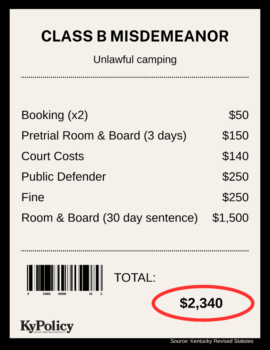
Someone experiencing homelessness in Kentucky and found sleeping in an outdoor public space is charged with “unlawful camping,” a Class B misdemeanor, after being caught doing so more than once. Accepting a plea deal enables them to avoid jail time but requires they pay court costs of $140 and a fine of $250. But when the deadline for payment comes, they don’t have the money and still don’t have a place to live. The judge schedules a hearing for the person to show cause for failing to pay, but they are unable to make it to court and a warrant is issued for their arrest. When an officer finds them sleeping in a park the following week and runs their name through the system, the outstanding warrant shows up on their record. The person is taken to jail, resulting in another booking fee and three days of incarceration before seeing a judge, and they receive a 30-day sentence.
The “receipt” below provides an example of the fines and fees that could follow this unhoused person’s arrests and conviction, totaling over $2,300.
There are proven strategies to help transition people to permanent housing
Instead of citing, arresting, fining and jailing people for being unhoused, state and local governments should invest in proven strategies such as:
- Permanent Supportive Housing: This model combines housing with essential support services tailored for individuals experiencing chronic homelessness. Providing people with a stable living environment along with comprehensive support helps people secure long-term housing stability and improve their health outcomes.
- Enhanced Outreach Efforts: Dedicated outreach initiatives can help service providers better understand each unhoused person’s specific needs, provide immediate assistance, and facilitate smoother transitions into supportive housing.
- Non-Congregate Transitional Shelters: State and local governments should allocate funding to develop non-congregate transitional shelters that are well-staffed and trauma-informed. In order to be most effective, shelters should remain open 24/7, remove barriers for entry, and provide supportive services like case management and housing navigation.