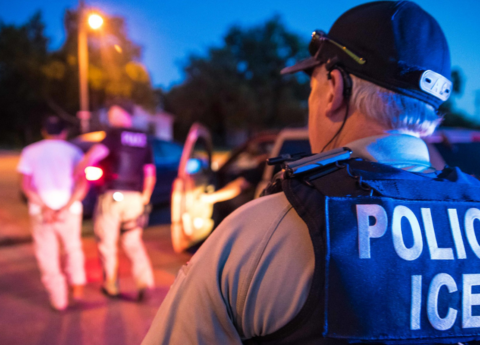

More than a year in to the Trump presidency, the administration’s mass deportation effort has resulted in a historic high of 70,766 immigrants locked up in detention, and Immigration and Customs Enforcement (ICE) is becoming increasingly aggressive in its pursuit of arrests. Despite mounting public outrage and fear, however, a growing number of local police and jails in Kentucky are entering into agreements and contracts to cooperate with ICE. And Kentucky legislators are proposing ways to further ramp up deportation efforts across the state even as ICE arrests in the state surge and the number of detainees in local jails increases.
State and local governments play a central role in implementing this mass deportation agenda, which includes financial incentives for law enforcement agencies to formally partner with ICE and for jails to rent out beds for detention. In Kentucky, 24 local law enforcement groups have already signed 287(g) agreements and 11 county jails are contracting with ICE to hold detainees. That is an increase of 10 additional law enforcement groups and two more county jails just in the last few months. In addition, several bills have already been filed this legislative session that would require local agencies to participate.
States and localities play a key role in administration’s anti-immigrant agenda
During the campaign the Trump administration promised to carry out the largest domestic deportation operation in American history and remove 15 to 20 million undocumented immigrants — a number greater than the 14 million estimated to live in the U.S. The administration is reportedly pressuring ICE to arrest 3,000 immigrants a day and deport a record one million each year.
On its very first day, the administration issued 10 executive orders and proclamations that set in motion a sweeping anti-immigrant policy agenda. The major executive order on immigration enforcement in the U.S. interior, “Protecting the American People From Invasion,” included numerous policies designed to massively increase arrests and deportations, including requiring immigrants without citizenship register with the federal government or be subject to criminal prosecution.
The administration is utilizing state and local law enforcement to carry out its plan. The “Protecting the American People From Invasion” executive order directed DHS to expand 287(g) agreements with state and local law enforcement to mobilize them as partners in enforcing federal immigration law “to the maximum extent permitted by law.” In addition, ICE issued a separate set of standards in July for immigrant detention in facilities that already incarcerate people in state/local custody. These new standards reduced the number of required procedures and oversight compared to dedicated facilities, a strategy to expand immigrant detention in local jails by making it easier to enter into these agreements with ICE.
An April executive order threatened to revoke all federal funding to states and localities deemed to be “sanctuary” jurisdictions that limit cooperation with federal immigration authorities. Louisville was on the Department of Justice’s published list of so-called “sanctuary” jurisdictions because of a local ordinance preventing the jail from keeping someone in custody at the request of ICE (an “ICE detainer”) for as long as 48 hours after their scheduled release; the mayor later announced a reversal of its policy and Louisville was removed from this list.
The “One Big Beautiful Bill Act” (OBBBA), the budget megabill that passed Congress in July, also appropriated $170.7 billion to carry out this anti-immigrant agenda. The majority of that funding is for immigration enforcement in the interior, including more than $75 billion specifically for ICE for detention and reimbursements to local agencies participating in 287(g) agreements described in this analysis, while $75 billion is for the enforcement, surveillance and militarization of borders.
24 Kentucky law enforcement agencies have already signed 287(g) agreements with ICE, five in January alone
Section 287(g) was added to the Immigration and Nationality Act in 1996, authorizing ICE to give state and local law enforcement officers the authority to enforce federal immigration law. Starting with 9/11, it has been utilized during times of heightened immigration enforcement.
During the first Trump administration, the number of 287(g) agreements nationally jumped from 35 to 150. There were 135 memorandums of understanding (MOUs) on Jan. 20, 2025, which surged to 1,036 October 1 and is now up to 1,381 across 40 states as of Feb. 4, 2026. New financial incentives in the OBBBA have been in effect since October 1 for state and local law enforcement agencies that participate, heightening long-held concerns about racial profiling, violence and other human and civil rights violations in the 287(g) program.
The majority of the agreements are the Task Force Model, which empowers state or local law enforcement to make immigration arrests during routine policing and was discontinued from 2012 until January 2025 due to documented civil rights abuses. As of Sept. 2, 2025, 8,501 Task Force officers had completed training and more than 2,000 additional officers were in training.
There are two other types of 287(g) agreements:
- Jail Enforcement Model – Corrections officers are deputized by the federal government to interrogate people about their immigration status.
- Warrant Service Officer Model – ICE trains, certifies and authorizes state and local law enforcement officers to serve and execute administrative immigration warrants on people who are in custody in their agency’s jail.
Both the Task Force Model and Jail Enforcement Model have historically required a four-week, in-person training program, while the more-limited Warrant Service Officer Model required just eight hours of training. However, in bringing back the Task Force Model the Trump administration is only requiring a 40-hour online training course, especially concerning given this model is the most aggressive and has a history of abuses.
In Kentucky, there are now 30 287(g) contracts across 24 different agencies, 20 of which are the problematic Task Force Model:
Task Force Model
- Grayson County Sheriff’s Office (3/5/25)
- Daviess County Sheriff’s Department (3/10/25)
- Heritage Creek Police Department (4/29/25)
- Bracken County Sheriff’s Office (5/8/25)
- Lyon County Sheriff’s Office (5/8/25)
- Marshall County Sheriff’s Office (5/8/25)
- Union County Sheriff’s Office (5/16/25)
- Scott County Sheriff’s Office (7/2/25)
- Butler County Sheriff’s Office (9/9/25)
- Clinton County Sheriff’s Office (9/9/25)
- Fulton County Sheriff’s Office (11/10/25)
- Carlisle County Sheriff’s Office (12/8/25)
- Hickman County Sheriff’s Office (11/14/25)
- Montgomery County Sheriff’s Office (12/8/25)
- Stanton Police Department (12/15/25)
- Hickman Police Department (1/7/26)
- Laurel County Sheriff’s Office (1/7/26)
- Winchester Police Department (1/7/26)
- McCracken County Sheriff’s Office (MOU link pending) (1/26/26)
- Pendleton County Sheriff’s Office (MOU link pending) (1/26/26)
Jail Enforcement Model
- Grayson County Detention Center (3/5/25)
- Oldham County Detention Center (3/10/25)
- Bullitt County Detention Center (3/21/25)
- Kenton County Sheriff’s Office (5/2/25)
- Butler County Sheriff’s Office (9/9/25)
Warrant Service Officer Model
- Grayson County Detention Center (3/5/25)
- Daviess County Sheriff’s Department (3/10/25)
- Oldham County Detention Center (3/10/25)
- Kenton County Sheriff’s Office (5/6/25)
- Butler County Sheriff’s Office (9/9/25)
Fourteen of the agreements happened after the OBBBA became law, all but two of which were for the Task Force Model. Since we first published this analysis in October of 2025, 10 new 287(g) agreements have been entered into, all of which are the Task Force Model.
Prior to the OBBBA, local law enforcement agencies partnering with ICE received limited federal funds for expenses like training and IT infrastructure. However, DHS is now fully reimbursing participating agencies for the annual salary and benefits of each trained 287(g) officer; this includes covering overtime up to 25% of their annual salary. In addition, agencies can receive quarterly “performance bonuses”— not dissimilar to a bounty — based on the “successful location” of undocumented immigrants identified by ICE and “overall assistance to further ICE’s mission to defend the homeland.” Agencies that locate 90% to 100% of ICE-identified undocumented immigrants receive $1,000 per eligible task force officer, $750 per eligible task force officer for locating 80% to 89% of ICE-identified undocumented immigrants and $500 for locating 70% to 79%.
There were nearly 2,000 ICE arrests in Kentucky in the first nine months of the new administration, and the arrest rate is increasing
On January 20, 2025 the Department of Homeland Security issued a directive rescinding the Biden administration’s “protected areas policy” that prevented immigration enforcement in places like churches, schools and hospitals. ICE arrests surged nationally following the inauguration, with 32,809 between January 20 and March 10, the equivalent of about 656 arrests per day, compared to 255 each day under the previous administration. After ICE reportedly received orders on May 20 to further intensify their efforts and started targeting workplaces and immigration court, there was a peak of around 30,000 arrests in June 2025 compared to 8,000 in June 2024. That was the highest level since at least 2020 but still far below the goal of 3,000 per day, or roughly 90,000 a month. ICE arrests were lower in July and August but then increased to more than 33,000 in September.
ICE arrest data obtained, processed and made available by the Deportation Data Project, shows that in Kentucky, between Jan. 20, 2025 and Oct. 15, 2025, there were 1,950 ICE arrests. That’s a 32% increase compared to the 1,475 arrests in 2024 during the same period.
According to an analysis by the Prison Policy Initiative, the ICE arrest rate in Kentucky was 17.2 per 100,000 residents in the first four months of the Trump administration (Jan. 20 to May 20, 2025) and increased to 25.5 between May 21 and Oct. 15, 2025. During both time periods, 75% of the ICE arrests in Kentucky happened at a jail or other lockup facility and 25% occurred at workplaces, homes, courts or other non-carceral locations in the community.
As can be seen in the map below, jails are the most common location for ICE arrests in the state, especially those occurring outside of Louisville. The data also shows that for the people arrested by ICE in Kentucky between Jan. 20 and Oct. 15, 2025 the most common country of origin is Mexico (832), followed by Guatemala (568) and Honduras (197).

Efforts to drive up the number of arrests have led to the targeting of people with no criminal history (and those convicted of a criminal offense may have been for a minor charge). Immigrants with no criminal convictions are increasingly the largest group of people arrested and detained by ICE.
And ICE arrests alone don’t even capture the full scope of the situation, as illustrated by a May 29 immigration raid in Harlan that was carried out by the Drug Enforcement Administration (DEA) despite being unrelated to drugs.
ICE detention in Kentucky is growing and the total number of people in federal custody in the state’s local jails is at a historic high.
The total number of people detained by ICE was 70,766 on Jan. 24, 2026, up from 39,703 on Jan. 12, 2024, a 78% increase. Yet these staggering numbers only reflect around two-thirds of people detained for immigration reasons as they don’t include those facing criminal prosecution in the custody of U.S. Marshals or the Bureau of Prisons.
Local jails are playing a significant role in the Trump administration’s mass arrest and deportation agenda because in 25 states they are the only facilities available for holding people arrested by ICE and the U.S. Marshals Service. The federal government depends on local jails for detention space, and transfers people across the country to local jails that they pay a per diem. In Kentucky, the increasing use of local jails for immigration detention puts pressure on an already-strained system rife with crowding and other poor, dangerous conditions.
Kentucky’s local jails have a long history of renting jail beds to the federal government because federal per-diem amounts are typically much higher than what the state pays jails to incarcerate people in Kentucky Department of Corrections (DOC) custody. Laurel County and Grayson County even vastly expanded their local jails for the specific purpose of holding more people in federal custody for this reason.
Until recently, these jails primarily held people in the federal criminal system for the U.S. Marshal’s service rather than ICE; however, there is a lot of interplay between the two agencies that is important to understand for getting a full picture of immigration detention in jails. For a person arrested by ICE who is charged with a federal immigration crime, custody is transferred to the U.S. Marshals until the criminal case is resolved, at which time ICE can arrest them again (directly from jail or prison after their case is dismissed or they serve a sentence) and then they re-enter immigration detention.
Kentucky jail data shows a marked increase in the number of people in federal custody in Kentucky jails since the beginning of 2024 — jumping from 1,963 on Jan. 23, 2025 to a historic high of 2,940 on Jan. 22, 2026 — a 50% increase.
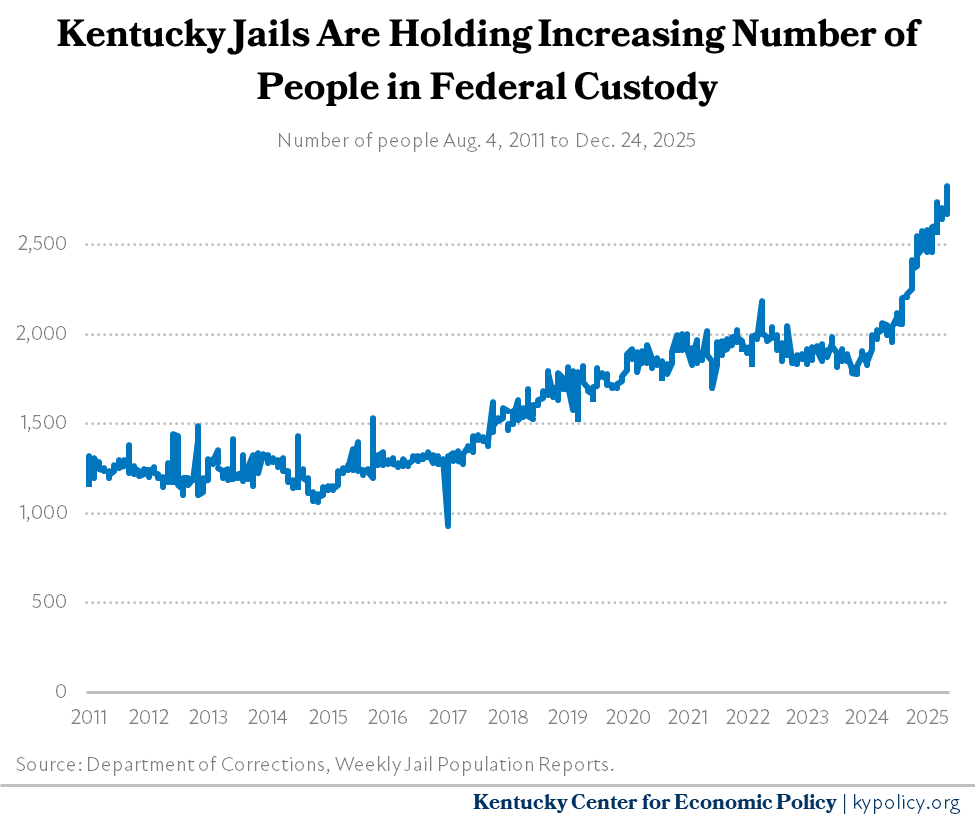
Note that the federal custody population number includes immigrants detained by ICE and by the U.S. Marshals for a federal immigration crime (and for 49% of people booked into U.S. Marshals custody in May of 2025, immigration offenses were the reason), as well as people in U.S. Marshals custody who are not immigrants and have federal criminal charges completely unrelated to immigration.
Although it isn’t possible to parse out exactly how many people in federal custody in Kentucky jails are being detained for immigration enforcement reasons, it’s clear the upward trend that started in February is related to the intensification of immigration enforcement happening around the same time.
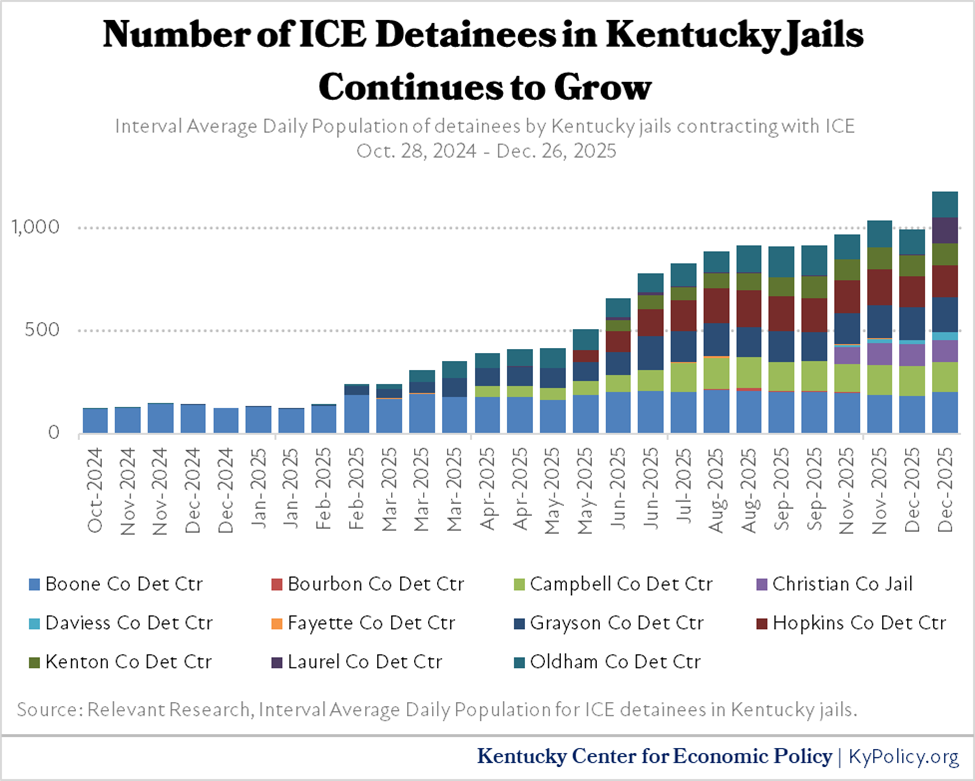
ICE data analyzed by Relevant Research shows dramatic growth in the number of Kentucky jails contracting with ICE for beds and in the estimated average daily population of these detainees. In 2024, just one local facility in the state, the Boone County Detention Center, had a consistent and significant population of people in ICE custody. On Jan. 21, 2025 the estimated “interval average daily population” (ADP) of ICE detainees in Kentucky jails was 120.5. By Aug. 18, 2025, there were an estimated 915.0 people in ICE custody across nine local jails. In November two additional jails — Christian and Daviess County Detention Centers — started contracting with ICE, and on Dec. 26, 2025, the estimated ADP was up to 1,176.3 across 11 local jails, seven of which consistently hold a significant number of people in ICE custody.
The National Immigration Law Center’s “Know Your Rights” resources and other up-to-date information for immigrant communities and advocates can be found here: https://www.nilc.org/resources.
This blog post by Professor Austin Kocher compiles a number of up-to-date “Know Your Rights” resources from reliable sources for ICE and border patrol encounters: https://austinkocher.substack.com/p/know-your-rights-resources-for-ice.