
Between 2022 and 2038, Kentucky will receive more than a billion dollars in proceeds from several national opioid settlements with companies complicit in starting the opioid epidemic in the 1990s. These funds, often referred to as “blood money,” are considered restitution for lives lost and are intended to address communities’ active needs related to the overdose crisis. Half of these funds are distributed to the state, and the other half directly to all 120 counties and 149 city governments to spend on treatment, recovery, harm reduction and prevention.1 It is essential that local governments invest these dollars wisely to save more lives in their communities. However, new local reporting data obtained by KyPolicy for fiscal year (FY) 2025 shows that too many local governments are either sitting on their opioid settlement dollars or spending them ineffectively.
As of June 30, 2025, more than $94.5 million in opioid settlement proceeds have been distributed to 120 Kentucky counties and $28 million to 149 cities. Distributions began in 2022, and yet only about 10% of the funds distributed to local governments have been spent. In FY 2025, the first year in which detailed reporting was required from local governments, half reported zero opioid settlement expenditures. Based on brief descriptions provided in these reports, spending that did occur in many cases does not appear to have been on impactful, evidence-based approaches to preventing overdose deaths and repairing other harms of the opioid crisis.
Our analysis of counties’ opioid settlement expenditures, based on information included in their FY 2025 reports, finds that at least $1.7 million of the reported $12.2 million in expenditures in FY 2025, was problematic spending on ineffective, unproven and/or harmful responses to drug use, addiction and overdose prevention.
Moving forward, Kentucky’s local governments must be proactive in investing their opioid settlement funds rather than holding them and must ensure the monies are spent on programs and strategies that will save lives. To make that process easier, we’ve collaborated with partners to produce a model that would help guide spending of these funds.
Local governments are sitting on their opioid settlement monies rather than making needed investments
While fatal drug overdoses have declined in recent years, much work remains to be done. Overdose deaths dropped to 1,110 in Kentucky in 2025, a nearly 23% decline from 2024 and the fourth year in a row with a decrease. However, 1,110 lives lost is still too many, and recent federal funding cuts to critical health and human services programs jeopardize the state’s progress.2 It is critically important that counties and cities invest opioid settlement dollars to save more lives in their communities, but too many Kentucky localities are sitting on the opportunity.
The settlements allocate funding to states and localities based on three population-adjusted weighted factors: the number of opioid-related deaths that occurred in the state/jurisdiction, the amount of prescription opioids shipped to the state/jurisdiction and the prevalence of opioid use disorder (OUD) in the state/jurisdiction. The payment timelines differ for each settlement but most of the major agreements end in 2038, at which time Kentucky’s local governments will have received around half-a-billion-dollars in total. At the end of FY 2025, the localities reported having received $122.4 million from settlements thus far, $29 million of which was in FY 2025 alone. Ultimately, the model allocates settlement funds in proportion to where the opioid crisis has caused harm.
The interactive map below provides detailed information about opioid settlement receipts and expenditures by county and city, including the total amount received to date, with a focus on receipts and expenditures for FY 2025.
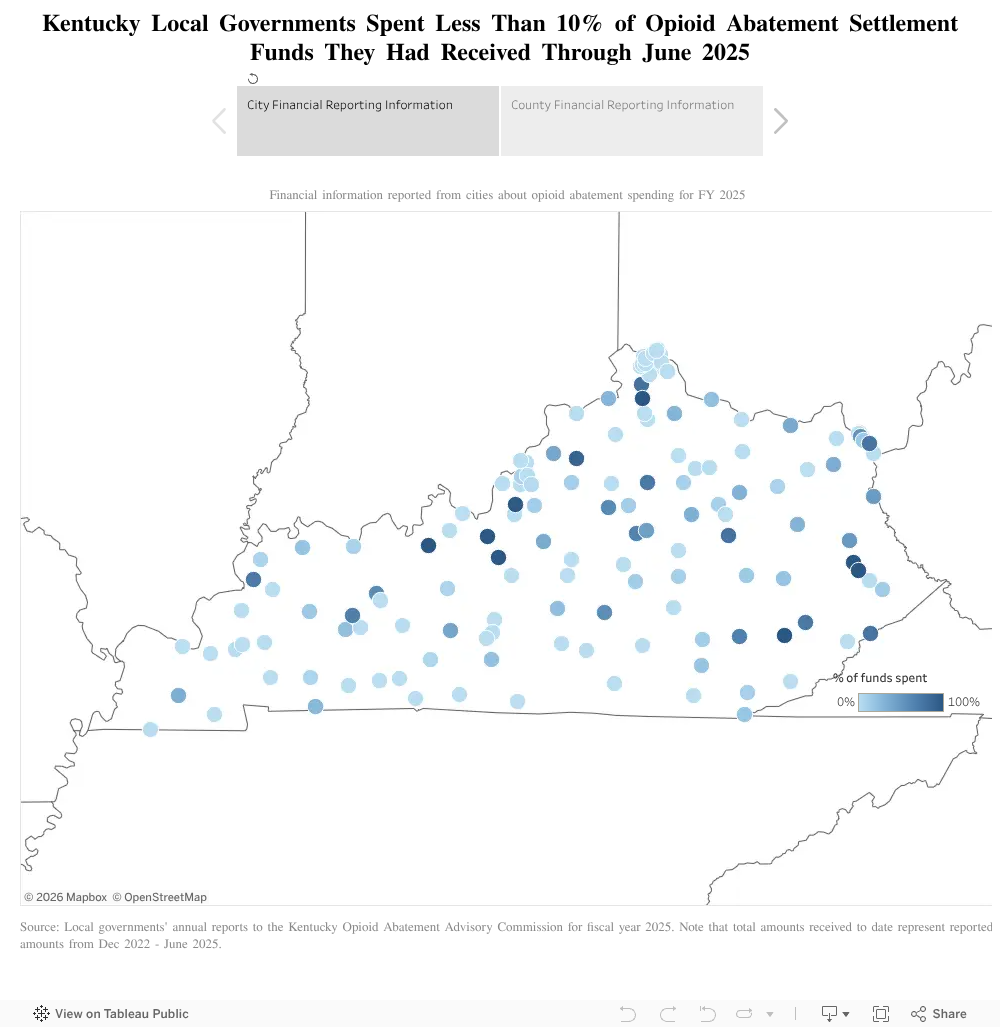
90% of Kentucky’s local opioid settlement funds remained unspent at the end of FY 2025
At the end of FY 2025, Kentucky’s local governments reported that they still have $109.8 million available to spend — $86.5 million for counties and $23.3 million for cities (note that these totals include accrued interest on unspent funds). This means that over 90% of the amount localities reported receiving from opioid settlements remains unspent, with counties spending just 8.5% of the amount they received, and cities just 16.8%.
Half of local governments spent zero dollars in FY 2025
The overall expenditure numbers are significantly impacted by many local governments not spending any money at all. In FY 2025, 138 of the 269 reporting local governments — or 51% — spent zero dollars:
- 50 out of 120 (42%) reporting counties had zero expenditures; and an additional three reported spending of just $20 to $30 for bank charges.
- 88 out of 149 (59%) cities had zero expenditures; and an additional city had just an $8 bank fee.
Localities reporting zero expenditures were required to provide an explanation for not using their funds. Of those explanations, roughly a third simply stated that they had not spent any money with no other explanation, and more than a quarter said they were still in the planning process. Numerous counties responded either that they were in the process of spending the funds, still aren’t clear about what the allowable expenditures are, or couldn’t find a relevant project to invest in. Several cities explicitly said they are saving the funds to spend at a later date, and one answered “NA.”
The interactive map below provides information about how much money remains unspent for each county and city, and if no money was spent, the reasons provided for the lack of expenditures.
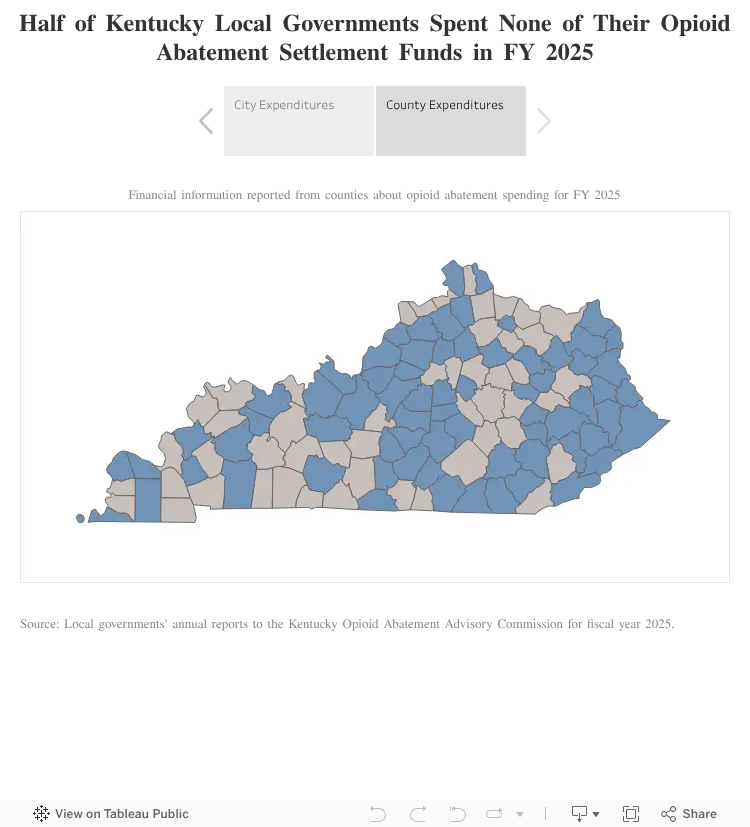
Counties and cities received $29 million, spent $14.5 million, in FY 2025
There were 131 local governments in Kentucky that spent opioid settlement funds in FY 2025, 70 counties ($12.2 million total reported expenditures) and 61 cities ($2.3 million reported expenditures).3
Counties’ total expenditure amounts in FY 2025 ranged from McClean County’s single $20 bank charge to Jefferson County’s $5.9 million distributed across 26 different recipients. The median total expenditure amount for the 70 counties in FY 2025 was $52,760.
Cities’ total expenditure amounts in FY 2025 ranged from West Buechel’s single $8 expenditure for bank fees to West Liberty’s 13 expenditures totaling $63,263 and Ashland’s four expenditures totaling $375,502. The median expenditure for cities that spent opioid settlement funds in FY 2025 was $11,040.
Best and worst uses of opioid settlement funds
Many local entities reported not spending their settlement funds due to lack of clarity on appropriate spending, but there are many resources available to cities and counties that provide clear legal guidance on effective and ineffective uses of this money at the national level, and within Kentucky. It is incumbent on local governments to consult these resources to ensure that they are investing settlement funds in proven solutions that address the greatest needs.
One national resource, the recently released 2026 National Roadmap for Spending Opioid Settlement Funds provides guidance on the most impactful uses of the funding and the types of spending that are problematic, either because the investments will likely be ineffective or because they will cause more harm. This policy guide was developed by organizations working on the frontlines of the overdose crisis, including Kentucky partners VOCAL-KY and Dream.org, and is endorsed by more than 230 organizations.
The settlements themselves require that 85% of the funds be used for “opioid abatement,” with allowable uses detailed in “Exhibit E” of each agreement that generally fall into the following main categories:
- Prevention (including education, training and support for families, schools and communities);
- Harm reduction (including naloxone distribution and syringe service programs);
- Treatment (including detoxification, counseling, inpatient or outpatient care and access to medications for opioid use disorder (MOUD)); and
- Recovery support (including supportive housing, peer support, reentry services for people leaving incarceration and employment assistance).
The Kentucky General Assembly also established permissible expenditures of the funds in Kentucky Revised Statutes (KRS) 15.291, which include expenses related to prevention, harm reduction, treatment, and recovery support, but that statute also allows expenditures on programs and purposes identified as being problematic or not effective, such as abstinence-based treatment, general “public education,” and emergency response provided by law enforcement or first responders as described more fully below.
“Good spending” versus “problematic spending”
The National Roadmap urges states and localities to prioritize investments in evidence-based public health services and related supports that, if created or expanded, can protect people from the harms of drug use, addiction and overdose. Examples of such “good spending” are public health interventions and harm reduction services, including syringe services programs and naloxone, MOUD, and health care for related health conditions such as hepatitis C; immediate housing and supportive services that are that are community-based and non-police led; and initiatives that address the racial and economic harms from the failed “War on Drugs,” such as reentry and recovery programs, civil legal support and community-based efforts to protect families and keep them together.
The National Roadmap characterizes opioid settlement spending as “problematic” when it funds ineffective treatment and prevention programs; harmful, failed punitive responses to drug use, addiction and overdose; and initiatives that are either unnecessary or already had a source of financial support that the settlement funds are replacing, which is known as “supplantation.” Although the KYOAAC has adopted the Johns Hopkins “Principles for the Use of Funds from the Opioid Settlements,” which discourage supplantation, state law does not explicitly prohibit this type of spending.
How Kentucky counties spent their opioid funds in fiscal year 2025
To begin to understand how expenditures made by the 70 Kentucky counties that spent opioid settlement funds in FY 2025 compare to the principles described above, we created this spreadsheet that lists 225 separate county expenditures for fiscal year 2025, including the county, recipient name and project information from the financial reports submitted to the KYOAAC. The spreadsheet also includes our determination — based on the information in the county financial reports of:
- The type of SUD response, categorized as prevention, harm reduction, treatment, recovery, law enforcement, other, or none;
- The category or categories of spending, which includes MOUD, housing, harm reduction, reentry and recovery, police, ineffective prevention programs, unproven treatment methodology; and
- An assessment of the spending as good, problematic, mixed, indeterminable or N/A.
Definitions and other methodological decisions are documented in the spreadsheet.
The categories we have selected are largely based on the National Roadmap, and we assigned expenditures to a category/categories based solely on project description and information provided by the county and in some cases, supplemented by public-facing information we were able to find through online searches. Our assignment of expenses to specific categories are simply that – we have no way of knowing, based on the information we received, the effectiveness of the actual execution or impact of the various expenditures.
According to our assessment:
- 76 expenditures totaling $7 million are examples of “good spending;”
- 73 expenditures totaling $1.7 million are examples of “problematic spending;”
- 25 expenditures totaling $1.6 million are a combination of good and problematic spending, or “mixed;”
- 38 expenditures totaling $1.5 million are indeterminable; and
- 13 expenditures totaling $142,808 do not fit within one of our categories (i.e., bank fees and legal fees).
We highlight trends and examples of each below.
Good spending
We categorized 74 county expenditures in FY 2025, totaling $6.9 million, as “good spending” on public health and harm reduction services; housing and supportive services; and/or repairing racial and economic harms from the failed “War on Drugs.” As a reminder, we have no way of knowing, from the data we received, whether these programs have been implemented and operated as described, or if they are achieving their goals; our categorization is based solely on whether the program is described by the local government as an investment in one of the categories identified as “good” above.
Many of these projects included a combination of public health, harm reduction and supportive services that are community based, and not police led. For example, Jefferson County spent $130,796 on a Feed Louisville/C.A.R.E. [Creating Action, Resources, and Empowerment] project that “implemented tailored, evidence-based approaches to address high-risk activities that are associated with increased overdose death rates and transmission of infectious diseases”:
As a formal community partner of LMPHW [Louisville Metro Department of Public Health and Wellness]’s syringe exchange, C.A.R.E. provided outreach to distribute harm reduction supplies and safer use education to people who are experiencing homelessness. Specific activities performed by the outreach team to individuals experiencing homelessness include: Daily engagement in the camps and on the streets. Education on overdose prevention and provision of lifesaving supplies, including naloxone and testing strips. Provision of basic wound care. Monitoring for acute issues that need immediate attention and referring people to healthcare, as needed. Education about the risks of drug use and unprotected sex, including the provision of safer sex supplies. Linking people to community services for individuals with opioid use disorder, including recovery facilities. Connecting people with permanent housing.
Floyd County allocated $100,000 to its school district’s Family Resource and Youth Services Center (FRYSC) to support school age children affected by opioid use/OUD. FRYSCs receive funding from the state budget but the funding is insufficient, especially in counties where so many families have been impacted by the opioid epidemic:
There is a significant number of school age children being raised by single parents, grandparents, family members, and other community members due to opioid abuse. This can cause extreme hardships on those individuals that are caring for these children. This program is to assist the children and families with assistance for their most basic needs. Ie., food, clothing, shoes, beds, bedding, and utilities. These monies kept the electric on in households that would have gone without electricity. It provided beds/bedding for children that were sleeping on the floor. As well as food, clothing, and shoes for children who were significantly lacking in those areas.
Several counties, including Letcher, Lee, Owsley and Whitley are funding community resource “hubs” that aim to reduce overdose deaths by increasing access to harm reduction and treatment navigation services; addressing barriers to economic security such as IDs, housing, transportation and employment; and strengthening long-term recovery through peer support, community partnerships and family engagement:
Letcher County ($50,000) – The Kentucky River District Health Departments Hub Project –
The Hub serves individuals with opioid use disorder and co-occurring conditions, as well as those in early recovery and community members seeking prevention, education, or support services. Special attention is given to underserved and high-risk populations, including individuals experiencing homelessness, justice involvement, or poverty-related barriers. Key activities include operating a Recovery Community Center that offers peer-led recovery coaching, harm reduction services, and linkage to treatment; administering a Barrier Relief Fund to remove practical obstacles such as transportation, birth certificates, fines, and employment readiness needs; and collaborating with local partners including the fiscal court, law enforcement, and community-based organizations to provide wraparound support. The Hub also expands outreach, education, and overdose prevention through naloxone distribution and recovery-centered community events. Together, these efforts promote recovery, reduce harm, and rebuild hope in one of Kentucky’s most vulnerable regions.
Other counties funding projects utilizing a hub-like model projects are Rowan’s “Recovery Rowan County” ($10,000) and Breathitt County Public Health Department’s “GRACE Center” ($50,000).
In terms of examples of evidence-based treatment specifically, at least six counties spent opioid money in FY 2025 to provide MOUD in their local jails, including Greenup, Mercer, Breckinridge, Taylor, Boyd and Wayne. Wayne County also funded a project ($22,500) to increase access to treatment for those individuals who needed the Intensive Outpatient (IOP) level of care to address their SUD but due to lack of insurance benefits or other means to pay, would not otherwise be able to receive this level of treatment.
Boyle County funded a Community Outreach Coordinator position ($52,938) to help connect people with SUDs to evidence-based treatment and recovery support:
Based at the Boyle County EMS headquarters, the coordinator responds to emergency calls involving SUD. Working alongside EMS staff, they assess the situation and the patient to identify the best support options. Services offered include referrals to inpatient/outpatient treatment, [MOUD], recovery groups, mental health counseling, and case management referrals. The coordinator also follows up with clients, provides Narcan kits, and shares educational materials on overdose prevention and recovery resources. Key activities and methods utilized include community education campaigns, mobile outreach unit, partnerships with local organizations, community resource navigation and naloxone distributions and training. The coordinator also works closely with the Boyle County Health Department, supporting the local needle exchange and harm reduction program to promote public health and recovery resources.
Problematic spending
We categorized 73 county expenditures in FY 2025, totaling $1.7 million, as “problematic spending,” either because the funds were used for purposes that are unproven and ineffective, or ones that cause additional harm.
Criminalization/police/jails – Unfortunately, there were many examples of counties’ opioid settlement funds being spent on punitive criminal legal system responses to drugs in FY 2025. Martin County spent $24,748 for two “Opioid Deputies” and $29,324 for gas for the Opioid Deputy, plus $7,807 to tow, repair and maintain the constable’s car. Henry County leased a “Drug Task Force Vehicle” for $39,839; Bath spent $40,731 for a sheriff’s department “Drug Response Project”; and Letcher used $100,000 to increase pay for sheriff’s department deputies. There were also expenditures for handheld narcotics analyzers (Meade County, $30,093), as well as X-ray scanning (Wayne County) and drug testing (Taylor County) at local jails.
Family separation – Crittendon County had multiple expenditures in FY 2025 to provide drug testing for family court. The National Roadmap does not support initiatives that increase referrals to the system responsible for child welfare, which frequently prioritizes removing a child from their parent/s and causes long-lasting emotional and psychological harm, or to purchase drug testing equipment for them.
“Treatment” without evidence-base – Examples of spending on treatment that does not have an evidence-base includes abstinence-only programs as well as coercive treatment. Both Harlan and Knox Counties used abatement funds for a Casey’s Law Advocate position to help people petition the court to force a family member/friend into treatment. Other concerning expenditures in this category include a total of $433,385 expended by eight counties to purchase controversial NET devices that deliver mild electrical nerve stimulation through a small, battery-operated control box wired to gel-backed electrode patches taped to the skin behind the ears. While the device is FDA-cleared to help stave off withdrawal symptoms, it has unknown long-term outcomes and is very expensive.
Ineffective prevention programs — There was a slew of spending by counties on ineffective prevention programs including:
- Grayson County’s expenditure of $25,000 for celebrity guest speaker basketball player Lamar Odom to talk at the high school.
- Funding for “just say no” D.A.R.E. programs (Ballard and Wayne Counties), which have been proven ineffective.
- An expenditure of $6,235 for Fatal Vision Opioid Goggles for school use by Crittenden County.
- An expenditure of $36,646 by Wayne County for the purchase of vape detectors for bathrooms in the middle and high schools.
- Nondescript community events paid for by several counties such as Celebrate Recovery, Red Ribbon Week and a drug free “battle of the schools” event.
Corporate exploitation and overpriced products – In addition to the $433,385 in expenditures for NET devices discussed above, another such example of corporate exploitation and overpriced products is the expenditure by McCreary County of $45,230 and Adair County of $22,769 for unnecessary drug disposal kits sold by the company Deterra, to deactivate and destroy unused medications. The federal Drug Enforcement Administration already sponsors prescription opioid collection events in communities and pays for associated costs, and the FDA has weighed in that it’s also acceptable to flush these medications down the toilet.
Supplantation or general fund use – Certain expenditures stood out as likely examples of supplantation or general fund use. For instance, Perry County’s expenditure of $91,362 for payroll for fiscal court employees that work in “the opioid department;” Perry also spent $3,537 for water and waste services for a City of Hazard building/s. Scott County used opioid abatement dollars to hire a counselor at the school ($81,050) and Menifee paid $40,000 for a School Resource Officer (SRO) in FY 2025.
Mixed spending
There were 25 expenditures totaling $1.6 million that we characterized as “mixed” when it was obvious there were both “good” and “problematic” aspects of the projects. For instance, while drug and family courts typically involve coercive treatment and family separation, spending that supports individuals’ successful participation in these programs can have a positive impact. We also categorized spending as mixed for police social workers, general jail programming to reduce recidivism, and a resource hub that alongside other services supports Casey’s Law petitions.
Indeterminable and N/A spending
We categorized an additional 38 expenditures ($1.5 million) as “indeterminable” when there was not enough information to provide an assessment of “good,” “problematic” or “mixed.” Expenditures categorized as indeterminable include strategic planning, some recovery housing programs and spending on administrative positions like Powell County’s Opioid Abatement Liaison position ($4,500).
Thirteen expenditures, totaling $142,808, were categorized as N/A (not applicable), such as bank fees and attorney fees.
How Kentucky communities can make the most of the money moving forward
It is both concerning and disappointing that Kentucky’s local governments have failed to spend a majority of the money received from the opioid settlement funds. Moving forward, with a combined balance of $109.8 million in county and city opioid settlement funds, and more than a decade of additional settlement disbursements and spending decisions still ahead, Kentucky local governments must remedy this situation by using the data, information and research available to meaningfully invest these proceeds into proven solutions, such as harm reduction, evidence-based treatment and community-based services and supports. And because local governments know how much money they will be receiving in the future, they can and should develop long-term plans for the expenditure of these funds.
Proper stewardship of these local opioid dollars is especially essential in the context of growing revenue challenges, alongside shrinking federal funds for harm reduction and other lifesaving services and programs. With reduced federal and state support impacting local government revenues, more local governments may be tempted to use opioid settlement funds for problematic purposes. For example, the budget just passed by Louisville Metro Council uses opioid settlement funds in FY 2027 to cover costs at the city’s 911 call center, jail and other agencies that have previously been paid with local general fund dollars — rather than spend the dollars to keep open the Arthur Street Hotel to provide much-needed supportive transitional housing.
One way that local governments can receive critical input to direct effective expenditure of these funds is through the establishment of a local opioid abatement advisory council. A model ordinance for counties developed in collaboration with Vital Strategies can be found here. It is aligned with best practices, including the Johns Hopkins “Principles,” and can be customized based on local needs and established practices.
An advisory council can provide a powerful mechanism to gather diverse perspectives, guide priorities, inform evidence-based decision-making on uses of funds, and promote public transparency. In particular, the inclusion of individuals with lived and living experience of substance use, overdose, recovery, and loss — including those with current substance use disorder, individuals in recovery, and their families — brings critical insight that is not available through data alone. Their voices help ensure that funding strategies are practical, compassionate, and responsive to real-world conditions, ultimately strengthening trust and increasing the likelihood that opioid abatement funds will be invested effectively to save lives.
— Model Kentucky Ordinance Establishing a County Opioid Abatement Advisory Council (Vital Strategies and KyPolicy, 2026)
It is more important than ever for local advocates to be engaged and involved with their local governments in informing the decision-making process and in ensuring that their local representatives are appropriately using these funds for their intended purposes. Here are some additional resources that may be helpful to community members as well as local governments in accomplishing these goals:
Opioid Policy Institute’s “Opioid Settlement Fit Test,” a simple way to remind decision-makers to pause and check the fundamentals before making money moves. It’s designed to support high-pressure, value-based decisions to help ensure settlement dollars stop this crisis and build healthier, more resilient communities.
- Contact information for County Judge Executives, which includes county fiscal court websites with contact information for County Magistrates/Commissioners.
- Kentucky Association of Counties (KACo) resources on opioid settlement funds.
- Opioid Policy Institute’s “Opioid Settlement Fit Test,” a simple way to remind decision-makers to pause and check the fundamentals before making money moves. It’s designed to support high-pressure, value-based decisions to help ensure settlement dollars stop this crisis and build healthier, more resilient communities.
How the 2026 National Roadmap Defines “Good Spending” and “Problematic Spending” of Opioid Settlement Monies
“Good spending” is investing in evidence-based public health services and related supports
The National Roadmap urges states and localities to prioritize investments in three types of evidence-based public health services and related supports that, if created or expanded, can protect people from the harms of drug use, addiction and overdose:
- Public Health & Harm Reduction Services – Includes public health interventions and harm reduction approaches such as syringe services programs, naloxone and fentanyl test strips; medication for opioid use disorder (MOUD) including telehealth and mobile medication services; expanded access to care for related health conditions such as hepatitis C, wound care and endocarditis; and compassionate, safer crisis response without police involvement.
- Housing & Supportive Services – Includes immediate housing options for people who use drugs and who are navigating homelessness or housing insecurity, particularly those that provide additional on-site support services and don’t have sobriety requirements, and compassionate outreach and supportive services that are community-based and non-police led.
- Repairing Racial & Economic Harms from Failed “War on Drugs” – Includes civil legal support; reentry and recovery programs and financial resources; and community-based efforts to protect families and keep them together.
“Problematic spending” is investing in ineffective, unproven and/or harmful responses to drug use, addiction and overdose
In contrast, the National Roadmap characterizes opioid settlement spending as “problematic” when it funds ineffective treatment and prevention programs; harmful, failed punitive responses to drug use, addiction and overdose; and initiatives that are either unnecessary or already had a source of financial support that the settlement funds are replacing:
- Criminalization/police/jails – As stated in the National Roadmap, “Decades of relying on policing and incarceration to address drug use, addiction, and overdose has failed. Responding to our addiction crisis with incarceration increases overdose rates, and over-policing deters people from seeking help. Funding for law enforcement and prisons far exceeds proven public health solutions such as housing, care, and treatment.”
- Family separation – The system responsible for child welfare frequently prioritizes removing a child from their parent/s, which causes long-lasting emotional and psychological harm including increased risk of adolescent and lifetime substance use. This is why the National Roadmap does not support initiatives meant to increase referrals to these agencies or to purchase drug testing equipment for them.
- “Treatment” without evidence-base – Many programs that claim to help people struggling with drug use and addiction are under-regulated and often do more harm than good. Settlement funds should be prioritized for community-oriented, low-barrier, evidence-based programs that offer FDA-approved MOUD, which often remain out of reach for those who need them most; the opioid money should not be used to fund abstinence-only programs, coercive treatment such as involuntary commitment initiatives, and unproven treatment methodologies such as the NET Device that while FDA-cleared to help stave off withdrawal symptoms has unknown long-term outcomes and is very expensive.
- Ineffective prevention programs – School-based programs that rely on celebrity speakers and “just say no” messages have been shown to be ineffective and may even increase substance use. There is also no rigorous evidence that “mock bedrooms” or use of impairment simulation goggles reduce youth opioid use.
- Corporate exploitation and overpriced products – Funds are sometimes diverted to for-profit companies offering unnecessary or overpriced interventions. An example is purchasing Deterra drug disposal kits to mail or hand out or paying for drug “take back days.” The federal Drug Enforcement Administration already sponsors prescription opioid collection events in communities and pays for associated costs, and the FDA has weighed in that it’s also acceptable to flush these medications down the toilet.
- Supplantation or general fund use – According to the National Roadmap, there are numerous settlement agreements and state laws or guidelines that require — or at least strongly encourage — that funds be used to create new or expanded services, rather than to replace existing funding or free up public dollars for unrelated purposes. In other words, opioid settlement money should supplement existing public spending, not supplant it. State and local governments should not use the money for unrelated needs, or to pay for programs and services already funded through other mechanisms.

- Consolidated local governments Louisville Metro and Lexington-Fayette Urban County Government receive settlement funds as counties.
- Federal funding cuts thus far include: nearly $1 trillion from Medicaid, the biggest source of addiction treatment funding in the country; at least $333 million from federal overdose prevention programs, which directly impact access to naloxone, fentanyl test strips and treatment; and $41 million from drug-related research, hindering the ability to research new treatments. Drug Policy Alliance, “Tracker: Federal Cuts Raise Healthcare Costs, Delay Care, and Increase Overdose Risk,” April 29, 2026, https://drugpolicy.org/resource/federal-cuts-threaten-overdose-prevention/.
- Note that there are instances when the total expenditure amount reported by a local government does not match the sum of the amount allocated/distributed for each of the local government’s financial recipients; the amount reported as disbursed to each of the 225 financial recipients adds up to $11.9 million but the total amount reported by counties as expenditures in FY 2025 is $12.2 million.