The massive surge in proposed data centers is prompting intense debates about their costs and benefits. One question emerging across the country is whether and to what extent states should subsidize data centers with public tax dollars. These concerns are growing as tech companies look to locate data centers all over the country and with the proliferation of new, artificial intelligence (AI)-driven “hyperscale” centers that are many times the size of the previous generation of data centers — making the cost of their tax subsidies that much larger.
Kentucky currently has a data center tax break on the books. The state’s sales tax exemption applies to the purchase of equipment and can last up to 50 years, though the state has not awarded any of these exemptions yet. Given publicly available information about the size of proposed data centers in Kentucky and industry data on average costs, we estimate that the commonwealth could easily forgo over $1 billion in sales tax revenue if this exemption is awarded to just a few large centers. The data center tax break, which was only estimated to cost $15 million a year previously, could quickly become the largest tax expenditure on the books in Kentucky. This subsidy would be awarded to the world’s most valuable companies even as they eagerly seek localities willing to accept data centers and meet the enormous and still-speculative demand for AI processing capacity.
In this rapidly-changing context, decision makers should think twice before handing over such a huge amount of state General Fund dollars through this exemption. This money would otherwise go to fund schools, Medicaid, infrastructure and other services that are receiving cuts in the current and recent state budgets. A growing number of states are engaging in serious debates about the merits and wisdom of data center tax breaks, with proposals and plans to pause, limit or end these subsidies.
Kentucky’s tax subsidy is for the purchase of equipment and can last up to 50 years
In 2024, the Kentucky General Assembly created a sales tax exemption for data centers that covers virtually everything purchased to outfit and maintain them. The original bill was limited to Jefferson County, but in 2025 lawmakers expanded the tax break to the entire state. The Cabinet for Economic Development has not yet awarded any of these exemptions but may soon consider doing so.
The sales tax exemption applies to all data center equipment and software including servers and routers as well as systems related to electricity, cooling, water usage and security. The only purchases that are not exempt from the sales tax are for development of the site, construction of the shell building, the purchase of electricity and the provision of office equipment related to administration of the data center.
That means most data center costs are subsidized under the sales tax break. Industry benchmarks show that only roughly 10%-15% of the cost of a data center is the land, basic site work, foundation and shell building. The remainder is the computer processing equipment and the machinery used to power and protect it, practically all of which is exempt from the sales tax under Kentucky’s law.
To qualify for the tax breaks, a data center must have a minimum capital investment of $450 million in counties with at least 100,000 people (currently Jefferson, Fayette, Hardin, Boone, Daviess, Kenton and Warren); $100 million in counties with 50,000-100,000 people (Bullitt, Campbell, Christian, Greenup, Laurel, Madison, McCracken, Nelson, Oldham, Pulaski and Scott); and $25 million in counties with less than 50,000 residents. The exemption can last up to 50 years for data centers with investment of over $450 million and 25 years for smaller centers.1 The computer equipment in data centers typically must be replaced every 3-5 years, resulting in additional tax breaks every few years until the incentive expires.
Tax breaks for proposed and potential data centers could easily cost billions of dollars
The more data centers that locate in Kentucky — especially hyperscale centers with their thousands of servers and miles of connection equipment — the more sales tax revenue will be forgone because of this tax exemption. The recent proliferation of proposed data centers across Kentucky provides a sense of what the exemption could cost the commonwealth.
The only data center under construction now is in southwest Jefferson County. This facility, being built by Powerhouse Data Centers/Poe Companies, will have the capacity to use about 400 megawatts (MW) of power and will cost $11 billion over its lifetime. A TeraWulf data center in Hawesville at the site of the former Century Aluminum plant is planned at 482 MW. Other proposed data centers include a massive 1 gigwatt (GW)(equal to 1,000 MWs) TeraWulf facility in Boyd/Greenup county and a 1.2 GW center in Mason County.
The power capacity at these four data centers alone totals 3.084 GW, or the equivalent of providing electricity for about 2 million homes. The financial cost of data centers depends on a variety of factors including whether the center is AI-optimized, meaning it has the enhanced capacity to run machine learning and large language models. Based on 2026 prices, a standard facility costs $8-$12 million per MW to build and outfit and an AI-optimized facility is in the range of $15-$25+ million per MW. Prices of equipment are also rising as demand for new data centers increases.
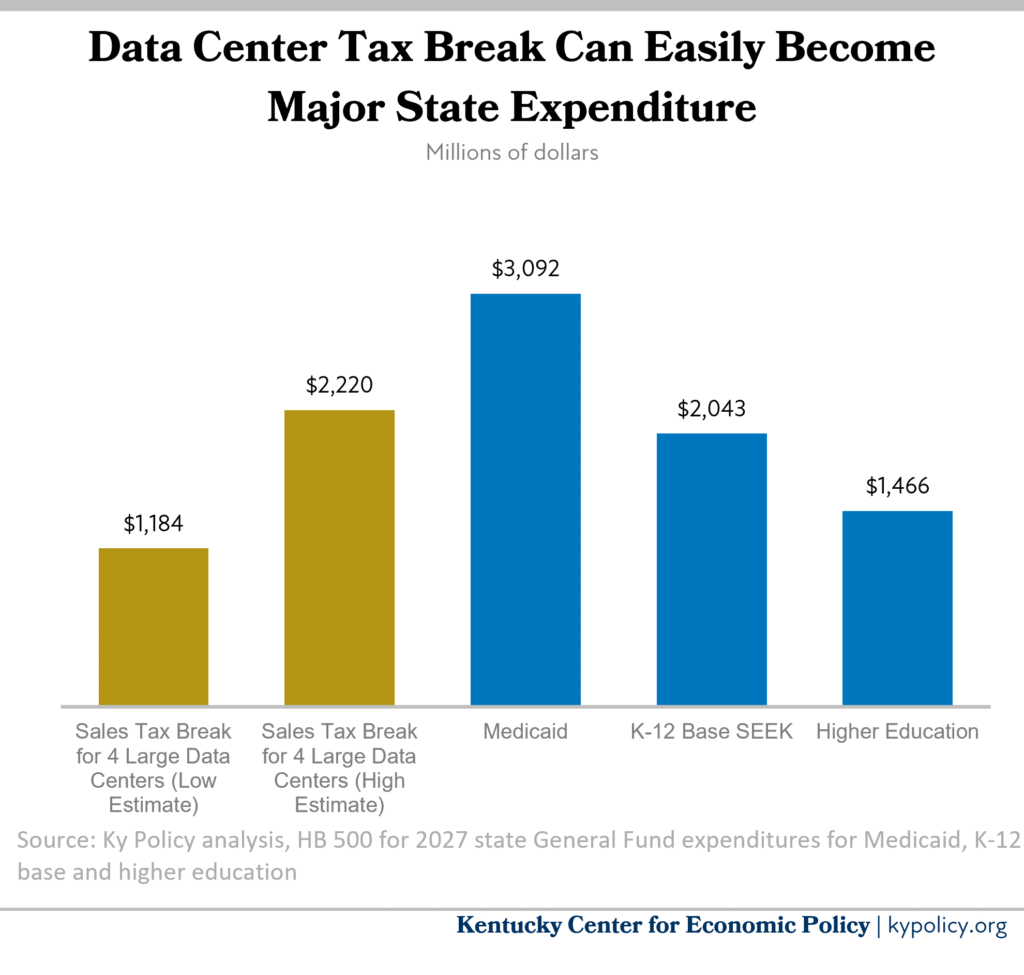
News reports and company releases to date suggest all four of these centers are designed to be AI-optimized. Nevertheless, using conservative estimates of $8-$15 million per MW and assuming 80% of the costs are for purchases exempted from the sales tax in Kentucky, the initial outfitting of just these four facilities could result in the state forgoing $1.2-$2.2 billion in tax revenue, with additional lost sales tax revenue as equipment is replaced and upgraded over the next 50 years. That far exceeds the state’s estimate of a $15 million annual cost of the data center tax exemption, which was calculated before the recent proliferation of AI-based hyperscale centers. But this new estimate may also turn out to be very conservative given the enormous size and high and rising price of AI-optimized data centers.
And these four proposed projects are far from the only data centers under consideration. The Kentucky Lantern is currently tracking 16 proposed centers. A draft analysis of a 1.2 GW proposed center in Barren County reported on by Barrenside describes that it will have $10.8 billion in information technology (IT) hardware and another $4.6 billion in “interior building systems” separate from the real property (the land and building). If the purchase of this equipment and systems falls entirely under the sales tax exemption, that is another $924 million in tax breaks for this data center alone. And the report calls this “a deliberately conservative baseline,” noting that with “rising hardware cost” the IT equipment cost “is likely materially higher.”
A recent report from the Kentucky Energy Planning and Inventory Commission for the Kentucky General Assembly described vast potential interest from data center developers and hyperscalers. As of March 2026, LG&E/KU was reporting 29 potential data center projects in its pipeline, with 11 of those projects totaling 3.5 GW having a greater than 50% chance of moving forward. The company told investors in May that total prospective electricity demand from potential data centers in its service region could reach 12 GW. And East Kentucky Power Cooperative (EKPC) says it “currently has 11 active data center projects seeking over 10 GW in power.”2 For context, 22 GW of power exceeds the 18.4 GW of power all utilities in Kentucky generated in the summer of 2024.
All those data centers are unlikely to be built. But taking potential known projects into consideration, the cost of the sales tax exemption has the potential to climb further, as shown in the table below.
Potential Cost of Kentucky's Data Center Sales Tax Exemption
Financial cost in millions of dollars for initial construction and outfitting phase| Power capacity (MW) | 80% of upfront costs of $8 million/MW | 80% of upfront costs of $15 million/MW | Cost of 6% sales tax exemption (low) | Cost of 6% sales tax exemption (high) | |
|---|---|---|---|---|---|
| 4 projects in Louisville, Hancock County, Boyd/Greenup County and Mason County | 3,084 | $19,738 | $37,008 | $1,184 | $2,220 |
| 11 projects with greater than 50% likelihood of advancing in LG&E/KU service area | 3,500 | $22,400 | $42,000 | $1,344 | $2,520 |
| Potential demand in LG&E/KU territory as reported to investors | 12,000 | $76,800 | $144,000 | $4,608 | $8,640 |
| 11 active data center projects in EKPC service region | 10,000 | $64,000 | $120,000 | $3,840 | $7,200 |
| Source: KyPolicy analysis of news reports, company documents, the Kentucky Energy Planning and Inventory Commission study of data centers and industry costs from irecruit.co and other sources. | |||||
How would the cost of this tax break compare to other major state expenditures? Just for a handful of these data centers, the potential cost could approach or exceed what the state spends for all its public universities and community colleges, core funding for K-12 public schools (known as the “SEEK base”) and Medicaid, which provides health insurance for one in three Kentuckians.
Some other states are pausing, limiting or ending data center tax breaks
More than 40 states currently provide tax breaks for data centers, ranging from sales tax exemptions like in Kentucky to electricity and property tax abatements and corporate tax credits. But many of these tax breaks were established for the previous generation of much smaller data centers, and states increasingly face sticker shock as the cost of subsidizing hyperscale-sized centers becomes clearer.
As KyPolicy outlined recently, new analyses also question the cost-benefit of data center tax breaks. An audit in Georgia estimated that 70% of data center projects would have located in that state without the subsidy. Virginia, which has the largest concentration of data centers in the country, has tax exemptions that cost the state over $1.6 billion annually and result in an estimated return in state revenue of just 48 cents per $1 spent, according to a legislative audit. An issue causing that low return is that while the construction of data centers involves many initial jobs, the centers provide relatively little permanent employment and the cost per job of large tax breaks over 50 years can be very high. Funds given away in tax incentives are not available for other job creation — such as in public construction of schools, housing, water systems and other pressing public needs.
States are also increasingly concerned about the risk associated with the data center build-out. If the rush to build so many new centers turns out to be a result of exaggerated expectations of future demand, communities may be on the hook to pay for the increased but unused power capacity. And if the build-out happens too quickly, communities may face rising energy prices as capacity-constrained utilities are forced to purchase more expensive power on the often-volatile open market.
The local controversies around data centers, and new evidence about their costs and risks, have led more states to halt or curb their subsidies. For example:
- Ohio Governor Mike DeWine has paused tax breaks for data centers while the legislature studies the issue.
- Arizona has enacted a three-year pause on its data center sales tax exemption and Governor Katie Hobbs has proposed eliminating it.
- Texas Governor Greg Abbott has called for blocking data center development in rural parts of the state and proposes repealing the state’s sales tax exemption for data centers in the 2027 legislative session.
- New York has put the brakes on all data center development for the next year.
- In Illinois, Governor J. B. Pritzker has put in place a two-year moratorium on data center incentives.
- Virginia recently enacted a new electricity consumption tax for data centers.
- Nebraska’s governor signed an executive order barring new data centers from receiving tax breaks.
- The Pennsylvania House of Representatives overwhelmingly passed a bill to end its tax exemption for data center equipment, though the bill ultimately did not pass into law.
In Kentucky, Governor Beshear previously vetoed legislation proposing data center incentives, and the bill expanding the sales tax exemption state-wide was enacted without his signature. Since then, the Cabinet for Economic Development has put in place guidelines for the approval of the data center sales tax exemption. These rules require a community engagement plan, an endorsement of the project from local officials and information from the utility provider about the data center’s impact. The governor has indicated Kentucky will not approve projects for tax incentives that pass utility costs onto other ratepayers or lack adequate community benefits. Kentucky congressman Brett Guthrie, chair of the Energy and Finance Committee in the House, said recently that data centers should “pay all the same taxes everybody else does. . . so it benefits the community.”
At the same time, moratoria on data center development are spreading rapidly across Kentucky localities. Nelson, Daviess, Fayette, Greenup, Butler, Boyd (the Terawulf data center is exempt), Breckinridge, Edmonson and Scott counties as well as a number of Kentucky cities have put in place pauses on any new data centers, and Meade County recently blocked rezoning for a data center.
To the extent data centers are allowed in Kentucky, the state should understand the reasons tech companies might want to locate here besides tax breaks. As law firm Frost Brown Todd describes, Kentucky is now a prime location for big data centers in part because of low electricity costs, grid access, internet connectivity, lots of water, cheap land and a favorable natural climate.
HB 869, which passed the Kentucky legislature earlier this year, requires the Cabinet for Economic Development to issue a report by August of 2027 about tax incentives for data centers in Kentucky and other states along with recommendations. But it is likely the 2027 Kentucky General Assembly will take up the issue of data centers before then, in part because lawmakers did not pass legislation in 2026 to ensure data center utility costs are not passed on to other customers. Before decision makers begin awarding the massive data center tax breaks they have authorized, the state needs a thorough debate about the full costs and benefits.
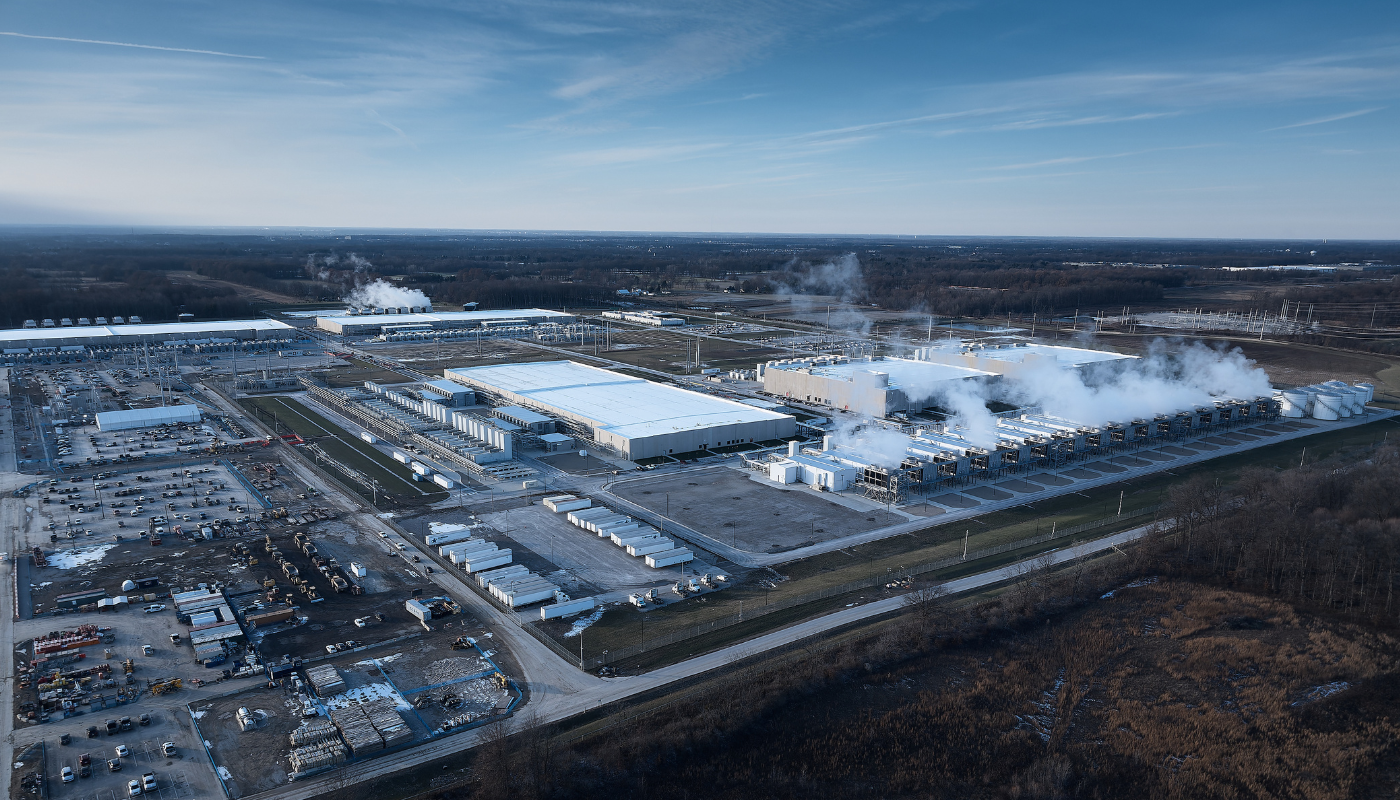
Photo: A Google data center in Central Ohio.

- For data centers established by a project organizer that only provides the infrastructure for the data center project, the minimum investment is $150 million and the incentive is available for 15 years.
- LG&E/KU and EKPC cover around 65% of the state’s energy customer base.