

Thousands of provisions in Kentucky state law, and untold local ordinances, make up a vast, hidden web of criminal legal system fines and fees that trap many people in a cycle of long-term debt and incarceration. In a poor state like Kentucky, owing a few hundred dollars in fines and fees for a minor offense can all too easily ensnare a person indefinitely in the criminal system and result in lost income and employment, homelessness, poor health, and family instability, among other consequences. As of 2019, Kentuckians owed at least $91 million in fines and fees debt.1
In response to “tough on crime” narratives and a desperate search to fill financial holes created by cutting taxes, the web is expanding. But the evidence suggests that increasing the use of fines and fees is not effective in deterring crime or providing a significant and reliable revenue source. Instead, imposing more and larger fines and fees increases hardship and leads to more incarceration.
In Kentucky, the web of criminal legal system fines and fees remains hidden because there is no comprehensive, centralized source of information about them. Given the absence of such a much-needed resource, this report sheds light on the more than 1,000 provisions we identified in state statute that impose a criminal legal system fine or fee, and the many onerous fees imposed on incarcerated Kentuckians as reported to us by the county jails and the Department of Corrections (DOC).
Fines and fees debt is a far-reaching problem that results in serious harms
Since 2008, Kentucky and almost every other state has increased or imposed new criminal legal system fees and expanded the categories of offenses that trigger fines in order to raise funding for courts, local criminal legal systems, and completely unrelated programs and initiatives.2 This trend is concerning given the large and growing body of research that shows fines and fees debt can often result in severe and compounding negative consequences for the people who owe them.
Fines are a form of punishment imposed when someone is convicted of a criminal offense. For example, in Kentucky a violation or low-level misdemeanor can result in a fine of up to $250, while a person convicted of a felony can face a fine of between $1,000 and $10,000.3 Fees and costs — which we collectively refer to as “fees” — are charges imposed by government entities for the explicit purpose of raising revenue, in some cases to offset costs and in other cases to fund unrelated programs or initiatives. Fees are imposed at every level and in every area of the criminal legal system.4 Asset forfeiture and restitution are other forms of legal financial obligations attached to the criminal legal system, and there are also civil fines and fees, but they are outside of the scope of this report.
According to a recent nationally representative survey, court-related fines and fees have become so ubiquitous that they affect around one in three people.5 The most common reason to have a fine or fee assessed in the past 10 years was a traffic ticket, the survey found, although more than a third of those with fines and fees had them from a criminal proceeding, most commonly for a misdemeanor.
These fines and fees for minor offenses can have devastating impacts when people cannot afford to pay them, as all too often is the case. The Fines and Fees Justice Center (FFJC) documented more than $27 billion in outstanding fines and fees court debt in the U.S. in a 2021 report, and that was from partial data reported by only half of states.6
A several hundred dollar fine or fee may be a minor inconvenience to one person but an insurmountable debt to someone else.7 For example, it would take almost an entire week’s wages for a person who works 40 hours a week at $10 per-hour to pay off court fees of $140 and a misdemeanor fine of $250. According to the Federal Reserve Board, 37% of Americans couldn’t afford an unexpected $400 expense in 2023.8
Research shows that owing fines and fees for minor offenses can completely destabilize individuals and families that are already struggling. Among working families impacted by fines and fees in the previously mentioned survey:
- 61% had to cut back on essentials, such as food, housing, childcare, transportation and health care.
- 99% of those who were parents cut back on at least one essential daily need and half had to cut back on two or more essential daily needs.
- 19% reported that court debt affected their employment in some way.
- 68% reported having to miss work to attend court dates related to their fines and fees.9
These effects are felt immediately and can compound over time. A recent study found that being assessed $174 in fines and fees for a traffic offense was associated with a decline in credit scores, borrowing limits and indicators of employment stability three years later.10
Those who cannot immediately pay fines and fees become more deeply entangled in the court system and their involvement may last for a prolonged period. Unpaid court debt or a related missed court appearance can result in additional criminal charges, a warrant, arrest and incarceration, along with associated fees — even when the underlying offense is as minor as a traffic ticket.11 Between 2005 and 2018, 38,000 people were jailed for unpaid fines and fees in Texas and 8,000 in Wisconsin.12 In Oklahoma, incarceration due to unpaid fines and fees is most commonly for a traffic offense that resulted in approximately $250 in monetary sanctions, or $500 if a warrant was issued for their arrest.13
People who are convicted of more serious offenses that result in probation or incarceration, in addition to outstanding court debt that must be paid, also often owe fees specifically related to their supervision or incarceration. Those costs can include room and board fees charged by jails, drug testing fees, supervision fees, GPS monitoring fees, treatment program fees, or other fees for services they receive. When individuals leaving incarceration or on probation or parole have criminal legal system debt, they face potential incarceration or re-incarceration for failure to pay, and these debts add to the already-steep challenges involved in attaining housing and employment and improving their economic wellbeing.14
Unpaid court debt can also prevent criminal record clearing for people attempting to move on from mistakes in their past. Kentucky is one of 14 states in which unpaid court debt does not expressly disqualify a person from having a felony conviction expunged, although it may be considered by the court or administrative body in deciding whether or not to grant an expungement.15 In Kentucky, outstanding court debt is not listed as a factor the court can consider when reviewing an expungement petition, but it is not explicitly excluded either.16 Expungement fees themselves can also be a barrier to record clearing. In Kentucky, the expungement fee is $100 for a misdemeanor and $300 for a felony, although if a person can show their inability to pay as defined in state statute, the fee can be waived.17 There is, however, no mechanism for waiving the initial $40 felony expungement certification fee paid to the Kentucky State Police.
Research also suggests there is no public safety benefit from fines and fees, which in many cases can hinder that goal. Rather than deter crime, research shows that court fines and fees trap poor people in a cycle of legal system involvement. Some people who owe fines and fees have even reported engaging in criminal activity to pay down fines and fees debt.18
The collateral consequences of fines and fees debt are disproportionately experienced by people with low incomes and people of color.19 Racial inequities already exist at every stage of the criminal legal system, and fines, fees and other monetary sanctions are an ingrained aspect of mass incarceration in the U.S. As stated in a Center on Budget and Policy Priorities report: “The damage these excessive fees and fines do in low-income communities and communities of color is hard to overstate: they are intertwined with racial profiling and can lead to violence and murder by police, ongoing harassment by predatory collection agencies, imprisonment for being poor, and various other forms of dysfunctional, state-sanctioned injustice.”20 The use of monetary sanctions as a revenue source for the criminal legal system goes back to reactions and response in the South to the abolition of slavery. Laws imposed a wide variety of fines on Black people for reasons as simple as being unable to prove employment. When people were unable to pay, they were forced to work without wages for white-owned employers and corporations and were subjected to sanctioned violence, a practice known as “convict leasing” that was in place in the South into the mid-20th century. Employers then paid the fines, which were a mere fraction of the profits they generated from the indebted persons’ labor, and the money from fines was used to support courts, police and other public services.21
What happens to Kentuckians who can’t afford fines and fees?
As reported by the Administrative Office of the Courts (AOC), there was at least $91.4 million in unpaid court debt in Kentucky as of Jan. 31, 2019.22 Based on the research discussed above, this number suggests there may be hundreds of thousands of people across the state who have been forced to cut back on basic necessities like rent and food, taken out high-interest loans and/or gone to jail because they owe fines and fees.
Over 90% of all criminal cases in Kentucky are resolved through plea deals rather than through trials.23 It is therefore likely that many people end up with outstanding court debt because they agree to pay fines or fees that they do not have the ability to pay as part of a plea deal to avoid or reduce incarceration time.
There are state statutes that allow fines and fees to be waived at sentencing if a person is unable to pay, but they do not require courts or other entities to determine whether the person is able to pay before imposing a fine or fee.24 A judge can waive fines and fees if the person is “indigent” or the court finds them to be a “poor person” who is unable to pay and will be unable to pay in the foreseeable future.25 The court can also establish an installment payment plan for people who are not able to pay all at once.26
An individual sentenced to pay court costs and fines who fails to make the full payment as required, or who misses an installment payment, can be summoned to appear at a “show cause” hearing to explain their failure to pay. At this point, the judge may allow the person more time or may waive or reduce the amount owed if the judge determines the failure is due to lack of ability to pay; however, there are no standards in the statute establishing what constitutes inability to pay and the requirements to extend the payment period or waive these costs are optional.27 Thus, people who truly lack the ability to pay can end up incarcerated, receiving “credit” against their debt for each day they are incarcerated until the debt is satisfied. Likewise, if a person fails to appear at the show cause hearing, the court may issue a warrant for the person’s arrest, which may result in incarceration until the person’s debt is paid through time served in jail.28
Even though individuals qualifying for a public defender are already considered to be “needy” and unable to afford a private attorney, they can be assessed a “partial fee” for legal representation if a judge determines they are able to pay it and if so what amount.29 Data on the amount collected for these fees in each county in 2024 provides insight into how such determinations and resulting fee assessments can vary. In McCracken County the amount collected was $62,262 while in Jefferson County, which has a population 11.5 times that of McCracken, the amount collected was $400.30
We were unable to obtain data to understand the magnitude of these issues in Kentucky, as discussed in a later section of the report.
Fines and fees are not a significant and reliable source of revenue
In times of fiscal stress, state and local governments have increasingly turned to fines and fees as a way to fund basic government services, including courts. During and immediately after the Great Recession, in 2008 and 2009, state and local governments across the country introduced new fees and increased the amount charged for fees in an effort to fill budget gaps. But those gaps aren’t always driven by recessions. Recent state tax cuts passed in Kentucky and other states are reducing revenue, which could lead state and local governments to again turn to fines and fees for necessary funding.31 In effect, in Kentucky these levies shift responsibility for funding a host of government programs and institutions to people with a court case, who often have limited resources.
Yet in addition to the extreme human costs of fines and fees described above, they are also a relatively small, inefficient, and unreliable source of revenue. In other words, they are “high pain for people, low gain for government.”32 That $91.4 million in court debt reported by Kentucky AOC is an amount that could be settled if the richest 1% of Kentuckians were excluded from the half-point tax cut scheduled to go into effect at the start of 2026.33
Relatively small source of revenue for both the criminal legal system and unrelated purposes
Census data shows that revenue from fines and fees averages just 0.6% of combined state and local general revenue at its peak, between fiscal years 2009 and 2013.34 In 2022, fines and fees made up just 0.3% of state and local general revenue, the lowest share in 17 years. Smaller cities, particularly those in poor and rural areas, are more likely to be reliant on fines and fees.35
In Kentucky, a portion of the criminal legal system fines and fees go to support courts and other components of the criminal legal system, but most are deposited directly in the state General Fund or used to fund unrelated programs and services.
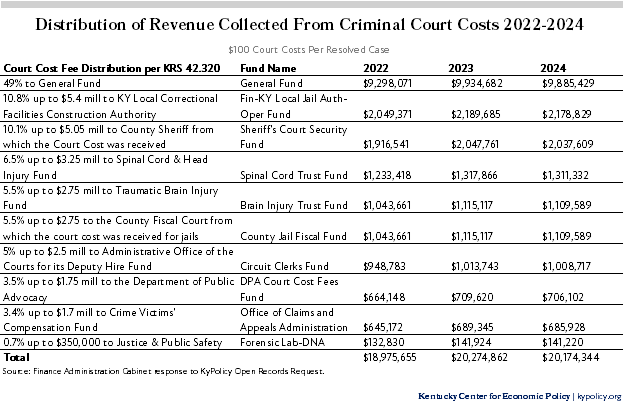
All court cases, including speeding tickets resolved outside of court, carry a minimum fee of $140 in both district and circuit court. The general court fee statutes impose a $100 cost that is divided 10 ways, with only $5 going to direct support of the court and another $3.50 going to support public defense.36 Of the remaining amount, $49 goes to the state General Fund, $10 goes to the county sheriff, with the next largest amounts, totaling $12, going to the completely unrelated spinal cord and head injury trust fund and the traumatic brain injury trust fund. The remaining amounts are distributed to support local jail costs, firearm records checks, and testing and storing DNA samples.37
As shown in the table below, the amount of these general court fees collected that were distributed to the state General Fund in fiscal year 2024 was $9.9 million, which is just 0.05% of the total state General Fund that year.38 The amount distributed to the Department of Public Advocacy in 2024 was $706,102, which is 0.8% of the agency’s total budget.39
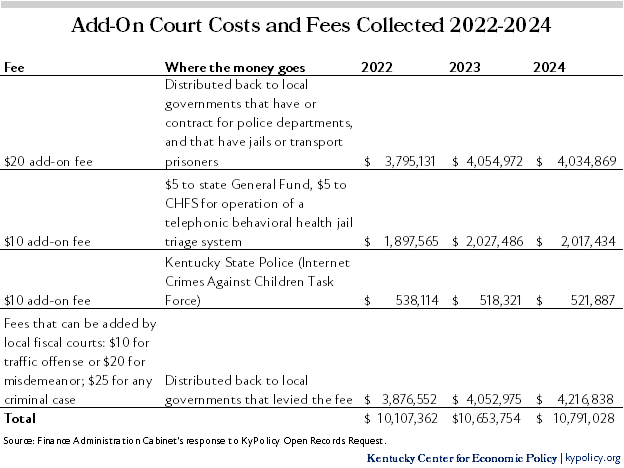
In addition to the general court fees described above, there are several additional add-on fees levied against people convicted of criminal offenses.40 The table below describes those levies, where the proceeds go, and how much was collected over the past few years. Local governments are also permitted to impose additional court costs of $10 for traffic offenses and $20 for misdemeanor offenses in District Court, and an additional fee of $25 for all criminal cases in Circuit Court.41
One glaring example of how criminal legal system fines and fees are directed to entirely unrelated sources is a bill proposed during the 2025 legislative session that passed in the Senate although it did not advance in the House. Senate Bill (SB) 57 would have assessed an additional $200 fee for driving at least 25 miles over the speed limit (a “super speeder”) to raise revenue for four funds newly established in the bill: a trauma care system fund, a rural hospital preservation fund, an emergency medical services education grant program, and a school AED (automated external defibrillator) fund.42 The impetus for such a bill may have been that a General Fund appropriation to support the programs in the bill would be difficult to obtain or unlikely in a non-budget session.
Costly to collect and unpredictable
Imposing, collecting and enforcing criminal fines and fees is very costly. A Brennan Center for Justice analysis of a sample of counties in two states found that, on average, jurisdictions spent more than $0.41 of every $1.00 of revenue raised just on court and jail costs.43 In contrast, the Internal Revenue Service spends just $0.34 for every $100 in taxes collected. Comparing these two numbers, it costs, on average, 121 times more to collect criminal fines and fees than taxes. As stated in the Brennan Center report, “Put concretely and in dollar terms, almost every cent spent on fee and fine collection is wasted as compared to collecting tax revenue.”
Jailing people unable to pay fees and fines was found to be especially expensive, sometimes as much as 115% of the amount collected.44 Kentucky statutes allow individuals to be incarcerated for failure to pay criminal court fines and fees, or for failure to appear in court to address their nonpayment. And during the period of incarceration, they receive a credit against what they owe:
- $50 a day for each day they remain incarcerated; or
- $12.50 per hour up to $100 per day for pay received for work in a community labor program.45
When someone is incarcerated for failure to pay outstanding debt, not only is the government forgoing collection of the assessed costs, it is also counterproductively paying to incarcerate the person (the average cost was calculated to be $47 per-person, per-day in 2024) whose only offense is not paying outstanding debt.46 The only “benefit,” if there is one at all, is that it does offer an opportunity for a person who cannot otherwise pay to get out from under the heavy debt load by spending time in jail; however, it comes at an exceptional cost to that person and their family.
Fines and fees revenue is unpredictable as well. Because fines and fees are rarely imposed based on a person’s ability to pay, huge sums of unpaid court debt that will not ever be collected stay on the books in perpetuity. From just 2012 to 2018, the states of Florida, New Mexico and Texas amassed a total of almost $1.9 billion in uncollected debt.47 In addition, criminal fines and fees debt never goes away, as Kentucky is one of 17 states with no limitation on the length of time criminal fines and fees may be collected.48 In contrast, there are no states with an unlimited statute of limitations for when civil debt may be collected, and the statute of limitations for collection on a civil judgment in Kentucky is 10 years.49 A Vera Institute of Justice report found that lengthier or unlimited criminal debt statutes of limitations are not strongly associated with higher criminal debt revenue amounts.50 Kentucky had the lowest amount of local revenue collected per-capita among the 31 states in Vera’s analysis.
Astonishing lack of data
FFJC attempted to determine the total amount of outstanding court debt in the U.S. and found that “the full extent of our nation’s problem with court debt is shockingly untraceable and unknown.”51 Even though all courts keep a record of every case that should specify the amount of fines and fees imposed at conviction, FFJC found that courts rarely track the amount of fines and fees they impose that are actually collected, and that they often lack the technology to do so. As stated in their report: “Uncollectible debt places an extreme financial burden on those who cannot afford to pay it. Considering the weight of this burden alongside the resources that courts, justice system stakeholders, and other government actors expend to collect these debts — you would expect states to be closely monitoring how much they are owed in fines and fees.”52
Our inability to obtain AOC data illustrates the lack of tracking and reporting of fines and fees data in Kentucky.
We had the opportunity to observe a special show cause docket created by a Kentucky judge in Jefferson County specifically for the purpose of hearing cases in which people failed to pay outstanding fines and fees. During the court session, many people were either making partial payments on their outstanding debt or asking for more time to do so. In one case, a person appeared in court for the 16th time, owing $644 and was still unable to pay. In another case, the person had been out of work almost a year, and as a result, the judge waived her remaining balance after she paid $100 that day.53 To understand what proportion of cases had fines and fees waived, we requested data from AOC but they have not been able to fulfill the data request, in part because of technological barriers, which we discuss in more detail in a later section of the report.
According to Jefferson County data from 2022, there were 8,576 district court cases with an active bench warrant for unpaid fines/fees for a conviction more than five years old.54 Prior to October 2016, the Jefferson County monies owed were recorded manually and these cases were only entered into their accounts receivable system if and when warrants were served. For the 869 of these cases that have the amount due entered into accounts receivable, the total amount due was $189,447. The average amount owed was $218 per case.
We requested from AOC the number of active criminal court cases statewide (both district and circuit) where there is an outstanding bench warrant for owed fines or fees. We were told by Court Services, the AOC division that maintains the records for court fees, that although efforts had been made to collect the information requested that confidence in the overall accuracy of this data is low and that further investigation into the reliability and accuracy of this data would be required by AOC.55
Without this information it is not possible to assess critical issues such as the extent to which government resources go toward trying to collect debt from people will never be able to pay. In addition, states that lack this data are unable to formulate policies to reduce harms for people trapped in the debt cycle. They also do not have reliable data about who owes the debt and is being impacted by current policies, which is vital to assessing policy solutions.56
First-of-its-kind Kentucky statute review found more than 1,000 provisions that impose criminal legal system fines and fees
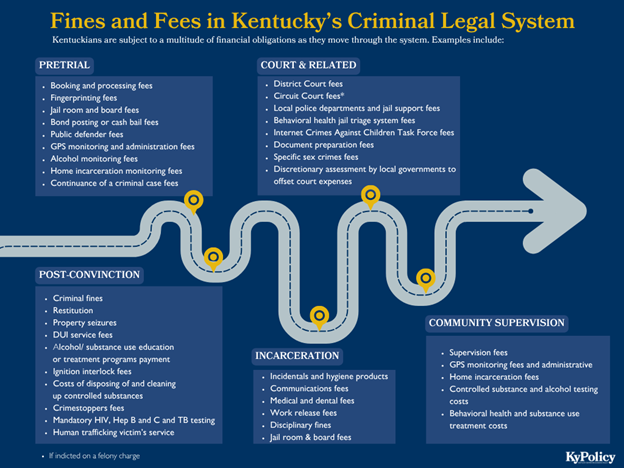
To better understand the vast web of fines and fees in Kentucky, we conducted a first-of-its-kind statute review that revealed there are more than 1,000 provisions in Kentucky state law that impose criminal legal system fines and fees.57
We reviewed the entirety of the Kentucky Revised Statutes (KRS) to identify all criminal fines that have incarceration as a possible punishment with the exception of traffic offenses such as speeding. For traffic offenses we included fine-only punishments because so many people are impacted by traffic fines and their associated court costs. If we had included provisions that imposed only a criminal fine as punishment, our list would have included thousands more entries. We also did not include local fines and fees authorized by state statute or imposed by local government ordinance.58 See Appendix A for more information about our methodology.
Other financial obligations that may be assessed against someone involved in the criminal legal system that we do not address in detail in this paper include restitution, which is compensation to a victim for harm or damage done, and forfeiture, which involves the loss of goods or property related to the commission of a crime or the loss of a right to have a license or certification. In addition, some fees that begin as related to criminal activity such as room and board fees imposed by local jails can be collected through a civil action, subjecting the person who owes the fees to wage garnishment, civil penalties, interest and the cost of an attorney to defend them. The full list of more than 1,000 provisions is detailed in the linked spreadsheet, which provides the statutory citation and key descriptive information such as whether the levy is a fine, fee or cost; the part of the system where it is imposed; the amount of the fine/fee/cost; and where the proceeds go if other than the General Fund.
More than 950 of the provisions identified in the spreadsheet are fines, because most chapters of the statutes, regardless of the topic they address, include some sort of criminal fine for violating them. Fees in contrast are imposed only at specific points within the system; court fees are the most common although additional fees are imposed at every level as people move deeper into the system, including for supervision, drug and alcohol testing, GPS monitoring, room and board for people who are incarcerated, and medical services, to name a few. For the vast majority of fines and fees we identified, the revenue is directed to the state General Fund.
Fines
Kentucky has a set of laws that generally define crimes and their punishments, referred to as “the Penal Code.” The Penal Code’s 35 separate KRS chapters identify actions that most people think of as crimes such as murder, robbery, rape, bribery, perjury, fraud, arson and other similar acts, and sets forth the possible punishment for committing those crimes, including fines and possible incarceration.59 There is one set of provisions that applies to all Penal Code offenses that establishes ranges for fines and length of incarceration depending on the classification of the offense:60
- For felonies, the fine is mandatory, unless a person is determined to be indigent by the court, and the amount shall not be less than $1,000 nor more than $10,000 or twice the amount of money the person obtained from committing the crime, whichever is greater. If a person is convicted of more than one felony for a single act the aggregate fine shall be the greater of $10,000 or twice the amount of money the person obtained from committing the crime.61
- For misdemeanors and violations, the imposition of fines is not mandatory but can be levied instead of or in addition to incarceration unless a person is determined to be indigent by the court. Fine amounts differ, depending on the classification of the offense:
- Class A misdemeanor – $500;
- Class B misdemeanor – $250;
- Violation – $250.62
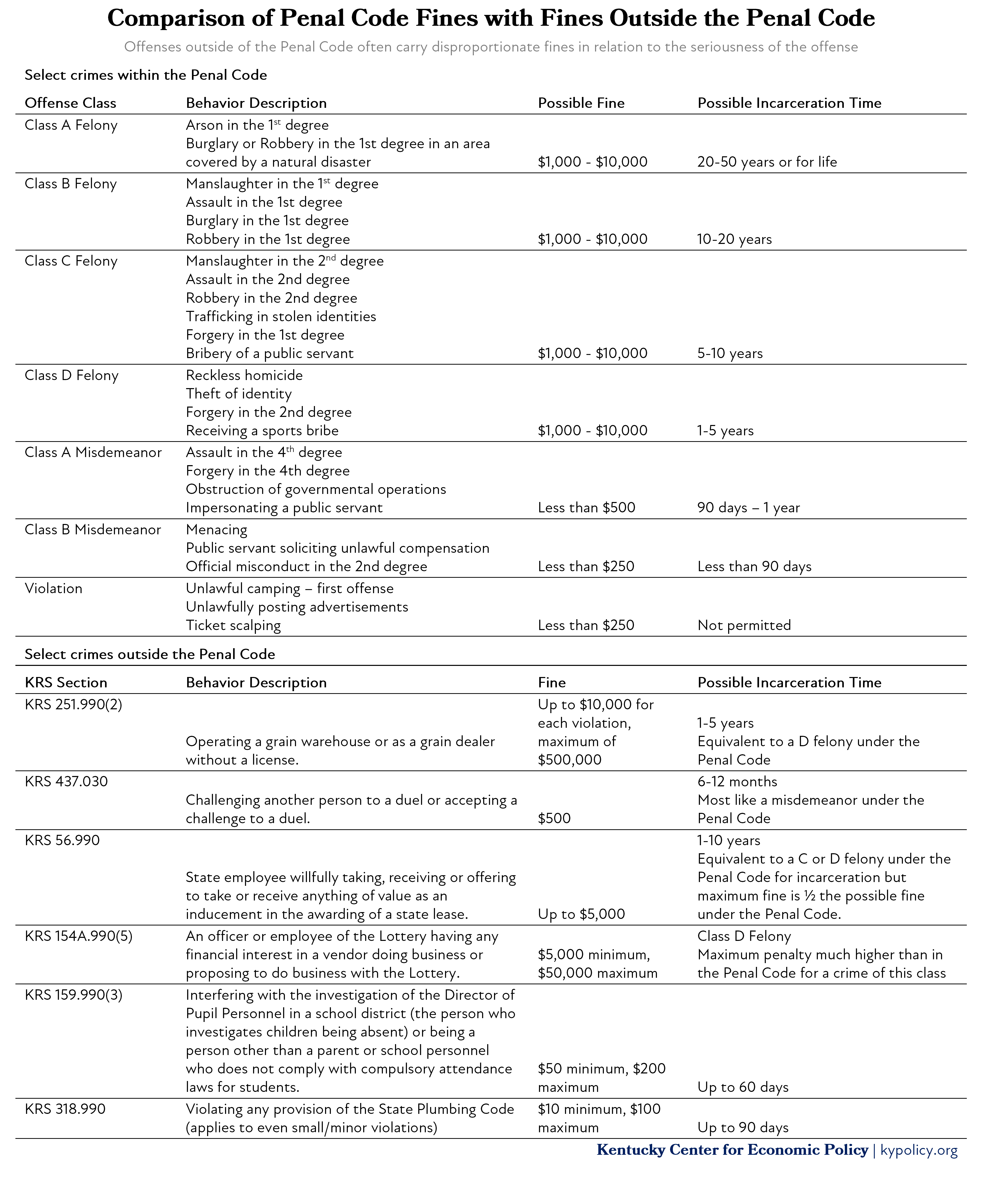
In addition to the crimes established by Kentucky’s Penal Code, our statute review identified hundreds of provisions in other chapters of the KRS that also impose criminal fines for specific activities. These provisions are not uniform and do not follow a coherent structure like that provided in the Penal Code, which seeks to match the possible punishment to the severity of the crime. For crimes outside the Penal Code, there is no such consistency. For many offenses, there appears to be little-to-no connection between the severity of the offense and the punishment — including the imposition of fines — especially when compared to similar crimes established by the Penal Code. For example, a person operating a grain warehouse or elevator without a license can be fined up to $10,000 for each occurrence with a maximum fine of $500,000 and can be incarcerated for 1-5 years. That fine is much larger than any established by the Penal Code, and the potential incarceration for the crime is comparable to a Class D felony, which includes offenses such as reckless homicide. See Appendix B for additional examples of fines for offenses in the Penal Code compared to fines for offenses outside of the Penal Code.
The Penal Code includes language that helps interpret how provisions relating to fines established by the Penal Code interact with criminal provisions outside of it. In this regard, KRS 532.005 provides that the fines established in the Penal Code apply to all crimes committed outside the provisions of the Penal Code for which a fine is not imposed. However, if a statute outside of the Penal Code establishes a fine that differs from the Penal Code fine, that fine would prevail.63
In reviewing the list of criminal fines, it seems unlikely that very many people are actually charged with or convicted of most of the crimes established outside of the Penal Code and a few other selected chapters. The crimes in the criminal law manual used for training law enforcement officers in Kentucky include those established by the Penal Code as well as traffic violations, drug-related offenses and a few select other provisions outside of the Penal Code. The manual excludes most of the provisions we’ve identified in our spreadsheet.64
Fees
Of the more than 1,000 criminal legal financial obligations we identified in state law, there are 56 provisions that impose fees, further extending the web in which someone in Kentucky can become entrapped. These fees primarily relate to court costs, community supervision (i.e., probation and parole) and incarceration fees.
Court costs
As described previously, when a case is resolved in court, either by a guilty plea or a trial by judge or jury, there are fees commonly referred to as “court costs” or “court fees” imposed. The minimum cost for anyone who has a case resolved is $140, which includes speeding tickets paid outside of court, and this minimum applies even if the fine a person ends up paying is only $25. These costs are assessed in addition to any fine or other costs imposed by statute that someone must pay. In fiscal year 2024 in Kentucky, there were 304,358 closed cases in criminal district court alone (176,819 traffic, 77,311 misdemeanor and 50,228 felony cases). There were 36,368 criminal cases closed in circuit court in fiscal year 2024.65
Community supervision fees
There are approximately 62,000 Kentuckians under some sort of community supervision like probation or parole.66 While community supervision can be viewed as a positive alternative to incarceration, it also carries many costs, and failure to pay those costs can result in revocation — being sent back to jail or prison for people on parole, or incarceration for people who were not incarcerated initially to serve the remainder of their sentence behind bars. In addition, individuals are typically required to remain on parole until they pay restitution and all accrued debt from fines and fees such as court costs, fines attached to their charges and jail fees.
Every person on community supervision is charged a monthly “supervision fee,” an amount typically set at $25 for state-supervised probation through the DOC Division of Probation and Parole.67 This cost is established by the sentencing judge and the money collected goes “to offset the costs” of community supervision.68
In addition to the monthly supervision fee, there may also be other mandatory fees depending on the terms of supervision.69 For example, some people are ordered to submit to random drug tests for which they must pay. Others may be required to attend mandatory classes such as anger management or parenting courses, which have enrollment and/or per-class attendance costs. There are also people on supervision who, once released from jail or prison, must first serve a certain amount of time on electronic monitoring, wearing a GPS ankle monitor. This practice, also known as “home incarceration,” requires people to cover the cost of hooking the device up and daily fees to maintain the monitoring.70
Kentucky is one of at least a dozen states to utilize private probation companies for pretrial and probation supervision and electronic monitoring devices, with little oversight or regulation.71 These for-profit entities are known to charge a wider range of fees, and much higher amounts than state-supervised probation.72 From 2007 to 2020, Kentucky counties — excluding Fayette and Jefferson — collected at least $8.2 million in revenue from home incarceration fees.73
Paying all these different fees can be challenging, especially when a person on supervision is also ordered to attend full-time, residential treatment for substance use disorder and/or mental health issues. One Kentuckian interviewed by Vera researchers shared that he still owed $500 from when he was ordered to pay $140 per month in supervision fees on top of other fines and court costs after leaving jail and before entering residential treatment, where he worked within the facility only making $100 per-month.74
Incarceration Fees
There are also KRS provisions that impose fees on people in state prisons and county jails. Currently, more than 30,000 Kentuckians are incarcerated in the state’s prisons and county jails and subject to onerous fees related to commissary accounts, communication services, health care and numerous other assessed charges.75 Jails are also permitted to charge incarcerated people for room and board, and there are five different statutes that either require or allow these levies.76
Entanglement in the web of fines and fees in Kentucky can leave anyone with hefty criminal legal system bills regardless of their ability to pay. For instance, consider the following scenario:
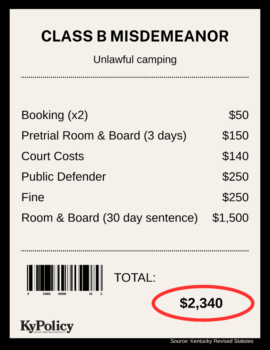
Someone experiencing homelessness in Kentucky and found sleeping in an outdoor public space is charged with “unlawful camping,” a Class B misdemeanor, after being caught doing so more than once. Accepting a plea deal enables them to avoid jail time but requires they pay court costs of $140 and a fine of $250. But when the deadline for payment comes, they don’t have the money and still don’t have a place to live. The judge schedules a hearing for the person to show cause for failing to pay, but they are unable to make it to court and a warrant is issued for their arrest. When an officer finds them sleeping in a park the following week and runs their name through the system, the outstanding warrant shows up on their record. The person is taken to jail, resulting in another booking fee and three days of incarceration before seeing a judge, and they receive a 30-day sentence.
The “receipt” below provides an example of the fines and fees that could follow this unhoused person’s arrests and conviction, totaling over $2,300.77
Data collected from Kentucky’s jails and prisons provides foundational insight into burdensome incarceration fees
Alongside the lack of a central catalog of fines prescribed in state statutes, our review also identified the absence of a centralized source tracking the imposition and collection of incarceration-related fees. To capture a snapshot-in-time of these fees across the commonwealth, in 2024 we submitted open records requests to the DOC and Finance and Administration Cabinet (FAC) asking for information related to fees imposed on those incarcerated in Kentucky state prisons. Additionally, we submitted open records requests to each of Kentucky’s 74 full-service jails asking for information regarding fees imposed on those incarcerated in their facilities, to which 57 provided response.78 Those responses can be seen in this linked spreadsheet.
The data we collected illustrates how incredibly burdensome these fees are for Kentuckians behind bars and their loved ones.
Whether someone is sent to a state prison or county jail to serve their sentence is determined by the type of criminal conviction and the anticipated length of the sentence. The 14 state-run prisons are centrally operated by the DOC; therefore, their fee structure is more uniform among facilities. The county jails, although regulated by DOC, establish their own fee structures and the types of fees they levied; these amounts vary significantly across facilities. Many fee-based services within jails and prisons are provided by contracted outside entities. Often, those contracts include payments back to the jail or DOC. Fees that prisons and jails have in common include those for medical services, communications, commissary accounts and fees related to paid work. Beyond these fees, jails are permitted to levy a host of additional fees.
Fees imposed by local jails
Fees jails can impose that prisons do not include room and board, booking fees, bond fees, and a range of other miscellaneous fees for the purpose of reimbursing the county “for expenses incurred by…the prisoner’s confinement.”79
Booking and admission fees
Upon admission to jail, most people are charged a booking or processing fee. There is no upper limit on the amount of this fee, so they vary widely.80 Other admission fees automatically charged upon entry by some jails include administrative fees or fees for a kit of essential toiletries like a toothbrush, deodorant, a drinking glass, a comb and other necessities. The following are examples of fees reported by jails as imposed when someone is arrested and brought to jail:
- Clark County: $45 booking + $5 hygiene81
- Madison County: $50 booking
- Boyle County: $25 booking + $8 admission kit82
- McCracken County: $20 booking
- Hopkins County: $70 booking
The median reported booking fee was $35 and the highest was Big Sandy Regional Detention Center’s fee of $130. When reporting booking fee amounts, some jails also noted their separate bond fees, but those are only charged when someone posts bail at the jail.
Room and board fees
A person who is incarcerated following an arrest will be held in a county jail, and anyone incarcerated in a county jail that is not the responsibility of DOC “shall be required beginning from the prisoner’s booking date to reimburse the county for expenses incurred by reason of the prisoner’s confinement…except for good cause shown.”83 The statute allows but does not require consideration of a person’s ability to pay in assessing these fees. The median daily fee jails reported charging was $20, and 16 facilities reported not charging any daily housing fees to those under their county’s custody.84
Miscellaneous fees
While the categories of fees described above are common across jail facilities, some reported charging other unique fees, too. Carroll County Detention Center reported charging a $10 fingerprint fee upon booking in addition to their $80 booking fee and $5 bond fee. Breckenridge County Detention Center listed a $10 monthly weight check-in, although the response did not specify if the check-in was required. Madison County Detention Center noted that they offer haircuts every other week for a $10 fee. Some individuals pay for required drug screenings while incarcerated, which facilities that responded reported as costing up to $65 per screening. Some facilities also charge fees when someone is tazed or pepper sprayed at up to $25 per incident. These are only some examples of miscellaneous fees that further expand the breadth and depth of incarceration costs.
There are more than 19,500 people who are currently incarcerated in Kentucky jails and subject to these fees. Researchers from Vera found that from 2007 to 2020, Kentucky counties — not including the two largest counties, Fayette and Jefferson — collected at least $53.5 million in revenue from jail “boarding” fees, $13.7 million from work release fees, and $8.2 million from jailers’ bond acceptance fees.85 Some of this information was reported annually by local jails to the Department for Local Government (DLG) and posted on their website between 2014 and 2022 but DLG does not plan to publish additional updates.86

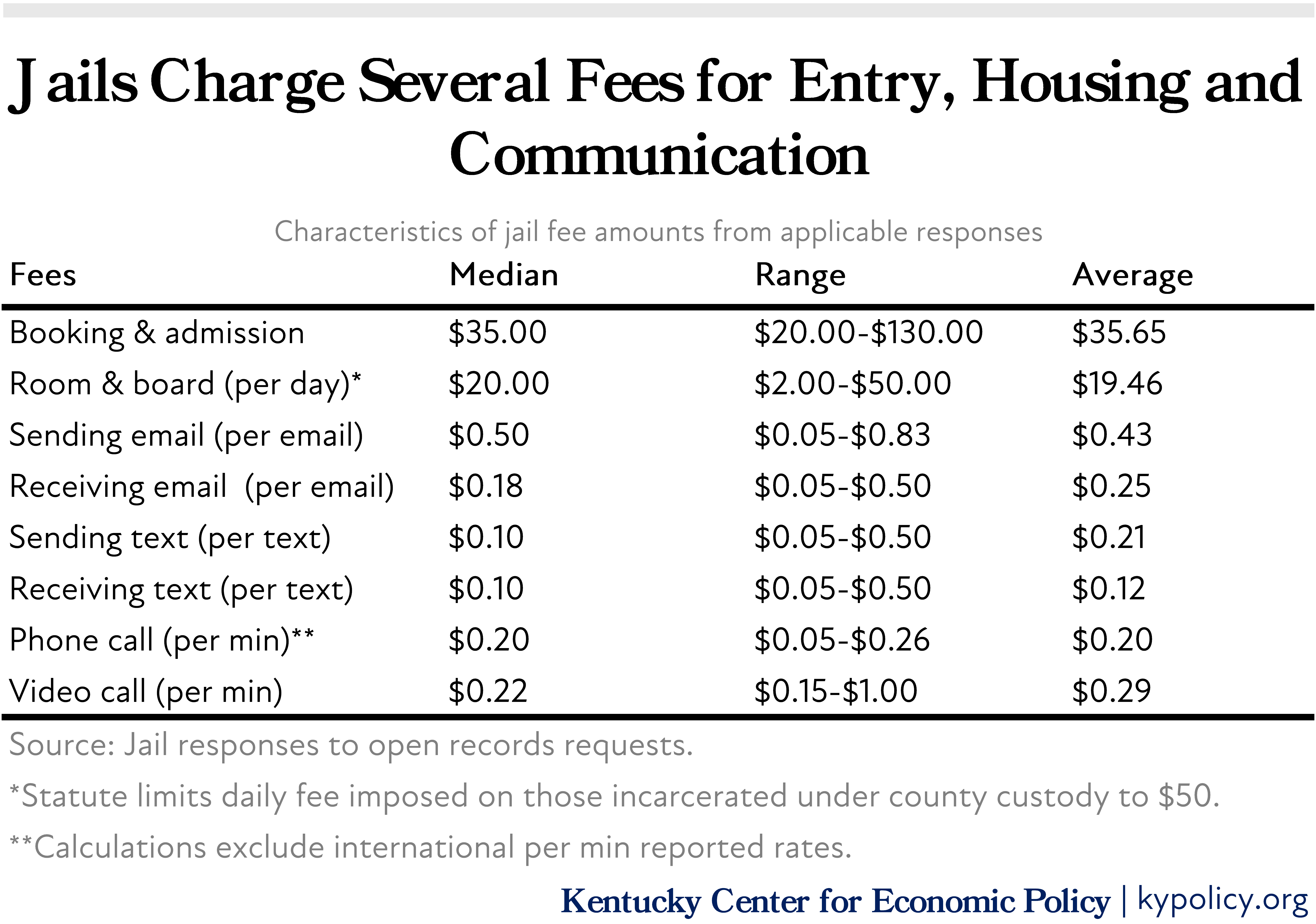
The table below provides more general information about the types of fees and general amounts imposed by jails based on responses received.
Fees imposed by both jails and prisons
Fees that both jails and prisons can impose include communications fees, medical, dental and psychological care fees, and fees associated with paid work.
Communications
Mounting research reiterates the importance of staying connected to loved ones while incarcerated, as continuous communication and maintenance of external relationships is shown to reduce recidivism rates and benefit the emotional wellness of both those incarcerated and their communities back home.87 However, keeping in touch comes at a steep cost to those held in prison or jail and the folks trying to reach them.
Communication options and fees for using the various forms of communication are uniform in prisons but differ across jails. Communications options may include physical mail, emailing, texting, phone calls, video calls, on-site visits or “chirping.” “Chirping” is an alternative to texting in which individuals can “rent” devices that allow minimal messaging features at rates charged to the person’s account, such as a monthly rental fee of $4 in addition to fees associated with each chirp. Other methods of communication also come with a price tag, but those costs vary. For instance, sending or receiving is reported to cost up to $0.83 each at some jails and $0.44 per message or page in prisons for e-messaging. Texts may cost up to $0.88 each. Phone calls may range anywhere from $0.05 to $0.75 per minute in jails and $0.10 to $0.25 per minute in prisons, and video calls may be even more expensive, ranging from $0.20 to $1.00 per minute in jails and $5 for 25 minutes in prisons. In-person visits are available in prisons, but not in many jails, and are very limited in the facilities that do offer this option.88 Thus, various forms of telephone and electronic communications with fees attached are in most cases the only means by which people incarcerated in jails can communicate with their loved ones.
Not only do the services themselves come at costly per-minute rates, but there is also often additional transaction fees required when funds are deposited into an incarcerated person’s account or when accepting collect calls from an incarcerated person.
Medical, dental and psychological care fees
Some medical, dental, and mental health care services provided in jails and prisons also have associated fees. Incarcerated individuals may be charged facility-set co-pays for services like sick/nurse calls, visits with doctors or specialists, eye exams, drug testing, ER visits and other health services. Prisons and jails may both impose fees against incarcerated people who can afford to pay, and the amounts due can be deducted from the person’s account provided that a person cannot be denied care because they have insufficient funds in their account.89
Prisons currently charge a flat fee of $3 for each non-emergency sick call. People incarcerated in prisons are not charged for formulary medications and pay $3 for each non-formulary medication. Medical devices and accessories such as prosthetics, hearing aids and eyeglasses have co-pays of $10, $5 and $5, respectively.90 Reported fees for similar services in jails vary significantly. For example, basic sick calls or nurse visits may cost $6, $50 or the full cost (whatever the care provider bills the facility), depending on the jail. A doctor’s visit could range from $5, $75 or the full cost billed to the facility. Necessary tests such as EKGs, ultrasounds and x-rays might cost an individual incarcerated in one county $0 while an individual incarcerated in another county would be charged $150 for the same test.91 The same lack of consistency across facilities exists for mental health services.
Personal accounts, deposit fees and deductions
Incarcerated people are permitted to have personal accounts referred to as commissary or “inmate accounts” in which amounts they earn through working and contributions made by loved ones are deposited. Amounts in the account can be used for expenses such as phone calls, emails, messaging, purchasing hygiene items not provided by the jail or prison, and other items from the commissary store. These accounts are one of the most opaque ways that jails and prisons extract payment for amounts owed by incarcerated people.
Friends and family members can deposit money in an individual’s account either electronically, over the phone or, in some cases, in person.92 Some jails contract with an outside company to run their commissary systems, and those companies charge a “deposit fee” on top of the actual amount that will be deposited into the account. For the jails that responded to our records request, deposit fees averaged $3.49 per transaction. However, depending on the method of deposit, some private companies charge much more, up to $13.95 or 5% of the total deposit. For prisons, which use an outside contractor to run the commissary accounts, deposit fees range from $1.00 to $6.95 depending on the type of transaction (either in cash, over the phone, online or at a lobby kiosk) and the amount of deposit.
The amount a person can have in a commissary account is limited by some jails. Accounts for those in prison are limited to $1,000 on an individual’s general account and $100 on an individual’s media-specific account.93
By statute, jails are permitted to deduct amounts owed to the jail for various fees imposed from a person’s account and can even create a negative balance in the account that will be offset by later deposits. Amounts that can be deducted include up to 100% of an initial deposit and up to 50% of any subsequent deposits.94 Likewise, people incarcerated in prison may have money from their personal accounts used to pay outstanding debts which shall not exceed 50% if the amount received is $100 or less. If the amount received is greater than $100, any amount over $100 shall be used to pay outstanding debt, and up to 50% of the remaining $100 may also be used to pay outstanding debt. This policy can vary from prison to prison as the warden can establish specific parameters.95 In addition to the deduction of over 50% of each deposit into an incarcerated person’s account, commissary items are typically priced at levels far exceeding costs of the same items sold in stores, making it even more difficult for incarcerated people to purchase what they need. For example, a hairbrush that would cost $1.25 on Amazon is priced in a prison commissary at $8.25, and a basic white Playtex bra, priced at $8.60 on Amazon, sells for $42.85 in the same commissary store. Using the hairbrush as an example, a family member would need to deposit $17 and pay a fee of $3.49 for a total of $20.49 so that their incarcerated loved one could buy a hairbrush that anyone else could buy on Amazon for $1.25.

Low wages for paid work and fees associated with work
Incarcerated people in jails who meet eligibility requirements may participate in a work program either within or outside the facility for very low wages, and the availability of work programs vary widely from jail to jail. Some people who are incarcerated in jails work in the facility, while others provide labor for local governments doing maintenance, picking up litter and performing other functions that save those governments significant amounts of money. People who participate in work release programs must pay a work release fee to the jail.96 Pay for these jobs can be as little as $0.32 per-day, although a few jails offer programs that place incarcerated people with local private employers where they can earn wages comparable to those earned by other employees. All amounts earned by incarcerated people are deposited in their accounts and can be taken to offset outstanding expenses.
State prisons offer more options for work within the facilities, with pay ranging from $1.07 to $2.93 for each day of work for people who do not receive sentence credits for their work. People who receive sentence credits receive half of the daily pay.97
In addition, there are work service programs for people in prisons through which certain government agencies and select private companies contract with the DOC so that incarcerated people can provide supplemental labor. Participating agencies are responsible for the costs of supervision, transportation, meals, and labor costs associated with the program such as the $2.93 per-day pay for each incarcerated person assigned to the job. Additionally, non-local governmental agencies pay the DOC a per diem fee of $3.95 for each participant.98 As is the case with jails, the meager amount earned by incarcerated people who work is deposited in their account and can be taken by the DOC to offset outstanding fees.
Collection of fees post-incarceration
As previously described, while a person is incarcerated, any money added to their account is subject to automatic deductions to cover accumulated debts. When a person is released from jail, any unpaid debt follows them and can be collected by the jail. Jails reported a variety of methods used to collect the debt; some contract with private debt collectors, others use jail staff to pursue debt collection through phone call or mail reminders, while others rely on recidivism to collect debts from previous incarcerations. A civil suit can be filed within 12 months after a person leaves incarceration to collect any outstanding debts.99 The DOC does not pursue debts following a person’s release, largely relying on deductions from deposits made on the person’s account during incarceration.
Policy Recommendations
It is important for Kentucky to require the collection and reporting of data necessary to better understand the imposition and impact of fines and fees. While this data will provide important insights into needed reforms, there are several additional policy changes described below that have been successful in other states, which the General Assembly can immediately pursue to mitigate harms to Kentucky communities.
Require fines and fees data collection, reporting and transparency
Not only does Kentucky lack a centralized, comprehensive source of criminal legal system fines and fees data, but there is very little publicly available data on the subject at all. And AOC, the one government entity that already collects a range of detailed relevant data and has the needed level of technological infrastructure to provide it, has been unable to do so.
To understand the imposition and impact of criminal legal system fines and fees, and to craft appropriate policies in response, we need to be able to understand how frequently various provisions are imposed, how much is collected, how much remains uncollected, and how long balances remain outstanding. Bills were filed on this topic in 2024 and 2025, which started an important conversation about the need for legislation in Kentucky that establishes fines and fees data collection, reporting and transparency.100
Because fines and fees are imposed by multiple entities at the state and local levels, and can stack on top of each other, it is important for the state to collect and publicly report data from, at a minimum, AOC, DOC, local jails and county governments — and to connect that data across jurisdictions. It will take the investment of financial resources and time for this to occur. Kentucky should also learn lessons from states that already have these systems in place or have enacted similar legislation like Alabama’s Senate Bill 203 (2022), which has not yet yielded hoped-for results in large part due to the technological infrastructure needed for government entities to track and report the information.101
Idaho provides an example of what is ultimately possible. The state tracks and reports a wealth of court data that is made publicly available on the judicial branch’s website, including for fines and fees. The Idaho Court Financial Data Dashboard includes detailed data over time on amounts assessed and collected, waived and suspended, bond forfeitures, revenue distributions, payment plans, delinquent debt and collections through tax refund intercept.102
Establish a uniform ability-to–pay determination
The state should prioritize establishing a uniform ability-to-pay determination that must be used at every juncture where a person could be charged with a fine, fee or cost. As currently written, Kentucky’s statutes provide for a waiver of most fines and fees for people who are indigent, but in most cases a determination is not required, nor is it revisited as people move through the system and are levied additional fees. Requiring uniform and consistent determinations of ability to pay and the completion of a specific and uniform questionnaire would go a long way toward addressing the harms experienced by many people who lack the resources to pay and are forced to move deeper into the system because of their indigence. Twelve states, including Indiana and Texas, already require their courts to hold an ability to pay hearing before they impose legal financial obligations.103
In 2023, Oklahoma made similar amendments to its state law by adding ability to pay factors, and creating a presumption that anyone receiving disability benefits, subsidized housing, or support from programs like the Temporary Assistance for Needy Families (TANF), the Supplemental Nutrition Assistance Program (SNAP), or Women, Infants, and Children nutrition education and supplemental food program (WIC) is eligible for a full or partial waiver of costs.104
Eliminate the use of jail time for unpaid court debt
Jailing Kentuckians for unpaid court debt is harmful and counterproductive.105 Research shows that even one day of incarceration can have lasting, negative effects on someone’s life.106 One study found that spending longer than 23 hours in jail after arrest significantly increases the likelihood of rearrest.107 Another found that almost half of interview respondents who spent time in jail reported suffering a “material loss” from detention, such as legal debt, missed work, and lost jobs or property.108
Additionally, jailing someone who does not have the means to pay owed debt for not paying it actually costs the government more money. As noted previously, the average calculated cost to incarcerate one person for one day in a county jail in Kentucky was $47 in 2024. This estimate doesn’t even include added expenses such as serving a bench warrant (a legal mechanism courts can use to secure the arrest of someone who has allegedly violated a court order), law enforcement costs for arrest and transportation, costs associated with putting the person’s case back on the docket, and ultimately, any cost to the arrestee who may lose their job while incarcerated, have their vehicle towed, or experience other collateral consequences.
The General Assembly can solve this problem by passing legislation that prevents incarceration as a punishment when the only issue in the case is failure to pay. Judges would still retain their inherent contempt power, but ideally it would be unlawful to jail someone for failure to pay alone. This change could even increase the general public’s willingness to appear in court on owed debt cases since the fear of being incarcerated for the debt would be eliminated.
Shift away from dependence on jail fees to offset counties’ incarceration costs
Absent full elimination of onerous jail fees, there should be a measured shift away from them as a revenue source to help offset the steep costs of incarceration. In 2019 the average county collected only 5% of jail revenue from fees, but this amount represented $24 million extracted from some of the state’s poorest Kentuckians.109 Supplanting this revenue is admittedly a tall order given the fiscal stress many counties have been experiencing. However, some cost reduction could be accomplished by eliminating the use of jailtime for unpaid court debt, as discussed above, and through policy changes that reduce pretrial incarceration.110
Enact a statute of limitations for the collection of criminal legal system fines and fees
Kentucky should join the majority of other states and establish a statute of limitations for the collection of criminal legal system fines and fees debt. A statute of limitations that is at least comparable to what it is for civil debt (10 years) would be a major improvement over unpaid fines and fees never going away, no matter how much time passes.
Implement a grace period for those leaving incarceration
Nearly 15,000 Kentuckians returned home after serving a felony sentence in jail or in 2023, and still more left jail after shorter stays for less serious offenses.111 Given the prevalence of fines and fees, most of these individuals
will be impacted by system-related debt. There is currently no law in Kentucky that allows someone returning home a grace period before having to start making payments on that debt, unlike the 180-day grace period in Alabama and the 120-day grace period in Arkansas.112
A grace period of at least four months would enable Kentuckians leaving incarceration time to secure employment, housing and other supports that will ultimately help them pay what they owe and rebuild their lives. While some judges allow a grace period upon the request of an attorney at sentencing, if the General Assembly passed legislation that required it, the practice would become standardized and would benefit thousands of Kentuckians.
Appendices:
B. Table comparing fines in the Penal Code with fines for offenses outside of the Penal Code

- Briana Hammons, “Tip of the Iceberg: How Much Criminal Justice Debt Does the U.S. Really Have?,” Fines and Fees Justice Center, April 2021, https://finesandfeesjusticecenter.org/content/uploads/2021/04/Tip-of-the-Iceberg_Criminal_Justice_Debt_BH1.pdf.
- Matthew Menedez, Lauren Brooke-Eisen, Noah Atchison and Michael Crowley, ”The Steep Costs of Criminal Justice Fees and Fines, “The Brennan Center for Justice, Nov. 21, 2019, https://www.center.org/our-work/research-reports/steep-costs-criminal-justice-fees-and-fines.
- KRS 534.040, https://apps.legislature.ky.gov/law/statutes/statute.aspx?id=20098. KRS 534.030, https://apps.legislature.ky.gov/law/statutes/statute.aspx?id=20097.
- Menedez, Brooke-Eisen, Atchison and Crowley, “The Steep Costs of Criminal Justice Fees and Fines.”
- Fines and Fees Justice Center and Wilson Center for Science and Justice at Duke Law, “Debt Sentence: How Fines and Fees Hurt Working Families,” May 2023, https://finesandfeesjusticecenter.org/content/uploads/2023/05/Debt_Sentence_FFJC-Wilson-Center-May-2023.pdf.
- Hammons, “Tip of the Iceberg.”
- Menedez, Brooke-Eisen, Atchison and Crowley, “The Steep Costs of Criminal Justice Fees and Fines.”
- The Federal Reserve, “Report on the Economic Well-Being of U.S. Households,” May 28, 2025, https://www.federalreserve.gov/consumerscommunities/sheddataviz/unexpectedexpenses-table.html.
- Fines and Fees Justice Center and Duke Law, “Debt Sentence.”
- Steve Mello, “Fines and Financial Wellbeing,” Review of Economic Studies, 2024, https://mello.github.io/files/fines_prepublication.pdf.
- Devah Pager, Rebecca Goldstein, Helen Ho and Bruce Western, “Criminalizing Poverty: The Consequences of Court Fees in a Randomized Experiment,” American Sociological Review, 2022, https://justicelab.columbia.edu/sites/justicelab.columbia.edu/files/content/Criminalizing%20Poverty.pdf.
- Johann D. Gaebler, Phoebe Barghouty, Sarah Vicol, Cheryl Phillips and Sharad Goel, “Forgotten But Not Gone: A Multi-State Analysis of Modern-Day Debt Imprisonment,” PLoS ONE, Sept. 13, 2023, https://doi.org/10.1371/journal.pone.0290397.
- Gaebler et al., “Forgotten But Not Gone.”
- Karin D. Martin, Sandra Susan Smith and Wendy Still, “Shackled to Debt: Criminal Justice Financial Obligations and the Barriers to Re-entry They Create,” Malcolm Weiner Center for Social Policy, Harvard University, Jan. 13, 2017, https://www.hks.harvard.edu/centers/wiener/programs/criminaljustice/research-publications/executive-sessions/executive-session-on-community-corrections/publications/shackled-to-debt.
- Caroline Cohn, Margaret Love, Ariel Nelson, Andrew Pizor, David Schlussel and Abby Shafroth, “The High Cost of a Fresh Start: A State-by-State Analysis of Court Debt as a Bar to Record Clearing,” National Consumer Law Center,” Feb. 1, 2022, https://www.nclc.org/resources/the-high-cost-of-a-fresh-start-a-state-by-state-analysis-of-court-debt-as-a-bar-to-record-clear/.
- KRS 431.073, https://apps.legislature.ky.gov/law/statutes/statute.aspx?id=53904. While court debt is not specifically mentioned in Kentucky’s expungement statute, the court may consider the person’s “behavior since the conviction or convictions, as evidenced that he or she has been active in rehabilitative activities in prison and is living a law-abiding life since release.”
- Associated Press, “Kentucky Supreme Court Orders Expungement Fees Waived,” Dec. 16, 2021, https://apnews.com/article/kentucky-statutes-louisville-kentucky-supreme-court-710578cd2eabf7cb37b3eaf5f5d7dae8.
- Alabama Appleseed, “Under Pressure: How Fines and Fees Hurt People, Undermine Public Safety, and Drive Alabama’s Racial Wealth Divide,” October 2018, https://alabamaappleseed.org/underpressure/. Fines and Fees Justice Center, “Interim Survey Results: The Impact of New Mexico’s Fines and Fees,” January 2023, https://finesandfeesjusticecenter.org/content/uploads/2023/01/New-Mexico-Survey-DIGITAL_2023.pdf.
- Cortney Sanders and Michael Leachman, “Step One to an Antiracist State Revenue Policy: Eliminate Criminal Justice Fees and Reform Fines,” Center on Budget and Policy Priorities, Sept. 17, 2021, https://www.cbpp.org/research/state-budget-and-tax/step-one-to-an-antiracist-state-revenue-policy-eliminate-criminal.
- Sanders and Leachman, “Step One to an Antiracist State Revenue Policy.”
- Sanders and Leachman, “Step One to an Antiracist State Revenue Policy.”
- Hammons, “Tip of the Iceberg.” This balance includes seven different fines, 27 different fees, and debt owed to funds, county attorneys, police departments, detention centers, Sheriff’s departments, and other imposed costs. However, the reported figure may underestimate the total amount of court debt owed for felony, misdemeanor, traffic and municipal code violation cases. The Administrative Office of the Courts’ Accounts Receivable system used to track outstanding balances wasn’t implemented in the first county in the state until July 2, 2012 so the reported figure may not include balances that accumulated before then.
- Taylor Six, “Plea Deals Ease KY Court Burdens, But Does This ‘Drive-Thru-Style Justice’ Help Defendants?,” Lexington Herald-Leader, Nov. 20, 2023, https://www.kentucky.com/news/local/crime/article278980039.html. Fewer than 10% of cases in Kentucky go to trial.
- Some statutes imposing fines or fees provide that the fine or fee shall not be imposed against someone who is unable to pay, with no reference about how ability to pay should be determined. Others reference the determination of indigency for appointment of a public defender under KRS Chapter 31 as the standard to use in determining ability to pay, while others reference KRS 453.190, which defines “poor person,” sets forth how the determination shall be made and requires the Supreme Court to establish a sliding scale of indigency to be used in interpreting the section; however, the sliding scale developed by the Supreme Court explicitly states that it “is intended only as a guideline for judges, who are encouraged to use discretion.” The Supreme Court has done this through the promulgation of an Administrative Procedure that applies to KRS 403.761(4)(a) (Domestic violence GPS monitoring), KRS 431.517(4)(a) (Home incarceration as a form of pretrial release with GPS monitoring), KRS 453.190(2) (Costs and fees associated with any court proceeding), KRS 456.100(4)(a) (GPS use in civil orders of protection), and KRS 533.250(3)(a) (Pretrial diversion program). Westlaw/Thompson-Reuters, “Baldwin’s Kentucky Revised Statutes Annotated Administrative Procedures of the Court of Justice,” Part XV Sliding Case of Indigency, https://govt.westlaw.com/kyrules/Document/NE7914BA2BCA811ED8D3F84B1C272033C?viewType=FullText&originationContext=documenttoc&transitionType=CategoryPageItem&contextData=(sc.Default).
- KRS 534.030 and 534.040 both include language that prohibits the imposition of a fine against people who are indigent as defined under chapter 31. Court costs can be waived if the court finds the person is a “poor person” as defined in KRS 453.190(2) and that he/she is unable to pay and will be unable to pay in the foreseeable future.
- KRS 534.020, https://apps.legislature.ky.gov/law/statutes/statute.aspx?id=46763.
- KRS 534.020.
- The judge may take this action pursuant to KRS 534.020, https://apps.legislature.ky.gov/law/statutes/statute.aspx?id=46763, or may rely on the inherent contempt power of the court for violating the court order.
- KRS 31.110, https://apps.legislature.ky.gov/law/statutes/statute.aspx?id=50882. KRS 31.211, https://apps.legislature.ky.gov/law/statutes/statute.aspx?id=54263.
- Department of Public Advocacy, “Defender Revenue by County FY24.” This data was obtained through email from Damon Preston, the state’s Public Advocate, on May 5, 2025. It is a list of the amount collected from assessed partial public defender fees in each county in fiscal year 2024.
- Janice Robinson, “Punitive Fines and Fees Are an Invisible Cost of State Tax Cuts,” Institute for Taxation and Economic Policy, April 4, 2022, https://itep.org/punitive-fines-and-fees-are-an-invisible-cost-of-state-tax-cuts/.
- The Financial Justice Project San Francisco, “Criminal Justice Administrative Fees: High Pain for People, Low Gain for Government: A Call to Action for California Counties,” Office of the Treasurer & Tax Collector, City and County of San Francisco, https://finesandfeesjusticecenter.org/articles/criminal-justice-administrative-fees-high-pain-for-people-low-gain-for-government-a-call-to-action-for-california-counties/.
- Institute for Taxation and Economic Policy, personal communication.
- Aravind Boddupalli, “Five Facts About Fines and Fees Revenues,” Tax Policy Center, Dec. 5, 2024, https://taxpolicycenter.org/taxvox/five-facts-about-fines-and-fees-revenues. As defined by the Census, this category includes financial penalties imposed for violations of the law, such as parking tickets and speeding tickets (including those from traffic cameras), court-imposed fees used to cover administrative costs and fund special initiatives, other criminal legal-related charges and penalties, and civil asset forfeitures, such as police seizures of property believed to be connected to a crime. Revenue amounts cannot be separated out by fines versus fees versus forfeitures in the data.
- Mike Maciag, “Addicted to Fines,” Aug. 19, 2019, https://www.governing.com/archive/gov-addicted-to-fines.html.
- KRS 23A.405, https://apps.legislature.ky.gov/law/statutes/statute.aspx?id=46761. KRS 24A.175, https://apps.legislature.ky.gov/law/statutes/statute.aspx?id=46762.
- KRS 42.320, https://apps.legislature.ky.gov/law/statutes/statute.aspx?id=46881.
- KyPolicy calculation using Office of the State Budget Director data. Office of the State Budget Director, “2024-2026 Budget of the Commonwealth,” Budget in Brief, https://osbd.ky.gov/Publications/Documents/Budget%20Documents/2024-2026%20Budget%20of%20the%20Commonwealth/2024-2026%20Budget%20of%20the%20Commonwealth%20-%20Budget%20in%20Brief.pdf.
- KyPolicy calculation using OSBD data. Office of the State Budget Director, “2024-2026 Budget of the Commonwealth,” Volume I, https://osbd.ky.gov/Publications/Documents/Budget%20Documents/2024-2026%20Budget%20of%20the%20Commonwealth/2024-2026%20Budget%20of%20the%20Commonwealth%20-%20Volume%20I.pdf.
- KRS 23A.206, https://apps.legislature.ky.gov/law/statutes/statute.aspx?id=20631. KRS 24A.176, https://apps.legislature.ky.gov/law/statutes/statute.aspx?id=20697. KRS 23A.2065, https://apps.legislature.ky.gov/law/statutes/statute.aspx?id=20632. KRS 23A.1765, https://apps.legislature.ky.gov/law/statutes/statute.aspx?id=20698. KRS 23A.209, https://apps.legislature.ky.gov/law/statutes/statute.aspx?id=44673. KRS 24A.179, https://apps.legislature.ky.gov/law/statutes/statute.aspx?id=44674.
- KRS 24A.185, https://apps.legislature.ky.gov/law/statutes/statute.aspx?id=20701. KRS 23A.220, https://apps.legislature.ky.gov/law/statutes/statute.aspx?id=20636.
- SB 57 (2025), https://apps.legislature.ky.gov/record/25rs/sb57.html.
- These amounts exclude other costs including the issuance and serving of warrants, and compliance costs for probation and parole officers required to monitor the collection of debts. Matthew Menendez and Lauren-Brooke Eisen, “The Steep Costs of Criminal Justice Fees and Fines,” Brennan Center for Justice, Nov. 21, 2019, https://www.brennancenter.org/our-work/research-reports/steep-costs-criminal-justice-fees-and-fines.
- Menendez and Eisen, “The Steep Costs of Criminal Justice Fees and Fines.”
- KRS 534.070, https://apps.legislature.ky.gov/law/statutes/statute.aspx?id=46765.
- Kentucky Department of Corrections, “Cost to Incarcerate – FY24,” https://corrections.ky.gov/public-information/researchandstats/Documents/Annual%20Reports/FY2024%20COST%20TO%20INCARCERATE.pdf.
- Menendez and Eisen, “The Steep Costs of Criminal Justice Fees and Fines.”
- Maria Rafael and Stephen Lurie, “A Matter of Time: The Case for Shortening Criminal Debt Collection Statutes of Limitations, a 50-State Survey,” Vera Institute of Justice, January 2024, https://vera-institute.files.svdcdn.com/production/downloads/publications/A-Matter-of-Time-The-Case-for-Shortening-Criminal-Debt-Collection-Statutes-of-Limitations-a-50-State-Survey.pdf.
- KRS 426.720, https://apps.legislature.ky.gov/law/statutes/statute.aspx?id=54153. See also McBrayer, “New Changes to Kentucky’s Judgment Lien Statute Ends Perpetual Lien Renewal and Imposes New Obligations on Judgment Creditors,” July 7, 2023, https://www.mcbrayerfirm.com/blogs-Real-Estate-Law-Blog,new-obligations-Kentucky-judgment-creditors#:~:text=In%20the%202023%20regular%20legislative,of%20judgment%20lien%20is%20recorded.
- Rafael and Lurie, “A Matter of Time.”
- Hammons, “Tip of the Iceberg.”
- Hammons, “Tip of the Iceberg.”
- KyPolicy analysis of Jefferson District Court 302 Show Cause Docket, Sept. 6, 2024.
- Administrative Office of the Courts, The Department of Information and Technology Services, Research and Statistics, “Jefferson District Court Amount Due Data,” Aug. 15, 2022.
- Email communication with Lyn Guarini, Team Lead, Research and Statistics, Information and Technology Services, Administrative Office of the Courts, Nov. 16, 2023.
- Hammons, “Tip of the Iceberg.”
- The KRS include all of the codified laws enacted by the Kentucky General Assembly. They are divided into subject matter chapters and provide the framework for the oversight and regulation of all areas in which the General Assembly has jurisdiction. Kentucky General Assembly, “Kentucky Revised Statutes,” https://apps.legislature.ky.gov/law/statutes/. Note that there are also enactments of the General Assembly, such as the biennial state budget, that are not codified in the KRS. These enactments can be found in the Acts of the Kentucky General Assembly for the session in which they were enacted. Kentucky General Assembly, “Acts of the Kentucky General Assembly,” https://legislature.ky.gov/Law/Pages/KyActs.aspx.
- Criminal fines are imposed as a punishment for breaking a criminal law. Criminal cases can only be brought by the government by a prosecutor and can also result in incarceration. Civil fines apply in cases between individuals or businesses, or to compensate for damages or harm in a setting where incarceration is not a form of punishment for the action or behavior.
- The Penal Code is located in Chapters 500 through 534 of the KRS. A list of offenses provided in each chapter can be found in the spreadsheet included with this report.
- See KRS Chapter 534 for Penal Code fine provisions. KRS 534, https://apps.legislature.ky.gov/law/statutes/chapter.aspx?id=39406.
- KRS 534.030, https://apps.legislature.ky.gov/law/statutes/statute.aspx?id=20097.
- KRS 534.040, https://apps.legislature.ky.gov/law/statutes/statute.aspx?id=20098.
- KRS 534.030, KRS 534.040.
- Department of Criminal Justice Training, “Kentucky Criminal Law Manual,” Tenth Edition, 2024, https://static1.squarespace.com/static/5c6ff8fe704680322ef00e02/t/669a7a79f2ad522aaff10c19/1721399932263/2024-KCLM-240719.pdf.
- Kentucky Administrative Office of the Courts, “Caseload: Yearly by Category,” https://www.kycourts.gov/AOC/Information-and-Technology/Analytics/Pages/Caseload-Yearly-by-Category.aspx.
- https://corrections.ky.gov/public-information/researchandstats/Pages/pandppopreport.aspx.
- Personal communication between the Administrative Office of the Courts and the Department of Corrections, Division of Probation and Parole. The statute contains more detailed information about fee ranges and caps that are permitted, including requirements for waiving these fees. KRS 439.315, https://apps.legislature.ky.gov/law/statutes/statute.aspx?id=19166#:~:text=The%20fee%20for%20a%20misdemeanant,(8)%20of%20this%20section.
- KRS 439.315.
- Kentucky Administrative Office of the Courts AOC-455, ”Order of Probation/Conditional Discharge,” https://www.kycourts.gov/Legal-Forms/Legal%20Forms/455.pdf.
- KRS 67.372, https://apps.legislature.ky.gov/law/statutes/statute.aspx?id=44787. KRS 431.517, https://apps.legislature.ky.gov/law/statutes/statute.aspx?id=47938.
- Beth Huebner and Sarah Shannon, “Private Probation Costs, Compliance, and the Proportionality of Punishment: Evidence from Georgia and Missouri,” The Russell Sage Foundation Journal of the Social Sciences 8(1): 179–99 (2022), https://www.rsfjournal.org/content/rsfjss/8/1/179.full.pdf.
- American Civil Liberties Union of Kentucky, “Private Probation in Kentucky,” Aug. 3, 2017, https://www.aclu-ky.org/sites/default/files/field_documents/private.probation.ky_final.pdf.
- Bea Halbach-Singh, Jack Norton, Stephen Jones, and Jessica Zhang, “The Criminalization of Poverty in Kentucky: How Economic Crises and Flawed Reforms Fueled an Incarceration Boom,” Vera Institute of Justice, 2023, https://www.vera.org/downloads/publications/the-criminalization-of-poverty-in-kentucky-report.pdf.
- The supervision fees were waived when he entered residential treatment. Halbach-Singh, Norton, Jones and Zhang, “The Criminalization of Poverty in Kentucky.”
- Department of Corrections, “Statewide Population Report,” June 30, 2025, https://corrections.ky.gov/public-information/researchandstats/Documents/Daily%20Population/2025/06/06-30-25.pdf. Department of Corrections, “Weekly Jail,” https://corrections.ky.gov/public-information/researchandstats/Pages/WeeklyJail.aspx.
- KRS 439.179(4) and (5) https://apps.legislature.ky.gov/law/statutes/statute.aspx?id=52483, KRS 441.265, https://apps.legislature.ky.gov/law/statutes/statute.aspx?id=53034, KRS 432.352, https://apps.legislature.ky.gov/law/statutes/statute.aspx?id=20070, KRS 532.356, https://apps.legislature.ky.gov/law/statutes/statute.aspx?id=20072, KRS 534.045, https://apps.legislature.ky.gov/law/statutes/statute.aspx?id=20099.
- KRS 532.090, https://apps.legislature.ky.gov/law/statutes/statute.aspx?id=20046, KRS 441.265, https://apps.legislature.ky.gov/law/statutes/statute.aspx?id=53034, KRS 431.520, https://apps.legislature.ky.gov/law/statutes/statute.aspx?id=43540, KRS 453.020, https://apps.legislature.ky.gov/law/statutes/statute.aspx?id=19542, KRS 431.532, https://apps.legislature.ky.gov/law/statutes/statute.aspx?id=18637, KRS 241A.176, https://apps.legislature.ky.gov/law/statutes/statute.aspx?id=20697, KRS 241A.1765, https://apps.legislature.ky.gov/law/statutes/statute.aspx?id=20698, KRS 24A.175, https://apps.legislature.ky.gov/law/statutes/statute.aspx?id=46762, KRS 31.211, https://apps.legislature.ky.gov/law/statutes/statute.aspx?id=54263.
- We requested information about the following:
- Handbooks with policies and procedures
- Booking fees
- Room & board fees
- Communication service providers and fees
- Medical/dental care service providers and fees
- Commissary account administration and fees
- Work release program positions, pay rates and fees
- Collection procedures for debts owed during incarceration and following release
- KRS 441.265, https://apps.legislature.ky.gov/law/statutes/statute.aspx?id=53034.
- KRS 441.265.
- Clark County’s hygiene kit includes items such as a towel, a roll of toilet paper and a drinking glass.
- Boyle County’s admission kit includes the following: plastic cup with lid, headphones, flex spoon, toothbrush, toothpaste, deodorant and comb.
- KRS 441.265. Incarcerated people who are the responsibility of DOC are not charged room and board by local jails and are not charged room and board by DOC, although they can be charged other fees by local jails.
- Jails that hold people under state and federal custody are also paid a per diem by those entities to house those individuals; the amount paid by the state is established by the General Assembly, and the amount paid by the federal government is established by contract. In their responses, many jails noted per diem payment rates received from those government entities, but our report focuses on the daily rates charged directly to individuals incarcerated under county custody.
- Halbach-Singh, Norton, Jones and Zhang, “The Criminalization of Poverty in Kentucky.”
- Department for Local Government, “Jail Report,” https://dlg.ky.gov/_layouts/download.aspx?SourceUrl=https://dlg.ky.gov/DLG%20Documents/Jail%20Report.xlsx.
Also personal communication with the Department for Local Government. - Leah Wang, “Research Roundup: The Positive Impacts of Family Contact for Incarcerated People and Their Families,” Prison Policy Initiative, Dec. 21, 2012, https://www.prisonpolicy.org/blog/2021/12/21/family_contact/.
- ORR response from DOC and responding jails.
- It is unclear how jails and prisons determine whether a person has the ability to pay. With regard to jails, the statute provides that anyone who has money in an inmate account that can be used to pay all or a portion of a medical fee shall not be deemed indigent. With regard to prisons, ”indigent” means “an inmate who has maintained a balance in his inmate account and media account for a combined total of $5.00 or less for thirty (30) days prior to requesting indigent status.” DOC Policies and Procedures 17.7, https://corrections.ky.gov/About/cpp/Documents/15/CPP%2015.7%20Effective%202025%20-%202-4-25.pdf. See KRS 197.020, https://apps.legislature.ky.gov/law/statutes/statute.aspx?id=53195 and KRS 441.045, https://apps.legislature.ky.gov/law/statutes/statute.aspx?id=49963.
- ORR response from the DOC.
- ORR responses from jails.
- Jails have different procedures and related fees for depositing money into these accounts and some have limits on how much an account can contain, capping total amounts at $300 or $500.
- In some facilities, incarcerated people have separate media accounts – this is typically the case when the company providing communications services differs from the company running the commissary accounts.
- KRS 441.265, https://apps.legislature.ky.gov/law/statutes/statute.aspx?id=53034.
- Department of Corrections Policies and Procedures 15.7, https://corrections.ky.gov/About/cpp/Documents/15/CPP%2015.7%20Effective%202025%20-%202-4-25.pdf.
- In jails where all individuals in county custody are charged a room and board fee, they would not be charged both a room and board fee and a work-release boarding fee, KRS 441.265 and KRS 439.179, https://apps.legislature.ky.gov/law/statutes/statute.aspx?id=52483. See also KRS 532.100, https://apps.legislature.ky.gov/law/statutes/statute.aspx?id=53983 and KRS 533.025, https://apps.legislature.ky.gov/law/statutes/statute.aspx?id=49965.
- Department of Corrections, “Inmate Wage/Time Credit Program,” Kentucky Corrections Policies and Procedures,” CPP 19.3, Feb. 4, 2025, https://corrections.ky.gov/About/cpp/Documents/19/CPP%2019.3%20Effective%202025%20-%202-4-25.pdf.
- Information from records provided in response to KyPolicy request for documentation of payments received by DOC from government entities participating in the Governmental Services Programs for per diem rate imposed for each participant in addition to actual labor costs paid to participants.
- KRS 441.265.
- HB 774 (2025), https://apps.legislature.ky.gov/record/25rs/hb774.html. HB 820 (2024), https://apps.legislature.ky.gov/record/24rs/hb820.html.
- SB 203 (2022), https://legiscan.com/AL/bill/SB203/2022. Personal communication with Alabama Appleseed.
- State of Idaho Judicial Branch, “Idaho court Financial Data,” https://courtdata.idaho.gov/Financials.
- National Center for Access to Justice, ”Fines and Fees Index,” https://ncaj.org/state-rankings/justice-index/fines-and-fees.
- HB 2259 (2024), https://www.oklegislature.gov/cf_pdf/2023-24%20ENR/hB/HB2259%20ENR.PDF. OS 22.22-983, https://law.justia.com/codes/oklahoma/title-22/section-22-983v3-d-1/.
- Tim Curry, “Why Are We Still Sending People to Jail for Being Poor? It’s Time to Truly Abolish Debtors’ Prisons,” Fines and Fees Justice Center, April 25, 2023, https://finesandfeesjusticecenter.org/2023/04/25/why-are-we-still-sending-people-to-jail-for-being-poor-its-time-to-truly-abolish-debtors-prisons/.
- Brian Nam-Sonestein,” Research Roundup: Evidence That a Single Day in Jail Causes Immediate and Long-lasting Harms,” Prison Policy Initiative, Aug. 6, 2024, https://www.prisonpolicy.org/blog/2024/08/06/short_jail_stays/.
- Christopher Lowenkamp,” The Costs of Pretrial Detention Revisited,” Arnold Ventures,Mar. 21, 2022, https://www.researchgate.net/publication/359797731_THE_HIDDEN_COSTS_OF_PRETRIAL_DETENTION_REVISITED/link/624eedc44f88c3119ce701ba/download?_tp=eyJjb250ZXh0Ijp7ImZpcnN0UGFnZSI6InB1YmxpY2F0aW9uIiwicGFnZSI6InB1YmxpY2F0aW9uIn19.
- Sandra Susan Smith, “How Pretrial Incarceration Diminish Individuals’ Employment Prospects,” Federal Probation, Vol. 86 No. 3, December 2022, https://www.uscourts.gov/sites/default/files/86_3_3_0.pdf.
- Vera Institute for Justice, “The Cost of Jails in Kentucky,” presentation to the Interim Joint Committee on Judiciary, July 8, 2021, https://apps.legislature.ky.gov/CommitteeDocuments/8/13370/Jul%2008%202021%20KY%20Jail%20Costs%20Vera%20Inst.pdf.
- Ashley Spalding, Pam Thomas and Dustin Pugel, “The Golden Key: How State-Local Financial Incentives to Lock Up Kentuckians Are Perpetuating Mass Incarceration,” Kentucky Center for Economic Policy, Oct. 21, 2021, https://kypolicy.org/the-golden-key-how-state-local-financial-incentives-to-lock-up-kentuckians-are-perpetuating-mass-incarceration/.
- Kentucky Department of Corrections, “2023 Annual Report,” https://corrections.ky.gov/public-information/researchandstats/Documents/Annual%20Reports/2023%20DOC%20Annual%20Report%20-%20final%20(1).pdf.
- Alabama Code, Section 15-18-64.1, ”Grace Period for Payment of Fines, Fees, and Costs Upon Release of Inmate From Physical Custody,” https://casetext.com/statute/code-of-alabama/title-15-criminal-procedure/chapter-18-sentence-and-punishment/article-4-costs-and-fines/section-15-18-641-grace-period-for-payment-of-fines-fees-and-costs-upon-release-of-inmate-from-physical-custody#:~:text=July%201%2C%202024.-,Section%2015%2D18%2D64.1%20%2D%20Grace%20period%20for%20payment%20of,to%20pay%20any%20outstanding%20court%2D. Arkansas Code, Section 5-4-203,” Alternative Sentence Prohibited – Time of Payment,” https://law.justia.com/codes/arkansas/title-5/subtitle-1/chapter-4/subchapter-2/section-5-4-202/.