
Kentucky has rapidly become a casino state as legalized slot machine gambling has proliferated across the bluegrass in recent years. With 13 facilities now operating thousands of slot machines, the amount bet on slots in Kentucky has more than quadrupled from $2.3 billion in 2020 to $10.5 billion in the 2025 fiscal year.1 Deceptive marketing of “historical horse racing” has allowed Kentucky to expand slot machine gambling to a level now on-par with neighboring “casino states.” But our tax rate on these machines is grossly low compared to other states, and most of the revenue is returned to the gambling corporations that own horse tracks and monopolize sports betting, with little generated for public education, infrastructure or other public services for Kentuckians. Meanwhile, the harms of gambling addiction are spreading.2
Sleight of hand allowed the expansion of slot machines in Kentucky
The launch of slot machines at Kentucky’s racetracks pre-dated their legality. Lobbyists for the horse racing industry began pushing for the machines’ legitimacy in 2009, and slots were first introduced in Franklin, Kentucky in 2011. At that time, the only forms of legal gambling in the state were the lottery and pari-mutuel wagering on horse races. Pari-mutuel wagering operates by pooling all bets on a single live race, subtracting the amount retained by the racing association and then splitting the payout between the winning bettors.
Given these legal limitations, Kentucky racetracks did not call the machines “slot machines.” Instead, they labeled them “historical horse racing” (HHR) and referred to playing the machines as “instant racing” in a thinly veiled attempt to pass off this form of gambling as pari-mutuel wagering. From the player’s perspective, the machines look and respond like conventional slot machines. The difference, according to the racing associations, is that their back-end system uses the outcome of previously run horse races to determine winners, while traditional slot machines outcomes are randomly generated. They argued that betting on the machines constitutes pari-mutuel wagering despite the absence of the primary element of pari-mutuel wagering — shared pools and bettors betting against each other rather than the house.
In 2010, after a request for an opinion on their legality, the Kentucky Attorney General ruled the machines were not permissible because the regulatory definition established by the Kentucky Horse Racing Commission was not broad enough to encompass this type of gambling.3
Later that year, the racing commission forged ahead by amending its regulations to include HHR slots under the definition of pari-mutuel wagering. The Department of Revenue also amended its regulations and tax forms to incorporate HHR slot revenues into the existing excise tax on wagering.
Following these regulatory changes, the racing commission, the Department of Revenue and the eight state racing associations jointly filed an action asking the courts to issue a formal opinion to determine if:
- The racing commission’s adoption of new regulations to license the operation of pari-mutuel wagering on HHR slots was a valid and lawful exercise of its statutory authority under KRS Chapter 230;
- The licensed operation of pari-mutuel wagering through HHR slots pursuant to the new regulations was consistent with the gambling prohibitions of KRS Chapter 528 because they fit within the pari-mutuel wagering exemption of KRS 434.480; and
- The Department’s amended regulation and tax form requiring the payment of the excise tax on the revenue generated from wagering on HHR slots was a valid and lawful exercise of its statutory authority.4
Shortly after the case was filed, the Family Trust Foundation of Kentucky (Family Foundation) intervened, challenging the validity of the regulations and the premise that HHR slots were truly pari-mutuel wagering. The organization requested discovery about whether so-called instant racing constitutes pari-mutuel wagering. The Foundation’s request was denied, and the circuit court ruled in favor of the Commission and the racing associations.
The Family Foundation appealed the case, and the Kentucky Supreme Court issued a decision to return the case back to the circuit court, opining that discovery was needed on whether instant racing is in fact pari-mutuel wagering before the case could ultimately be decided. In that same decision, the Supreme Court held that the Department of Revenue did not have the legal authority to tax HHR slots under existing statutes because the statutes only allowed the taxation of live racing. The General Assembly addressed the lack of taxing authority by passing legislation during the 2014 session authorizing the taxation of HHR slots at the low rate of 1.5% of the handle, which refers to the total amount of money wagered.5
After being sent back to the lower courts, the suit finally made its way back to the Kentucky Supreme Court. In 2020, the court unanimously ruled that betting through HHR slots was not pari-mutuel wagering as used in horse racing, and therefore violated Kentucky law.6 The decision created a major issue for both racetracks and the General Assembly because the tracks continued to expand the number of slot machines while the lawsuit was pending, with significant investments in slot facilities at the tracks and at satellite gambling facilities. These expansions allowed HHR slots to become a significant source of revenue for the racing associations, even as their legality was in question.
Legislative action to address this decision followed swiftly in 2021 with the passage of Senate Bill (SB) 120, which redefined pari-mutuel wagering to allow betting through HHR slots. The new definition is different from the commonly understood and accepted definition used by Kentucky and all other racing organizations offering betting on horse races.7 This sleight of hand only works because the new definition forgoes fundamentals of pari-mutuel wagering that would not allow payouts over time, requires multiple bettors wagering against each other by contributing to the same pool and only relies on patron-established odds and payout.
The legislative action during the 2021 session addressing the court decision also offered a unique opportunity to increase the tax rate on HHR slots. As the case moved through the courts and the number of HHR slots and overall wagers continued to increase, KyPolicy wrote about how the tax rates imposed on slots in Kentucky were egregiously low compared to similar machines in surrounding states, and how most of the money collected was diverted back to funds benefiting the horse industry.8 A large number of advocacy groups and some legislators from across the political spectrum pushed strongly for an increase to the rate, but movement stalled due to lack of agreement among lawmakers.9 The legislature did not raise the tax during the 2021 session, but it did form a task force to examine the rate, and the racetracks pledged “to work constructively to revise and raise the tax structure on historical racing machines, including consideration of a fair and equitable graduated tax structure.”10
The task force, dominated by legislators with connections to the horse industry, met during the interim and published a report that did not address the taxation of HHR slots at all.11 As a result, pari-mutuel tax legislation passed during the 2022 session only repealed the tax on track admissions and made very minor changes to the various industry fund allocations.12 The rate imposed against betting on slot machines remains egregiously low, at only 1.5% of the handle with most revenues from the tax still returning to the horse industry.
If it looks like a slot, and pays like a slot, why not tax it like a slot?
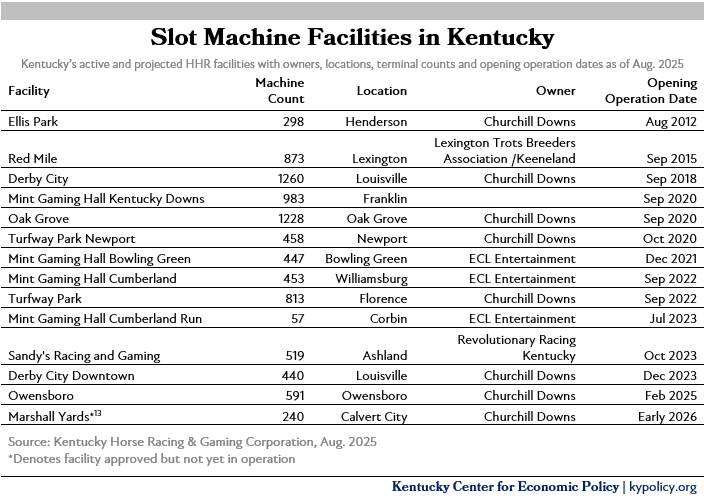
In the last few years since the legalization of HHR slots in Kentucky, the number of machines has soared from 5,249 in six facilities in 2020 to 8,420 machines in 13 different facilities in Louisville, Corbin, Williamsburg, Henderson, Bowling Green, Franklin, Lexington, Ashland, Oak Grove, Florence, Owensboro and Newport as of May 2025.
These numbers are continuing to grow as companies have announced expansion projects, including the new Churchill Downs HHR facility in Calvert City that will be an extension of its Oak Grove harness racing track. That new location will be Churchill Downs’ eighth slot facility in Kentucky.
While traditional casinos and slot machines remain illegal in the state, walking into any of Kentucky’s HHR slot facilities would provide an experience similar to visiting a typical casino, as shown in the photographs below. One image was taken at Red Mile Gaming & Racing in Lexington while the other was taken in Las Vegas, and it is impossible to tell the difference between the machine types. Historical horse racing slot machines mimic traditional slot machines from a player’s perspective, featuring reels, symbols, wilds and bonuses. From a financial perspective, they are also like traditional slots, providing an average payout of approximately 91% of the amount wagered.13
Although these HHR slots are advertised as being extensions of opportunities to bet on historical Kentucky horse races, and they directly benefit the horse racing industry, the primary companies who own and profit from these gambling facilities, including Churchill Downs, are not primarily in the horse racing business. They are instead primarily casino companies that operate across more than a dozen states, from California to Florida to New York.14

The rapid expansion of HHR slots has resulted in a significant increase in the amount of money wagered on them. According to the Kentucky Horse Racing and Gaming Corporation (KHRGC), which replaced the racing commission in 2024, about $10.5 billion was wagered on HHR slots in Kentucky during the 2025 fiscal year, which is five times greater than the annual handle before HHR slots were officially legalized in 2021.
Amounts bet on HHR slots each year in the commonwealth are also now more than quadruple the amount bet through the state’s lottery, an arguably more convenient and accessible form of gambling that now does not attract nearly as much betting as HHR slots.
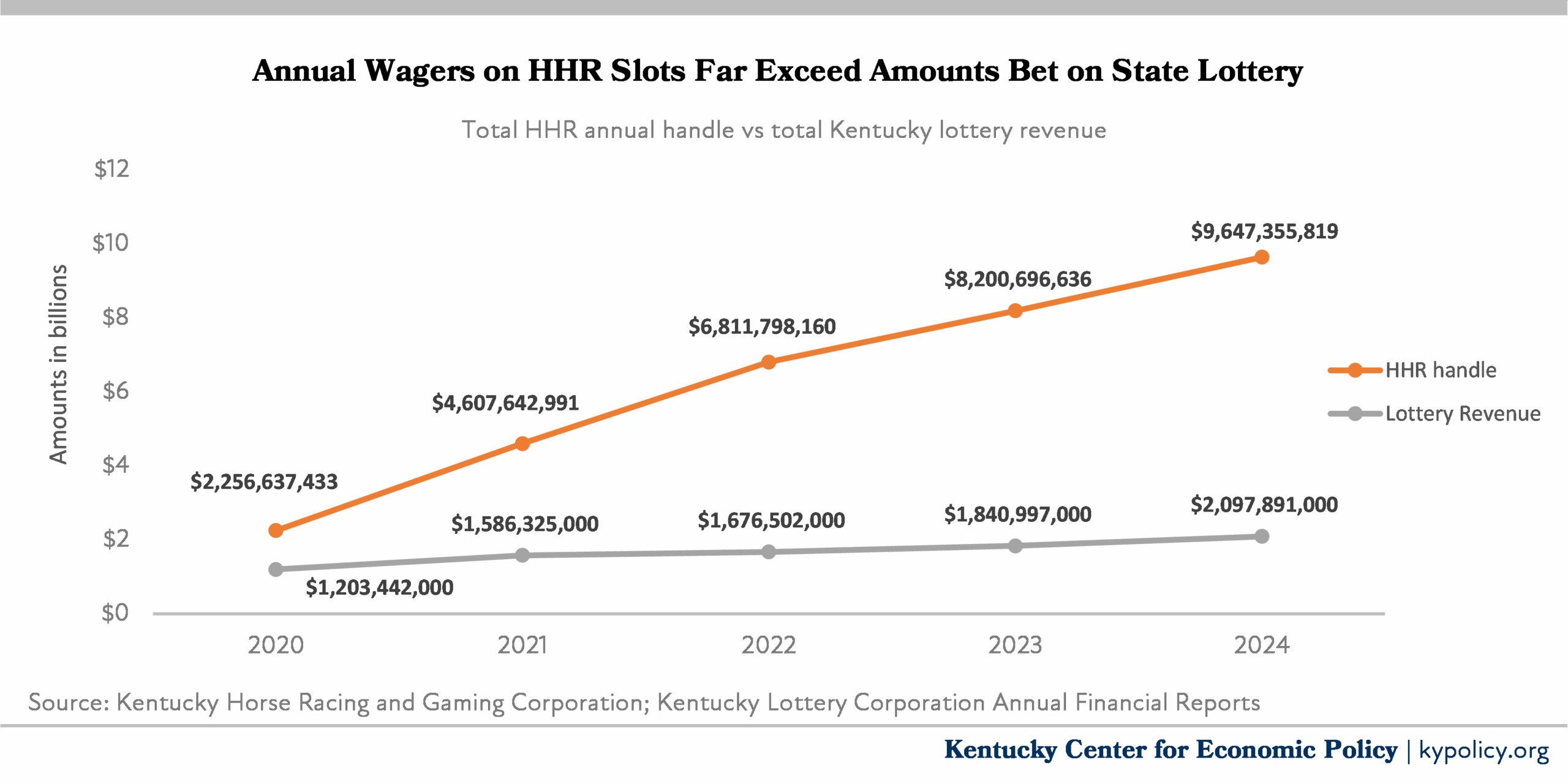
The lottery is operated by the state, and the total amount bet that remains after operation costs and payouts to winners all comes back to the state. The proceeds are primarily used to support higher education. Comparatively, the state receives very little from the tax imposed on betting on HHR slots; those tax revenues primarily go back to various funds and initiatives that directly support the horse industry.

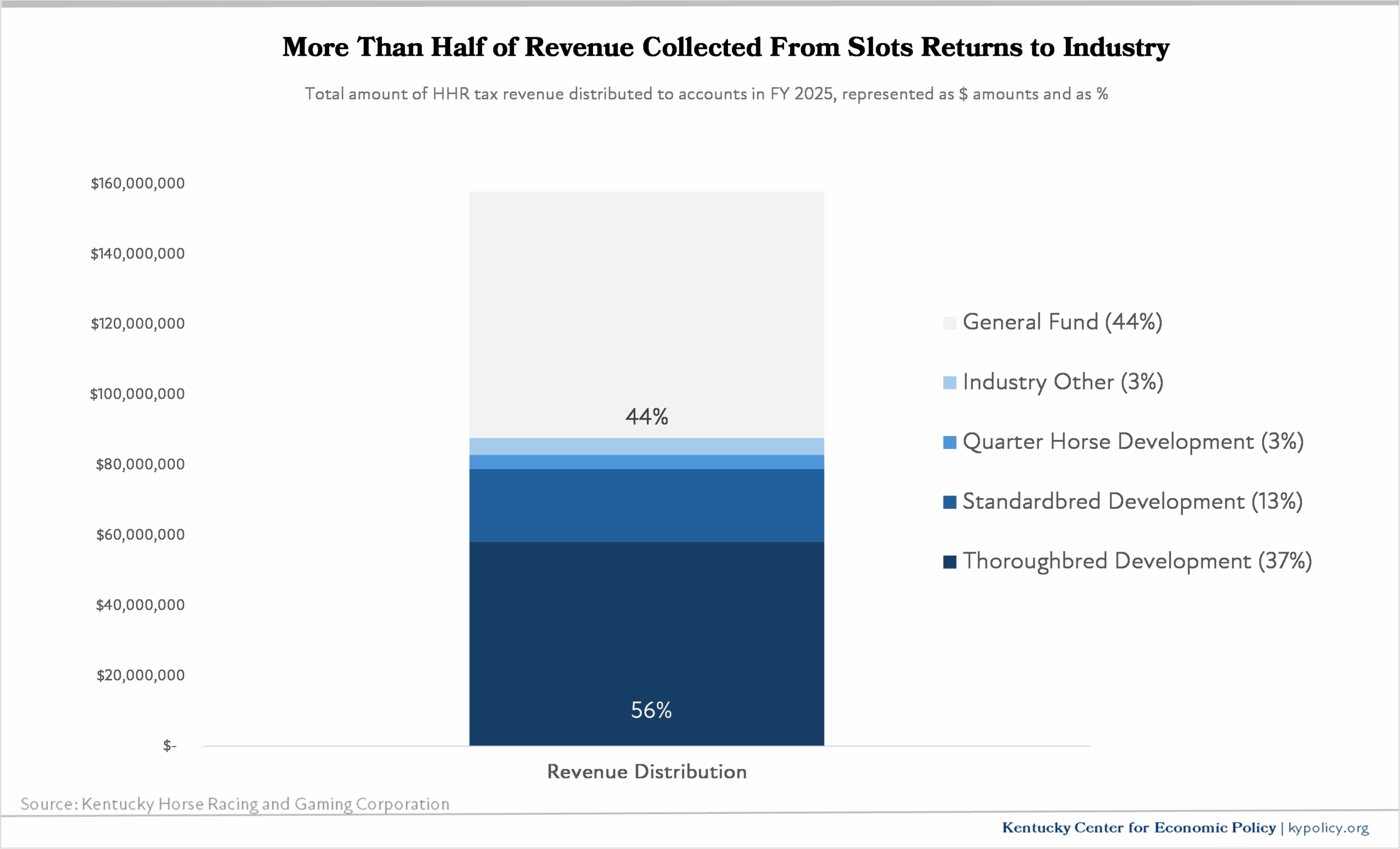
The major reason the revenue from slot machines in Kentucky is so low is that the effective tax rate is much lower than other states that tax slots. Comparisons to other states require additional calculations because Kentucky uses a tax base that differs from other casino states. While other states impose their tax against gross revenues or gross commissions, which is the amount left after paying over approximately 90% of the amount collected to winning bettors, Kentucky imposes a 1.5% levy on the handle or entire amount bet. Kentucky’s tax on the handle is equivalent to a rate of 16.4% if applied to the same base as other casino states. However, that number overstates the tax rate because the amount of money that actually flows to the state General Fund is only 7.3% of gross receipts. A majority of the amount collected (56%) is returned back to the horse industry through specific funds and subsidies, as illustrated in the graph below.
The overall amount of money Kentuckians are wagering on HHR slots is comparable to or even exceeds the amounts wagered in neighboring “casino states.” For example, as of 2024, Kentucky’s annual per capita slot wagering is $2,875, exceeding Ohio’s $2,848 (Indiana had a rate of $4,033 and West Virginia $9,025).15 But Kentucky collects significantly less revenue from its slot machines than other states do. Kentucky’s effective tax rate of 7.3% to the General Fund is exceedingly low compared to other nearby states, as compiled annually in a report by the American Gaming Association16:
- Pennsylvania’s racinos have a tax of 55% on gross electronic gaming revenue.
- West Virginia has a tax of 50.5% on electronic gross gaming device revenue.
- Ohio has a tax rate of 33% on its racinos’ gross revenue.
- Indiana has a graduated rate of up to 40% on casino revenue and 35% on gross racino revenue.
- Illinois has a graduated rate of up to 50% on commercial gross casino gaming revenue.

Churchill Downs, which operates a majority of the HHR slot machine facilities in Kentucky, owns and continues to profitably operate similar facilities in Pennsylvania, Ohio, and Illinois, and pays the tax rates described above in those states. It also owns facilities in Florida with its 35% rate; one in Maryland with a rate of 42%-58%; one in Maine where the rate is 39%-46%; and one in Louisiana where the rate is 27.5%-36%. But in Kentucky, it pays only 7.3% to the state’s General Fund.17 Churchill’s revenue from casino style gambling far outpaces its revenue from live horse racing: $1.8 billion vs $470 million as of the end of calendar year 2024.18
Even though in 2025 more than $10 billion is now bet on HHR slots in our state, only about $72 million is going to the state’s General Fund to be invested in public needs.19 During the 2021 legislative session when the General Assembly needed to act if it wanted to make these already-operating slot machines legal, four bills or amendments were introduced that would have raised the effective tax rate on slot machines to between 25% and 35% of gross commission. One example is House Bill 481, which maintained the existing excise tax of 1.5% on HHR slots’ total handle to generate revenues for both the General Fund and the industry and added a surtax of 27% on the gross commission received by the tracks.20 All revenue from the surtax was allocated to the General Fund. The surcharge would have increased the effective tax rate to 34.5%, still lower than that of most nearby casino states. As the graph below illustrates, had the bill’s proposed rates been adopted, Kentucky would now be generating $259 million more a year in revenue to support public needs.

Other gambling expansions and the problems that come with expanded gaming
In addition to gains from HHR slot machines, the horse racing industry is also benefiting from sports betting, which was legalized in September of 2023. Sports wagering is directly tied to the state’s horse racing industry, as only Kentucky’s licensed horse racing facilities can offer on-site and mobile sports betting.21 Since operations began, $4.9 billion has been wagered on sports in Kentucky. The tax rate for wagers placed via websites or mobile applications is low and comparable to that of most other states, so the state has collected only $75.8 million from this gambling so far.22 Under state law these revenues will be allocated to administrative expenses, the Kentucky problem gambling assistance account and the permanent pension fund, as described in statute.23
As gambling booms across Kentucky, so do the social costs tied to problem gambling, including financial, social and mental health harms.24 In 2022, the Kentucky Council on Problem Gambling reported that up to 165,000 Kentucky adults reported problem gambling traits, and nearly 65,000 Kentucky adults struggle with gambling addiction.25 Following the legalization of sports betting in Kentucky, calls to Kentucky’s problem gambling hotline more than doubled from 2023 to 2024.26 Counselors have voiced concerns that, as the expansion of gambling continues, the need for problem gambling treatment will far exceed the commonwealth’s available resources and services.27
Kentucky has adopted casino-style gambling and gained casino-scale social strain through a shadowy process that hid the rapid expansion of gambling behind the tradition of horse racing. But horse racing has long faced declining national popularity, and many of the corporations that operate slot machines in Kentucky are now primarily in the casino business. It is apparent that Kentucky’s casinos could operate and profit while paying more in taxes, since they continue to thrive in nearby states with much higher tax rates.
Expanded gambling comes with increased costs for communities and state and local governments, including the growing need to support those who experience gambling addictions. And there are major concerns that the gambling industry’s ambitions are far from satisfied, as plans develop across the country for expanded slot-type gambling available on already-addictive smartphones.28 What kind of place will Kentucky be if or when there is a casino in every pocket? It is a critical time to ask hard questions about the consequences of Kentucky’s decisions to quietly and quickly expand casino-style gambling and to be clear about the best path forward for the commonwealth.

- Kentucky Horse Racing and Gaming Corporation, “Pari-Mutuel Wagering for FY 2020 (YTD)” report, “Pari-Mutuel Wagering for FY 2024 (YTD)” report, https://khrc.ky.gov/PariMutuel.aspx?menuid=80.
- Caleb Stultz, “How Kentucky’s Gambling Boom is Wreaking Havoc on Lives- And What’s Being Done To Stop It,” Jan. 29, 2025, https://www.leoweekly.com/news/how-kentuckys-gambling-boom-is-wreaking-havoc-on-lives-and-whats-being-done-to-stop-it-17375095.
- Kentucky Attorney General Opinion 10-001, January 5, 2010, https://www.ag.ky.gov/Resources/Opinions/Pages/Opinions.aspx.
- This type of lawsuit is called a declaration of rights. It is a legal proceeding in which the parties ask the court to formally opine on the legality of a situation. These lawsuits differ from other court cases in that there are not parties on both sides of the issue.
- 2014 Ky. Acts Ch 102, https://apps.legislature.ky.gov/law/acts/14RS/documents/0102.pdf.
- Fam. Tr. Found. of Ky., Inc. v. Ky. Horse Racing Comm’n, 620 S.W.3d 595, 600–03 (Ky. 2020). Accessed at https://caselaw.findlaw.com/court/ky-supreme-court/2088262.html.
- 2021 Ky. Acts Ch 008, https://apps.legislature.ky.gov/law/acts/21RS/documents/0008.pdf. This legislative sleight of hand only works because the new definition forgoes fundamentals of pari-mutuel wagering that would not allow payouts over time, would require multiple bettors wagering against each other by contributing to the same pool and would only rely on patron-established odds and payout.
- Jason Bailey and Pam Thomas, “Any Action on Proliferating Slot Machines Must Raise Artificially Low Tax Rate,” Kentucky Center for Economic Policy, Dec. 16, 2020, https://kypolicy.org/any-action-on-proliferating-slot-machines-must-raise-artificially-low-tax-rate/. Jason Bailey, “Letter to the Kentucky House of Representatives on Raising the Inadequate Tax Rate on HHR Slot Machines,” Kentucky Center for Economic Policy, Feb. 10, 2021, https://kypolicy.org/letter-to-kentucky-house-raising-hhr-slot-machine-tax-rate/.
- “Coalition Letter to Kentucky General Assembly: End the Tax Break on Slot Machines,” Feb. 1, 2020, https://kypolicy.org/coalition-letter-kentucky-general-assembly-taxation-of-historical-horse-racing-slot-machines/.
- Special Committee Pari-Mutuel Wagering Taxation Task Force, available at https://apps.legislature.ky.gov/LRCSiteSessionSearch/dtSearch/dtisapi6.dll?cmd=getdoc&DocId=7674&Index=E%3a%5cProduction%5cDTSearch%5cDTSearchIndex%5cParentWebSite&HitCount=6&hits=e6+e7+e8+e9+ea+eb+&SearchForm=.
- “Report of the Pari-Mutuel Wagering Taxation Task Force,” Research Memorandum No. 530, Kentucky Legislative Research Commission, Nov. 2021, available at https://legislature.ky.gov/LRC/Publications/Research%20Memoranda/RM530.pdf.
- 2022 Ky, Acts CH 124, https://apps.legislature.ky.gov/law/acts/22RS/documents/0124.pdf.
- “Pari-Mutuel Wagering,” Kentucky Horse Racing & Gaming Corporation available at https://khrc.ky.gov/PariMutuel.aspx?menuid=80. Retrieved Dec. 9, 2024.
- ECL Development projects, https://ecldevelopment.com/our-projects, accessed Aug. 25, 2025. Churchill Downs Incorporated properties, https://www.churchilldownsincorporated.com/properties/, accessed Aug. 25, 2025.
- KyPolicy analysis of data in reports: “VLT Results for Fiscal Year 2024,” Ohio Lottery, https://www.ohiolottery.com/getmedia/f9897480-9196-4c2a-86b9-0a18773f91ef/VLT-Statewide-Monthly-Fiscal-Year-Revenue-Report-2024.pdf. Ohio Casino Control Commission, “2023 Statewide Casino Revenue,” https://dam.assets.ohio.gov/image/upload/casinocontrol.ohio.gov/revenue-reports/Full%20Year%20Revenue%20Reports/December%202023%20Ohio%20Casino%20Revenue%20Report.pdf. “2024 Annual Report to Governor Eric Holcomb,” Indiana Gaming Commission, https://www.in.gov/igc/files/FY2024-Annual.pdf. “Annual Comprehensive Financial Report for Fiscal Years Ended June 30, 2024 and 2023: A Component Unit of the State of West Virginia, https://downloads.ctfassets.net/nm98451qj5dg/404RFEoic8jvSk7B8yz74S/f2ff20d014194115d26f2552da8e8cfb/Annual_Report_FY_2024.pdf. 2024 Census data of KY, OH, IN and WV 21+ population.
- “State of the States 2025: The AGA Analysis of the Commercial Casino Industry,” American Gaming Association, May 13, 2025, https://www.americangaming.org/wp-content/uploads/2025/05/AGA-State-of-the-States-2025.pdf.
- Jason Bailey, “Proposal Would Continue to Tax Slot Machines at Egregiously Low Level,” Kentucky Center for Economic Policy, Mar. 29, 2022, https://kypolicy.org/hb-607-proposal-would-continue-to-tax-slot-machines-at-egregiously-low-level/.
- Churchill Downs Incorporated FY 24 Form 10-K, https://ir.churchilldownsincorporated.com/static-files/7fe2c672-a1d1-447f-9eda-e60ad40aa481.
- KyPolicy analysis of KHRG data, available at https://khrc.ky.gov/PariMutuel.aspx, accessed Dec. 10, 2024.
- HB481 21RS, https://apps.legislature.ky.gov/record/21rs/hb481.html.
- 2023 Ky. Acts Ch 147, https://apps.legislature.ky.gov/law/acts/23RS/documents/0147.pdf.
- Kentucky Horse Racing and Gaming Corporation, “September 2023 – June 2025 Sports Wagering Market Report,” https://khrc.ky.gov/Documents/Sports%20Wagering%20Report%20250730%20FINAL.pdf.
- KRS 230.817, https://apps.legislature.ky.gov/law/statutes/statute.aspx?id=56035.
- National Council for Problem Gambling, “FAQ: What is Problem Gambling?” https://www.ncpgambling.org/help-treatment/faqs-what-is-problem-gambling/. The Lancet Public Health Commission on Gambling, November 2024, https://www.thelancet.com/journals/lanpub/article/PIIS2468-2667(24)00167-1/fulltext. The Lancet Public Health, “Time for a Public Health Response to Gambling,” November 2024, https://www.thelancet.com/journals/lanpub/article/PIIS2468-2667(24)00248-2/fulltext.
- Kentucky Council on Problem Gambling, “By the Numbers: A Research Analysis of Gambling and Problem Gambling in Kentucky,” 2022, https://kycpg.org/wp-content/uploads/2022/09/By-the-Numbers.pdf.
- “Kentucky Council on Problem Gambling sees increase in helpline calls amid greater awareness,” Jan. 26, 2025, https://nkytribune.com/2025/01/kentucky-council-on-problem-gambling-sees-increase-in-helpline-calls-amid-greater-awareness/.
- Jacob Munoz, “Kentucky’s gambling addiction cases may be more than it can handle,” NPR, Apr. 7, 2024, https://www.npr.org/2024/04/07/1243294344/kentuckys-gambling-addiction-cases-may-be-more-than-it-can-handle.
- Wayne Parry, “Slow to Expand, Internet Casino Gambling Is the Future of US Betting, Industry Execs Say,” Associated Press, May 8, 2024, https://apnews.com/article/internet-gambling-betting-casinos-cannibalization-online-b4ffd4f1abad68709ce46d520551e2b5. Pamela Ferdinand, “A Casino in Your Pocket: Gambling Industry Is a Growing Worldwide Health Threat, Experts Say,” U. S. Right to Know, November 4, 2024, https://usrtk.org/healthwire/gambling-industry-growing-worldwide-health-threat/.