
In 2022, the General Assembly passed House Bill (HB) 4, a sweeping cut to Kentucky’s unemployment insurance program that reduced the number of weeks workers could claim jobless benefits. For more than 80 years, Kentuckians could claim 26 weeks of unemployment benefits, which is still the standard in most states. But HB 4 reduced the maximum to 14 weeks, though it was changed to 16 weeks the next year.
As job openings have severely dwindled over the last couple of years, this cut is resulting in a steep rise in Kentucky workers exhausting their benefits before landing their next job. Now, 46% of jobless claimants are hitting the maximum number of weeks and losing their sole source of income. This “exhaustion rate” is near its previous high point (before COVID) in 2013, when jobs were scarce in the aftermath of the Great Recession, the unemployment rate was elevated and coal jobs were being lost rapidly due to competition from fracking.
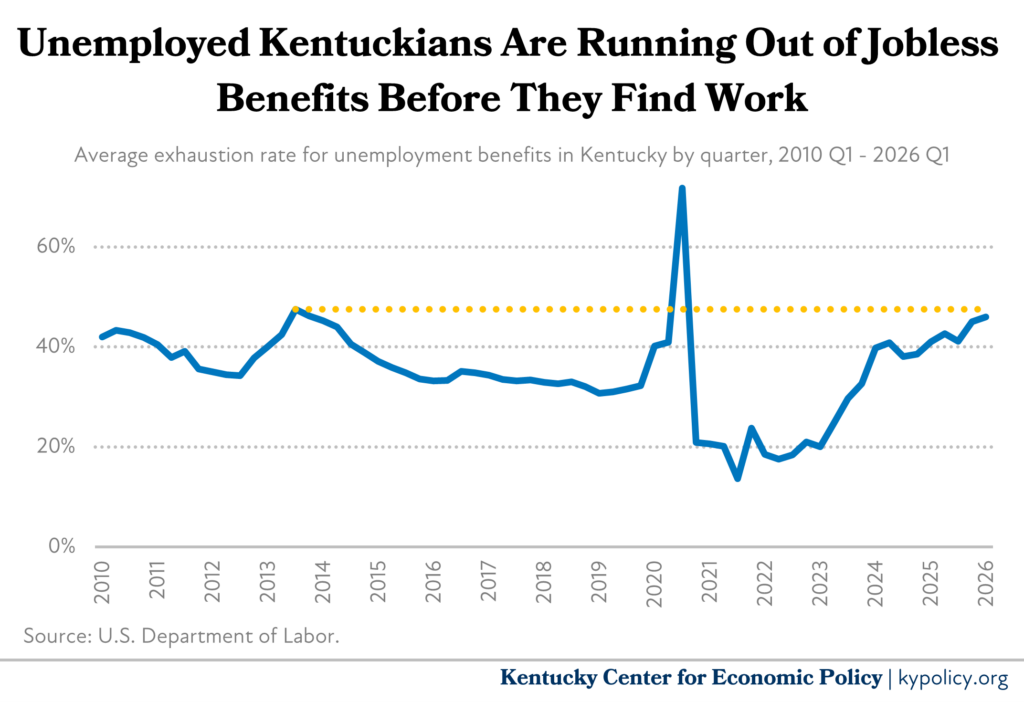
It is remarkable that Kentucky’s exhaustion rate is so high right now because we are not in a recession, and layoffs remain subdued. Rather, this indicates that the deep cut to Kentucky’s maximum duration of unemployment benefits has left workers with too-little time to find a job in an economy where hiring is also low – the hiring rate in December 2026 (3.1% of the labor force) was at its lowest point since January 2010.
Kentucky’s maximum duration can increase if the unemployment rate also rises, but that “index” for changing the maximum duration was ill-conceived from the start. Kentucky’s unemployment rate remains low relative to most years, but many other factors contribute to the difficulty of finding a job. Too-few hiring employers is certainly one, but regionalized downturns (Lewis, Magoffin, Martin and Wolfe counties all had an unemployment rate above 8% in 2025); personal circumstances that make it more difficult to land work such as a felony conviction, racial discrimination or a disability; and technological shifts like the burgeoning use of AI, are all employment barriers that Kentucky’s low maximum duration of benefits ignores.
For more than 80 years, 26 weeks had been the standard maximum duration to account for these and other factors, and Kentucky should return to it before the next downturn or major technological change hits and working Kentuckians are left even more financially stranded.