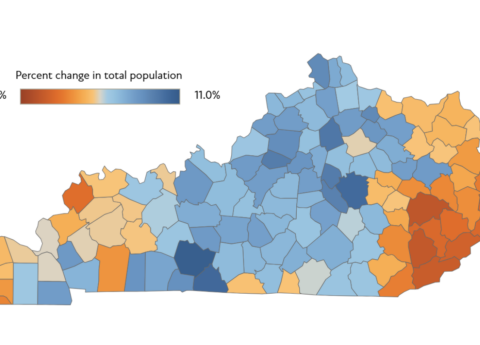

More than 230,000 people in Kentucky, 4% of the state’s population, are immigrants. 1 These Kentuckians and their families are neighbors, friends, coworkers and classmates, who make profound contributions to their communities and state and local economies. They work, go to class, pay taxes and care for their children or grandchildren just like everyone else.
In the past year, however, the Trump administration has ramped up its mass deportation agenda with the goal of removing one million immigrants from the country every year. While well below that extreme goal, the number of people arrested and detained by Immigration and Customs Enforcement (ICE) in the interior U.S. is at record levels, and the rate of deportation after arrest and detention is 4.6-times what it was before the inauguration.2
Federal funding for anti-immigrant enforcement is historically high as well, with the passage of H.R. 1 last year appropriating more than $75 billion to ICE, including $45 million to increase its detention capacity.3 H.R. 1 also included funding to rapidly expand the deportation infrastructure by incentivizing state and local law enforcement agencies to participate in ICE’s 287(g) program, which authorizes state and local officers to enforce federal immigration law and has a history of racial profiling, violence and civil rights abuses.4
Kentucky is not immune from this ramp-up. Last year, ICE arrested nearly 2,000 people between Jan. 20 and Oct. 15, a 32% increase compared to 2024.5 And despite ICE’s increasingly aggressive tactics and the mounting harms, a growing number of local law enforcement agencies are signing 287(g) agreements — which several bills in the 2026 Kentucky General Assembly proposed to make mandatory — and local jails are renting beds to ICE. There are currently 36 local law enforcement agencies in Kentucky with 287(g) agreements and 11 local jails that have immigrant detention contracts.6
In just its first year, the Trump administration’s anti-immigrant agenda has already caused substantial harm to individuals, families and communities. There are also broader economic impacts.
This report describes the economic consequences in Kentucky if the mass deportations goals are fully realized, including:
- A diminished labor force that could result in labor shortages;
- Job losses for U.S.-born workers in roles that depend on immigrant workers; and
- Risks to occupations with a large percentage of immigrant workers, such as restaurants, construction and farming.
Mass deportations would shrink Kentucky’s workforce and could result in labor shortages
Kentucky immigrants, both those who are documented and undocumented, make up a meaningful portion of the state’s workforce. Mass deportations, which have targeted both undocumented immigrants and those with non-citizen legal status, could result in labor supply shortages. As shown in the graph below, the state’s immigrant population helped prevent a workforce collapse in the years following the Great Recession and leading into the COVID-19 pandemic. Based on 2024 data, their removal from the state’s working population ages 25 to 54 would be a loss of 112,700 workers.
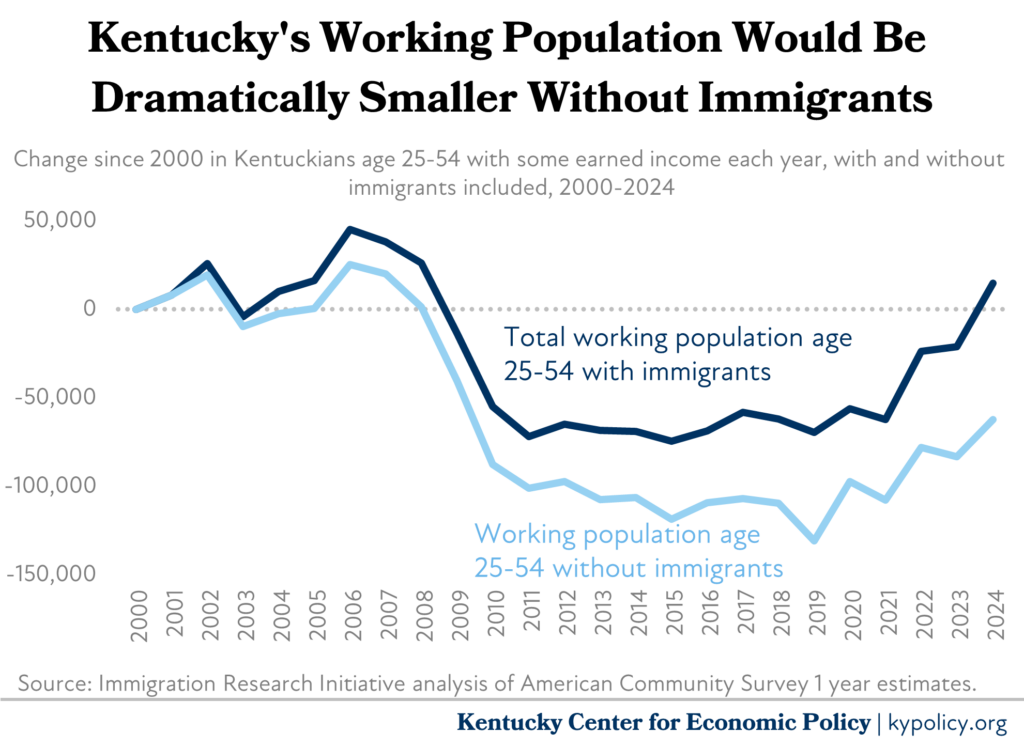
Businesses would be forced to shrink as their ability to adjust by hiring new workers is already significantly constrained given the state’s relatively low unemployment rate of 4.3% in January 2026.7 Costs would go up too, not only because immigrants are often underpaid, but more fundamentally because there would be an under-supply of workers and therefore the goods and services they produce. As a result, Kentuckians would end up paying more for essentials like food, child care, housing and medical care.
Mass deportation agenda puts Kentucky’s hospitality, construction and agriculture sectors particularly at risk
Immigrants make critical contributions to Kentucky’s economy in many ways, including through the jobs they fill. According to the American Community Survey, the types of jobs that immigrants most fill are diverse – from truck drivers, cooks, and domestic workers to managers, physicians and nurses. Without immigrants, many different sectors of the economy would experience harm.
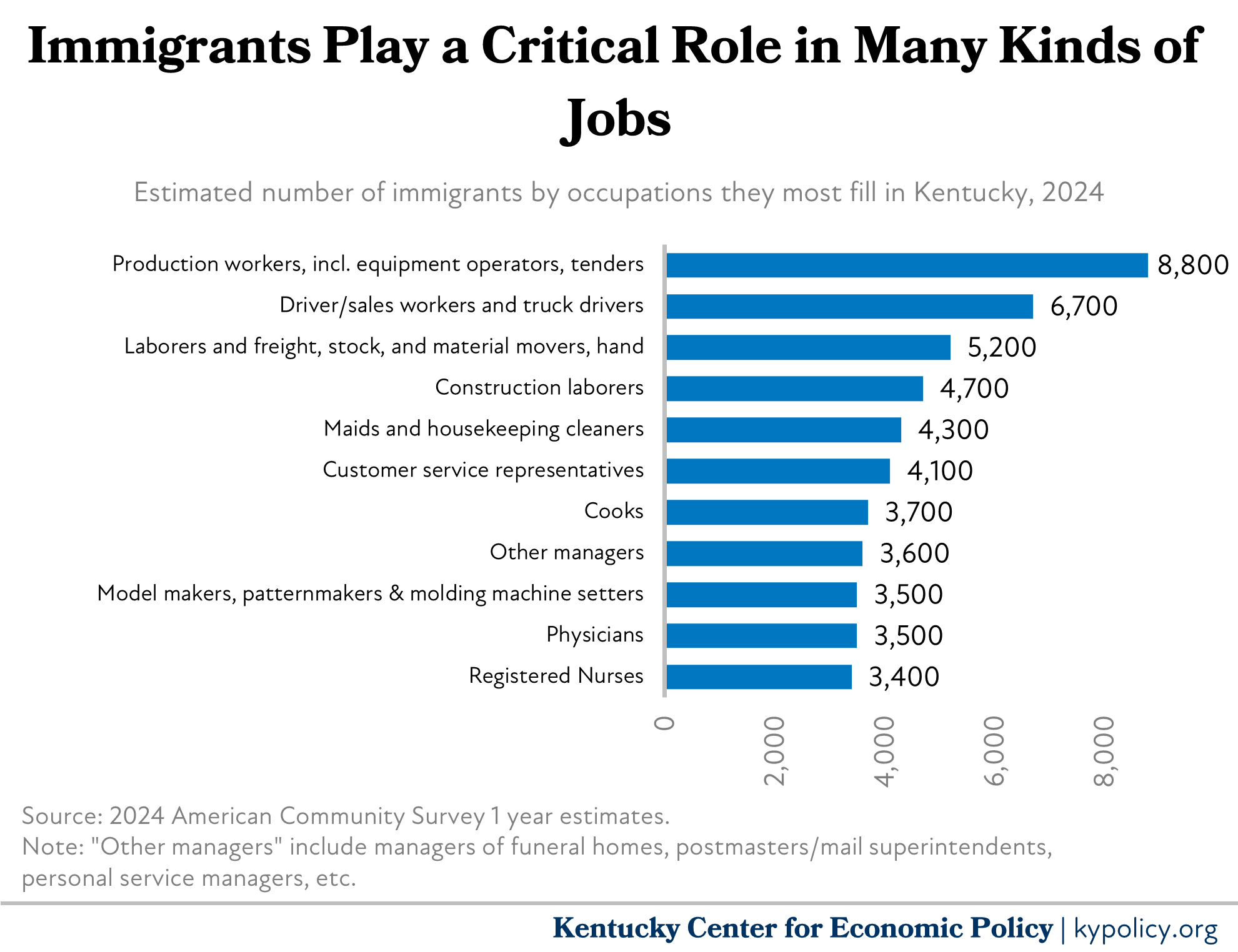
Here are some examples of parts of the economy where working immigrants play an outsized role in Kentucky:
Restaurants
In Kentucky, there are 3,700 cooks who are immigrants (including both those who are documented and undocumented), 8% of the total; 600 chefs/head cooks who are immigrants, 16% of the total; and 400 dishwashers who are immigrants, 10% of the total. While some other workers could step into these jobs, the predictable result of an outflow of workers is shrinkage of other jobs that rely on these workers.
Construction
In Kentucky, there are 12,000 immigrants (both documented and undocumented) in the construction industry in a variety of jobs; they make up 8% of all workers in the state’s construction industry. Removing thousands of workers from the labor force, some of whom are also union members, would increase the cost of construction, limiting the total construction feasible during a time in which Kentucky is projected to have nearly 300,000 fewer homes than is needed to house all families in the state by the end of this decade.8
Farming
On over 69,000 farms across Kentucky, more than $8 billion in food is produced each year. As of 2022 (the most recent data available), nearly 44,000 Kentuckians were farmers, and in 2025, 6,400 H-2A visas were awarded in agricultural businesses, allowing migrant workers to lawfully farm in Kentucky. Poultry, corn, soybeans, cattle, wheat and dairy make up the majority of the state’s food production, and are both consumed by Kentuckians and sold for export.9 Farms are also important to the economic and social vitality of rural communities, enhance the local landscape, and are part of a growing agritourism industry. Removing immigrants from Kentucky’s farm workforce would create additional pressure on an industry that is critical to Kentucky’s well-being and has already been under decades of strain.
Pay and working conditions are in dire need of improvement for farm workers. But the likely result of deporting current immigrants and restricting new immigration is not an improvement of working conditions, but a decline in farming.
Other common jobs that Kentucky immigrants fill
In Kentucky, there are 2,000 janitors who are immigrants (documented and undocumented), or 5% of the total. There are 2,000 landscaping workers who are immigrants (10% of the total); 100 nail technicians (61% of the total), 200 laundry and dry cleaning workers (11% of the total), and 4,300 maids and housekeepers who work in homes, hotels and other locations (20% of the total). Immigrants also comprise 4% of child care workers in the state.10
In Kentucky, although we don’t know the exact number of the immigrant workers in these jobs who are undocumented and therefore at the highest risk of deportation, the Pew Research Center estimates that nationally 12% of cooks, 11% of janitors, and 24% of maids and housekeepers are undocumented immigrants, for example.11
Deporting the estimated 50,000 undocumented Kentuckians would result in a predictable decline of jobs for U.S.-born workers
According to a leading journal article on the subject, contrary to popular belief, deporting immigrants reduces the number of jobs for other workers.12 That’s because the types of jobs undocumented immigrants are more likely to fill, such as construction workers or cooks and dishwashers, complement the types of jobs U.S.-born workers are more likely to fill, such as construction site managers or restaurant servers. If restaurants experience a shortage of cooks, for example, they cannot serve as many customers, reducing jobs for servers. Undocumented immigrants also work in jobs that are essential to others’ participation in the workforce, such as providing child care for working parents. Finally, without spending on goods and services by undocumented immigrants, local businesses would not need as many workers.13 All of this adds up to a decrease in work for U.S.-born workers.
Both undocumented immigrants and those with legal status are at risk for deportation
The Trump administration’s immigration agenda is aimed at a much broader group than the approximately 14 million immigrants in the U.S. — an estimated 50,000 in Kentucky — who are undocumented.14 While undocumented immigrants are the most vulnerable to deportation, those with non-citizen legal statuses are also being targeted for removal including:
- Recipients of Temporary Projected Status (TPS) due to armed conflict or environmental disaster in their country of origin (of which, 5,915 live in Kentucky);
- Student visa holders (there are 21,544 student visa holders living in Kentucky);
- Deferred Action for Childhood Arrivals (DACA) recipients (of whom 2,270 live in Kentucky);
- Asylum seekers (as of 2023, 260 people in Kentucky had been granted asylum, though many more await approval); and
- Employees hired with an H1-B visa to work in specialty occupations (there were 679 new and renewed H1-B visa holders in Kentucky in 2025).15
The Trump administration has been moving to terminate the TPS designations for most of the 17 eligible countries, which, depending on the outcome of ongoing litigation, would impact a large share of the 1.3 million total TPS recipients. In addition, a recent DHS memo specified that legally-residing refugees who have not yet received their “green cards” could be detained and possibly deported; this overturned decades of precedent and was implemented in the January 2026 ICE surge in Minneapolis.16
Even immigrants with permanent resident status (“green card” holders), and some with legal citizenship, are at risk of deportation. Student visa holders and legal permanent residents have been targeted for deportation on the basis of their political speech and activities.17 The administration is also attempting to revoke the citizenship of immigrants who became naturalized U.S. citizens at a rate of 100 to 200 citizens per month.18
Of the more than 230,000 immigrants who live in Kentucky, approximately 80,000 are U.S. citizens and 100,000 are non-citizens who have legal status.19
Fear of deportation is also impeding immigrants’ participation in economic and community activities
The chilling effect of such a widespread threat towards documented and undocumented immigrants alike could add to the loss of immigrants in the workforce. Regardless of whether a Kentuckian’s immigration status is targeted for enforcement, the fear of arrest and family separation will almost certainly lead many to stay home rather than going to church or school or work – especially given the recent Supreme Court ruling allowing for racial profiling in immigration enforcement.20 Past research has found that during periods of increased immigration enforcement, even immigrants not targeted for deportation were afraid to leave their homes to participate in everyday activities.21
Fear is particularly acute for the many immigrants in mixed status families in which some family members are undocumented and others are U.S. citizens or have another legal immigration status. A survey conducted in December 2024 in anticipation of the inauguration found that 60% of respondents in mixed-status families worried about participating in one or more of seven everyday activities, such as going to work, visiting a doctor or hospital, sending children to school, or attending religious services or community events, because they do not want to draw attention to their immigration status or that of a family member.22
Many immigrants of all statuses are deciding to stay home as much as possible to avoid interactions with immigration authorities. A survey of over 2,000 Spanish-speaking immigrants conducted in March 2025 found that two in five respondents had to miss work because of the federal government’s new immigration agenda.23
Immigrants help keep Kentucky economically strong and culturally vibrant
Mass deportation efforts by federal and participating local agencies are harming immigrants in our state, and if continued at this pace will hurt Kentucky’s economy as well. Immigrant workers, both documented and undocumented, accounted for 6% of gross domestic product (GDP) in Kentucky in 2023.24 Undocumented immigrants contribute $119 million in state and local taxes, which help pay for the essential programs and services that Kentuckians rely on.25 Furthermore, 8% of business owners in Kentucky in 2023 were immigrants, and 13% of main street businesses (such as salons, restaurants, retail stores, etc.) are owned by immigrants.26 These businesses help maintain the vibrancy of Kentucky’s economy by spurring innovation, hiring workers, and adding locally owned storefront shops that keep neighborhoods vibrant.
Kentucky is stronger when we embrace our diverse backgrounds and experiences and unite around policies that keep our communities strong and grow jobs and wages for everyone.

- KyPolicy analysis of 2024 American Community Survey 1-year microdata estimates. Of the 230,000 immigrants in Kentucky, 81,000 have become U.S. citizens through naturalization and 149,000 are not U.S. citizens, but Census data does not clarify what portion are documented through a visa, green card, DACA recipiency, etc.
- Graeme Blair and David Hausman, “Immigration Enforcement in the First Nine Months of the Second Trump Administration,” Data Deportation Project, Jan. 27, 2026, https://deportationdata.org/analysis/immigration-enforcement-first-nine-months-trump.html#interior-deportations-increased-by-four-and-a-half-times.
- American Immigration Council, “What’s in the Big Beautiful Bill? Immigration & Border Security Unpacked,” July 14, 2025, https://www.americanimmigrationcouncil.org/fact-sheet/big-beautiful-bill-immigration-border-security/.
- Naureen Shah, “Deputized for Disaster: How President Trump’s Supersized 287(g) Deportation Force Is a Powder Keg for Law Enforcement, Our Communities, and Our Democracy,” American Civil Liberties Union, Feb. 26, 2026, https://www.aclu.org/publications/deputized-for-disaster.
- Ashley Spalding et. al., “Amid Mounting Harms, Kentucky Is Ramping Up Anti-Immigrant Enforcement,” Kentucky Center for Economic Policy, Feb. 5, 2026, https://kypolicy.org/ice-enforcement-in-kentucky/.
- Titus Consulting, “Active 287(g) Agreements,” Maxwell Commons, last updated April 23, 2026, https://lookerstudio.google.com/u/0/reporting/ebe8be08-53be-4afc-9240-83ec3075e873/page/p_5yty8mz8xd?utm_source=substack&utm_medium=email. Relevant Research, ”ICE Detention Reports,” accessed April 27, 2026, https://detentionreports.com/.
- U.S. Bureau of Labor Statistics, Unemployment Rate in Kentucky, retrieved from the Kentucky Center for Statistics Apr. 14, 2026, https://kystats.ky.gov/KYLMI/PressRelease/d5e4e0fd-9f4c-4508-8858-ec34e02a51ea.
- Bowen National Research and the Kentucky Housing Corporation, “Kentucky Housing Supply Gap,” accessed Feb. 5, 2026, https://www.kyhousing.org/Data-Library/Housing-Gap-Analysis/Pages/Data.aspx.
- U.S. Department of Agriculture, “2022 Census of Agriculture State Profile: Kentucky,” accessed Feb. 5, 2026, https://www.nass.usda.gov/Publications/AgCensus/2022/Online_Resources/County_Profiles/Kentucky/cp99021.pdf.
Will Snell, “The Ag Census Confirms Geographic and Commodity Shifts in the Kentucky Farm Economy,” University of Kentucky Department of Agricultural Economics, Mar. 28, 2024, https://agecon.mgcafe.uky.edu/ag-census-confirms-geographic-and-commodity-shifts-kentucky-farm-economy. - Nail technicians include manicurists and pedicurists.
- National estimates of the number of undocumented workers were provided to IRI by Jeff Passel of the Pew Research Center, and are based on an analysis of the 2022 American Community Survey, consistent with the analysis in “What We Know About Unauthorized Immigrants in the U.S.,” Pew Research Center, July 22, 2024.
- East, et al. “The Labor Market Effects of Immigration Enforcement,” Journal of Labor Economics, vol 41, number 4. This work is summarized in an accessible fashion by Chloe N. East in “The Labor Market Impact of Deportations” The Hamilton Project, Sept. 18, 2024.
- Chloe East, “The Labor Market Impact of Deportations,” The Hamilton Project, Sept. 18, 2024.
- Jeffrey S. Passel and Jens Muanuel Krogstad, “U.S. Unauthorized Immigrant Population Reached a Record 14 million in 2023,” Pew Research Center, Aug. 21, 2025, https://www.pewresearch.org/race-and-ethnicity/2025/08/21/u-s-unauthorized-immigrant-population-reached-a-record-14-million-in-2023/#what-has-happened-to-the-unauthorized-immigrant-population-since-2023.
- For the number of immigrants, non-citizen immigrants, and estimate of immigrants who are undocumented, see the Immigration Research Initiative fact sheet, “50 States: Immigrants by Number and Share.” Number of immigrants and non-citizen immigrants are an IRI analysis of the 2023 ACS. Number of immigrants who are undocumented is estimated by the Pew Research Center based on the 2022 ACS. The fact sheet gives parallel estimates from the Center for Migration Studies (2022 ACS) and from the Migration Policy Institute (2019 5-year data).
- The Forum, “Temporary Protected Status (TPS): Fact Sheet,” Feb. 4, 2026, https://forumtogether.org/article/temporary-protected-status-fact-sheet/.
- U.S. Citizenship and Immigration Services, “Count of Active DACA Recipients by State or Territory,” Mar. 31, 2025, https://htv-prod-media.s3.amazonaws.com/files/daca-recipients-state-of-residence-688add6d42882.pdf.
- U.S. Department of Homeland Security, “SEVIS Data Mapping Tool,” February 2026, accessed Mar. 2, 2026, https://studyinthestates.dhs.gov/sevis-data-mapping-tool.
- U.S. Department of Homeland Security, “State Immigration Statistics,” 2023, accessed Mar. 2, 2026, https://ohss.dhs.gov/topics/immigration/state-immigration-data/state-immigration-statistics.
- Gabriel Cortes, “These are the U.S. States With the Most – and the Least – H1-B Visa Applications and Renewals,” CNBC, Sep. 20, 2025, https://www.cnbc.com/2025/09/20/h-1b-visa-applications-renewals-by-state.html.
- Arelis R. Hernandez and Teo Armus, “New DHS Memo Outlines Plan to Detain Refugees for Further Vetting,” Washington Post, Feb. 19, 2026, https://wapo.st/3MN3tU2.
- Tara Watson and Jonathan Zars, “100 days of immigration under the second Trump administration,” Brookings Institution, April 29, 2025.
- Hamed Aleaziz, “Trump Administration Aims to Strip More Foreign-Born Americans of Citizenship” New York Times, Dec. 17, 2025.
- For the number of immigrants, non-citizen immigrants, and estimate of immigrants who are undocumented, see the Immigration Research Initiative fact sheet, “50 States: Immigrants by Number and Share.” Number of immigrants and non-citizen immigrants are an IRI analysis of the 2023 ACS. Number of immigrants who are undocumented is estimated by the Pew Research Center based on the 2022 ACS. The fact sheet gives parallel estimates from the Center for Migration Studies (2022 ACS) and from the Migration Policy Institute (2019 5-year data).
- Erika Ryan, et. al, “Supreme Court Clears the Way for ICE Agents to Treat Race as Grounds for Immigration Stops,” NPR, Sep. 13, 2025, https://www.npr.org/2025/09/13/nx-s1-5507125/the-supreme-court-clears-the-way-for-ice-agents-to-treat-race-as-grounds-for-immigration-stops.
Gabriel R. Sanchez and Edward D. Vargas, “Racial Profiling by ICE Will Have a Marked Impact on Latino Communities,” Brookings Institute, Oct. 16, 2025, https://www.brookings.edu/articles/racial-profiling-by-ice-will-have-a-marked-impact-on-latino-communities/. - East 2024.
- Hamutal Bernstein, Dulce Gonzalez, and Diana Guelespe, “Immigrant Families Express Worry as They Prepare for Policy Changes,” The Urban Institute, March 12, 2025.
- Anthony Capote, David Dyssegaard Kallick, Cyierra Roldan, and Shamier Settle, “Responding with Courage: How Spanish-Speaking Immigrants Report Being Impacted by the New Deportation Regime”, The Immigration Research Initiative, May 8. 2025. For more on the how deportation fears harm immigrants, see: Kristina Fullerton Rico, “Deportation fears create ripple effects for immigrants and their communities,” The Conversation, Feb. 19, 2025.
- Immigrant share of economic output is estimated by showing the share of all earned income – wages plus proprietors’ earnings. The data source is the 2023 American Community Survey, 5-year data.
- Carl Davis, Marco Guzman, and Emma Sifre, “Tax Payments by Undocumented Immigrants,” Institute on Taxation and Economic Policy, July 30, 2024.
- IRI Analysis of 2023 American Community Survey, 5-year data.
Immigration Research Initiative and the Kentucky Center for Economic Policy, “Immigrants Are a Vital Part of Kentucky’s Future,” Jan. 17, 2025, https://kypolicy.org/immigrants-are-a-vital-part-of-kentucky-communities/.