Last summer’s One Big Beautiful Bill Act (H.R. 1) enacted the largest cut to Medicaid in history at over $1 trillion across the next ten years. During the debate over H.R. 1, public outcry over the harm it would cause to rural hospitals (including putting 35 at risk of closure in Kentucky) led to the inclusion of a $50 billion fund called the Rural Health Transformation Program (RHTP). While this fund is a positive initiative designed to improve health outcomes, it will not prevent the overwhelming health care harms of H.R. 1, particularly in Kentucky.
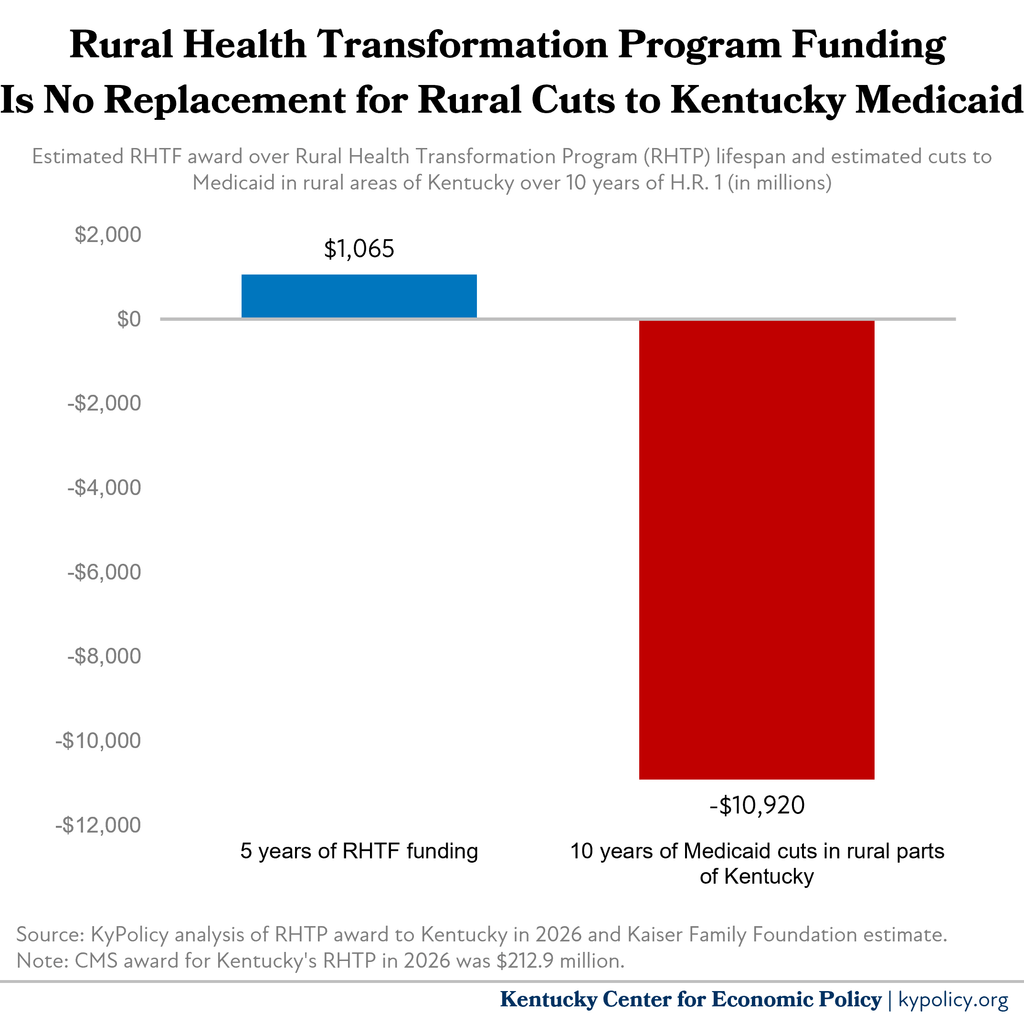
While Kentucky’s award for its RHTP proposal was significant this year ($212.9 million), the estimated cuts to Kentucky’s Medicaid program in rural areas is $10.9 billion over the next decade. Assuming Kentucky is awarded a similar amount every year for all five years of the RHTP, funding from that project will make up for less than 10% of the cut to Medicaid in rural Kentucky.
Additionally, funds from the RHTP cannot be used on the very things that will make rural hospitals financially vulnerable under these cuts, including supplementing provider payments and defraying the cost of uncompensated care. In fact, many of the allowable initiatives put forth in federal guidance have nothing to do with rural hospitals, and Kentucky’s plan follows suit.
While the RHTP has meaningful potential to help improve the well-being of rural Kentuckians in targeted ways, it is not, and never was intended to be, a replacement for lost Medicaid funds. If Congress wants to preserve health care capacity in rural Kentucky (and in every area), it will need to reverse the harsh cuts contained in H.R. 1.
Kentucky hospitals are facing multiple threats to revenue from H.R 1
The 35 rural hospitals in Kentucky that the Sheps Center at the University of North Carolina-Chapel Hill noted as being financially at risk were identified based on two criteria: they are in the top 10% of rural hospitals with the highest concentration of Medicaid-covered patients in their payer mix, and they had negative operating margins during the past three years. Even without the historically large cuts to Medicaid, these hospitals were identified as financially strained.
At the same time, the multiple ways in which Medicaid funding will be cut in the coming years are especially harmful to hospitals, including rural hospitals, over other health care providers. Three policy changes in particular will disproportionately harm rural hospitals:
- Reduction in state directed payments will greatly reduce Medicaid payment amounts. Due to a combination of reducing special, supplemental payments to hospitals, and a reduction in the taxes on providers that help contribute to the state match of those payments, hospitals will receive much lower amounts through Medicaid starting in 2028. Existing “state directed payment” amounts are huge; in 2025, those payments to hospitals totaled $5.3 billion out of Medicaid’s $20 billion budget. Those payments could fall by as much as 90% by the time the cuts are fully phased-in.
- Work reporting requirements will reduce the number of patients with health insurance. The initial estimate from the Congressional Budget Office was that, nationwide, 5.3 million people would lose coverage and become uninsured due to new work reporting rules in H.R. 1. In Kentucky, one estimate suggests that 208,000 to 303,000 adults will be subject to the requirement, with another estimate showing 120,000 to 136,000 losing coverage as a result. An additional national estimate suggests that the reduction in hospital revenue from Medicaid work reporting requirements will result in a 13.3% reduction in hospital’s operating margins in expansion states like Kentucky.
- New co-pays will reduce utilization for those who remain on Medicaid. Kentuckians covered by Medicaid with incomes between 100% and 138% of the Federal Poverty Level (or FPL, equaling $15,960-$22,025 for an individual) must pay co-pays at $1 for prescriptions and $5 for most health care services starting in 2028. Co-pays are not meant to recoup the cost of services, but rather to introduce friction in utilizing services, forcing patients to decide whether receiving that care is “worth it.” This friction has a long, documented history of reducing the amount of care patients seek.
While H.R. 1 establishes these rules, the Centers for Medicaid and Medicare Services (CMS) has written rules that make the implementation of the requirements even stricter than the legislation requires. Specifically, one rule on the use of provider taxes makes it more difficult for states to meet their required match of Medicaid costs, particularly for the aforementioned state directed payments. Another rule makes it more difficult to exempt very sick patients from the work reporting requirement. Both of these will reduce Medicaid payments to hospitals even more than H.R. 1 requires.
The size of Kentucky’s Medicaid cuts dwarfs the RHTP
Together, these three policy changes alone will have severe consequences for all hospitals, but particularly hospitals located in areas most vulnerable to Medicaid cuts, which are primarily rural. In fact, Kentucky’s rural areas will suffer the most from these cuts, with the Kaiser Family Foundation estimating that rural Kentucky providers will suffer $10.9 billion in Medicaid cuts over the next 10 years from H.R. 1. The state with the next largest amount is North Carolina (a state 2.5 times larger than Kentucky by population) with a cut of $6.4 billion.
By contrast, the RHTP is far smaller, and will last only five years. Kentucky’s first award from the Centers for Medicare and Medicaid Services (CMS) was $219.9 million. Those funds must be spent by September 2027. Assuming Kentucky receives the same amount for each of the five years the program is in effect, the state would receive just under $1.1 billion in total, not even a tenth of what rural Kentucky is expected to lose in Medicaid funding over the course of H.R. 1.
Further, RHTP funding began this year and will run for four more years with the final grants being made in 2030. The Medicaid cuts, by contrast, will begin with the implementation of work reporting requirements starting January 2027, and then in 2028 when co-pays are required from Medicaid patients and the reduction of the state directed payments will begin to phase-in. The reduction of state directed payments will continue for the following five years.
Most allowable uses of the RHTP do not help rural hospitals
While the goals of the RHTP are important and needed the providers most likely to benefit from them are not hospitals. There are five initiatives that Kentucky was awarded funding for under this program, which include:
- Rural community hubs for chronic care innovation, which are focused on obesity and diabetes prevention and management.
- Telehealth-enabled prenatal and postpartum care teams that serve mothers and their infants in maternity-care deserts and high-risk regions.
- Mobile behavioral health response teams and other technology-enabled crisis stabilization services that are aimed at connecting people with acute behavioral health needs to community care.
- Improved dental care in rural areas through funding for dental hygiene training, and portable dental clinics or other forms of remote care.
- Improved support for rural EMS providers through training and data connectivity.
None of these initiatives directly benefit hospitals or move toward addressing any of the three main ways in which hospital finances will be harmed through H.R. 1 – lower Medicaid payments, fewer covered patients, and reduced utilization of services from remaining Medicaid patients. In fact, the first two of those issues – the reduction in state directed payments and increased uncompensated care – are issues that the federal guidance for the RHTP explicitly prohibits addressing. There are many restrictions on how providers, including hospitals, are allowed to receive funds from the RHTP and enhanced payments for currently billable services are not an allowable use. Using funds to cover uncompensated care (other than care that is specifically tied to an initiative in an approved plan) is also not allowed.
While there could be some residual financial benefit to rural hospitals, these funds are not directed to them, and the vast majority of the funds will benefit other kinds of health care providers.
Rural hospitals are in real financial jeopardy – all hospitals will suffer the cuts
Rural counties in Kentucky – and the hospitals located within them – are especially vulnerable to Medicaid cuts, but the scale of the cuts to Medicaid will be felt by all hospitals in the state. An estimate from RAND suggests that Kentucky will lose a total of $25.6 billion over the next decade from H. R. 1 cuts to Medicaid. While much attention has been paid to rural hospitals, Medicaid makes up a similar portion of urban hospitals’ payer mix. Additionally, if cuts to Medicaid lead to the closure of rural hospitals, the need for hospital-based care will not go away, and the number of patients at urban hospitals will rise. That increase will not necessarily benefit urban hospital finances as a larger number of Medicaid-covered patients will come with lower reimbursement rates due to H.R. 1, often below operating costs.
Further, as the Sheps Center study points out, the cuts to Medicaid could create problems other than hospitals closing outright. Ending certain services (such as maternity care), reducing staff or limiting patient capacity are all possible ways hospitals could adapt to Medicaid cuts. The RHTP cannot address the scope or shape of the cuts to Medicaid in H.R. 1 and without action to reverse them from Congress, all hospitals and the Kentuckians who rely on them are at risk.