
The past month has been volatile for those covered by Medicaid. The budget passed by the General Assembly for fiscal year (FY) 2027, which runs from July 1, 2026, to June 30, 2027, appropriated $269 million less in state funds than what is needed to maintain existing Medicaid services. Because of the shortfall, the governor announced rate cuts for providers, jeopardizing critical services for hundreds of thousands of Kentuckians. After significant advocacy efforts from people covered by Medicaid and their families, the governor announced that he had identified additional funding from other places in the budget, allowing him to reverse the announced cuts through FY 2027. But those actions were extraordinary and represented a one-time, short-term opportunity to address funding issues that continue beyond the current fiscal year.
The funding gap between what was appropriated and what is needed to maintain existing services will grow even larger in the next fiscal year, with an anticipated shortfall of $421 million in FY 2028. The General Assembly must address this growing shortfall in the 2027 legislative session so Medicaid recipients and their loved ones aren’t forced to repeat this summer’s turmoil, or lose services altogether.
How Medicaid’s budget was cut, and what is needed to reverse it
The projected Medicaid shortfalls in FY 2027 and FY 2028 both trace back to the same problem: the legislature isn’t putting enough money into Medicaid relative to what the executive branch says is needed to run the program.
Due to insufficient revenue resulting from state income tax cuts, the typical way of funding programs (making appropriations from our General Fund, or the standard tax dollars that flow into the public coffers) wasn’t enough to fully fund the program in the new state budget. So for FY 2027, the governor’s budget proposal tried to fully fund Medicaid in two unusual ways. First, he asked to transfer $350 million to Medicaid from the Insurance Regulatory Trust Fund (IRTF), a pool of money built from fees the state collects from insurance companies. Second, he proposed delaying one payment to Kentucky’s managed care organizations — the private companies that manage care for most Medicaid enrollees — pushing it from one fiscal year into the next. That delay alone would have reduced Medicaid costs in FY 2027 by $220 million. While neither of these are long-term solutions, they solved the problem of not having enough money in the budget this year to cover everything with the General Fund.
The General Assembly rejected the payment delay and the fund transfer. Instead, lawmakers took $290 million of the proposed $350 million IRTF transfer and put it in the Budget Reserve Trust Fund with the provision that it could potentially be used for Medicaid if deemed necessary by the 2027 General Assembly. That session doesn’t begin until January, which means that is the soonest those funds could be released (halfway through the current fiscal year). The General Assembly used the remaining $60 million from the IRTF for other non-Medicaid purposes.
In FY 2028, the Governor proposed spending a lot more from the General Fund ($723 million more) to cover the cost of Medicaid Benefits than in 2027 and didn’t need to use any other budget tricks. However, the final version of the legislature’s budget appropriates $421 million less from the General Fund than the Governor said is needed to pay for Medicaid. While the FY 2027 shortfall led to a possible 4% rate cut, the much larger FY 2028 deficit could lead to health care provider payment cuts of 7% or more.
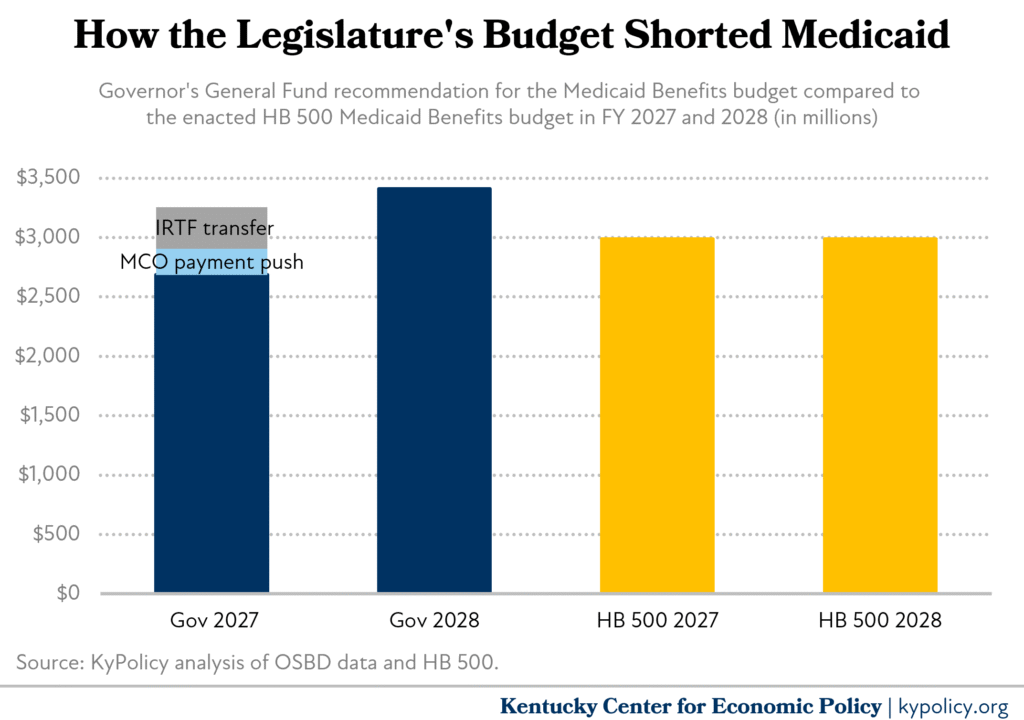
Kentucky has the money to fix the FY 2028 shortfall. When lawmakers reconvene for the 2027 legislative session in January, they will need to unlock the $290 million currently sitting in the Budget Reserve Trust Fund (which lawmakers have referred to as a “lockbox”) and add an additional General Fund appropriation of $131 million. Combined, $421 million should be enough to fully close the FY 2028 hole and prevent future cuts. Those additional funds could come from the Budget Reserve Trust Fund, which is expected to still have over $2 billion by the end of the biennium.
Income tax cuts are the root of the problem
Medicaid isn’t the only program underfunded in this budget. For example, the Department for Community Based Services (DCBS), which oversees foster care and family support programs, and the Department for Behavioral Health, Developmental and Intellectual Disabilities (BHDID), which serves Kentuckians with disabilities and mental health needs, have faced their own funding gaps this year that required their own emergency fixes to avoid cuts.
This problem is the result of the failure of state revenue to keep up with the growth in costs. Since 2022, the state has cut its individual income tax rate from 5% to 3.5%. Those cuts have prevented roughly $2.1 billion per year from going to the General Fund — money that could have gone toward fully funding Medicaid, disability services and child welfare. If the state continues down this path of income tax cuts, the budget holes that hit Medicaid, DCBS, and BHDID this year will only get deeper and harder to fill.
Kentucky families who depend on these services deserve better than a budget that requires last-minute rescues every summer. For now, the General Assembly has the tools and resources to fix FY 2028’s Medicaid shortfall before it becomes another crisis. Lawmakers should use them when they return to Frankfort in January.