
Too little funding for early childhood care and education (ECCE) in Kentucky means that quality care is too expensive for low-income families, and remains unaffordable for most Kentuckians.
A new report from the Economic Policy Institute lays out a broad argument for why bold investment in ECCE is needed. In short, children who have high quality early childhood experiences benefit immediately and well into adulthood, families with access to affordable care are able to invest in their income-earning potential and pursue careers, and states can more generally invest in a better prepared workforce.
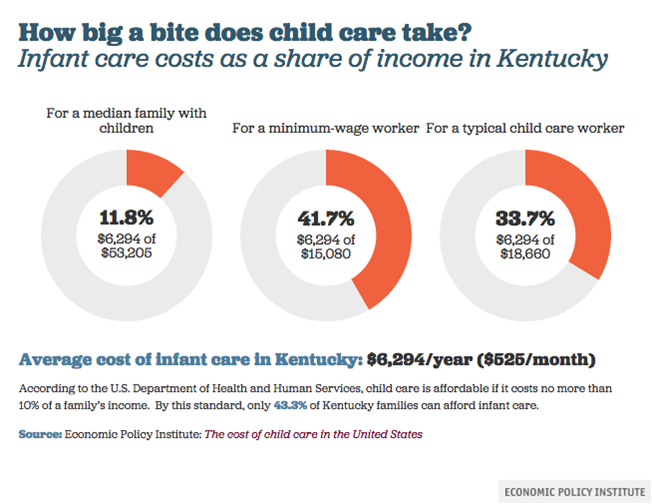
Specifically, the report proposes that families shouldn’t have to spend more than 10 percent of their income on child care. This proposal is based on the recommendation the Federal Cabinet for Health and Human Services makes to states who receive the Child Care Development Fund grant, which pays for a large portion of child care assistance programs such as Kentucky’s CCAP. Such a goal would require considerable public investment, but the returns to Kentucky would be worth it. EPI describes four main types of benefit:
Better care means better outcomes for kids:
- High quality childcare can meaningfully narrow academic achievement gaps, which has real implications for individuals, Kentucky’s workforce and our economy as a whole.
- Home visitation programs for very young children, such as the HANDS program in Kentucky, have been linked to better academic achievement later in life.
- When children get high-quality child care and education, studies have shown that they have better health, are less likely to get in trouble with the law and have more stability in their personal lives as adults.
Lowering cost of childcare would help working families make ends meet:
- In Kentucky, capping child care costs at 10 percent of income would mean $974 more each year for the typical family with an infant.
- Extra savings from in-kind child care policies would mean families could save for college, pay for needed health care or pay for rent, which is unaffordable for most renters in Kentucky.
Ensuring consistent child care will increase parents’ opportunity to work:
- Studies have shown that in places where child care assistance was improved, every 1 percent increase in subsidy raised the maternal labor force participation by roughly .25 percent.
- In Kentucky, EPI estimates that capping child care costs for families at 10 percent of income would result in a 0.5 percent, or $939 million boost to the state economy due to increased labor force participation.
Better wages for child care workers would reverse the trend of depressed wages in the industry, and remove barriers to a higher quality workforce:
- In Kentucky, a typical child care worker makes $18,621 per year. Nationally, child care workers’ median pay is 39.3 percent less than that of workers in other occupations.
- Research confirms that high-quality programs that benefit children’s wellbeing and success later in life, such as the Chicago Child-Parent Program, have well-trained, well-compensated staff.
Kentucky’s HANDS program, CCAP, and publicly funded preschool are examples of ECCE programs that EPI more generally refers to throughout their report. However, such programs don’t reach everyone who needs assistance. For example, many families are unable to qualify for CCAP and must pay full market rates. Only 43.3 percent of Kentucky families can afford child care for infants, and significantly fewer can afford care for two children.
Further, CCAP only reimburses providers between $6 and $25 per child per day, depending on several factors such as part or whole-day care and the age of the child. This is far below the recommended 75th percentile of current market rates which range between $17 and $30 per child per day, meaning that the quality of care children receive may suffer due to inadequate funding.
State and federal funding as well as parental co-pays make up CCAP funding, and all three have declined in recent years. However, the approved biennial budget, now on Gov. Bevin’s desk, takes steps in the right direction. It adds $10.6 million in each fiscal year to raise the limit of eligibility for families to receive child care assistance from $33,525 to $38,880 for a family of four 1 . Additionally, $7.5 million of the public preschool appropriation will be used as a grant to encourage full-day collaborations between local school districts and private child care providers.
Meaningful investment in ECCE in Kentucky will help families make ends meet, give children more opportunity for a successful life, get more parents to work and bring much needed income to an underpaid workforce. This recent report from EPI affirms that bolstering Kentucky’s ECCE is crucial.
- The current standard for CCAP income eligibility is 150 percent of the 2011 Federal Poverty Level. The budget enhancement would instead make families “at or below 160 percent of the federal poverty level as determined annually by the U.S. Department of Health and Human Services” eligible for assistance. ↩