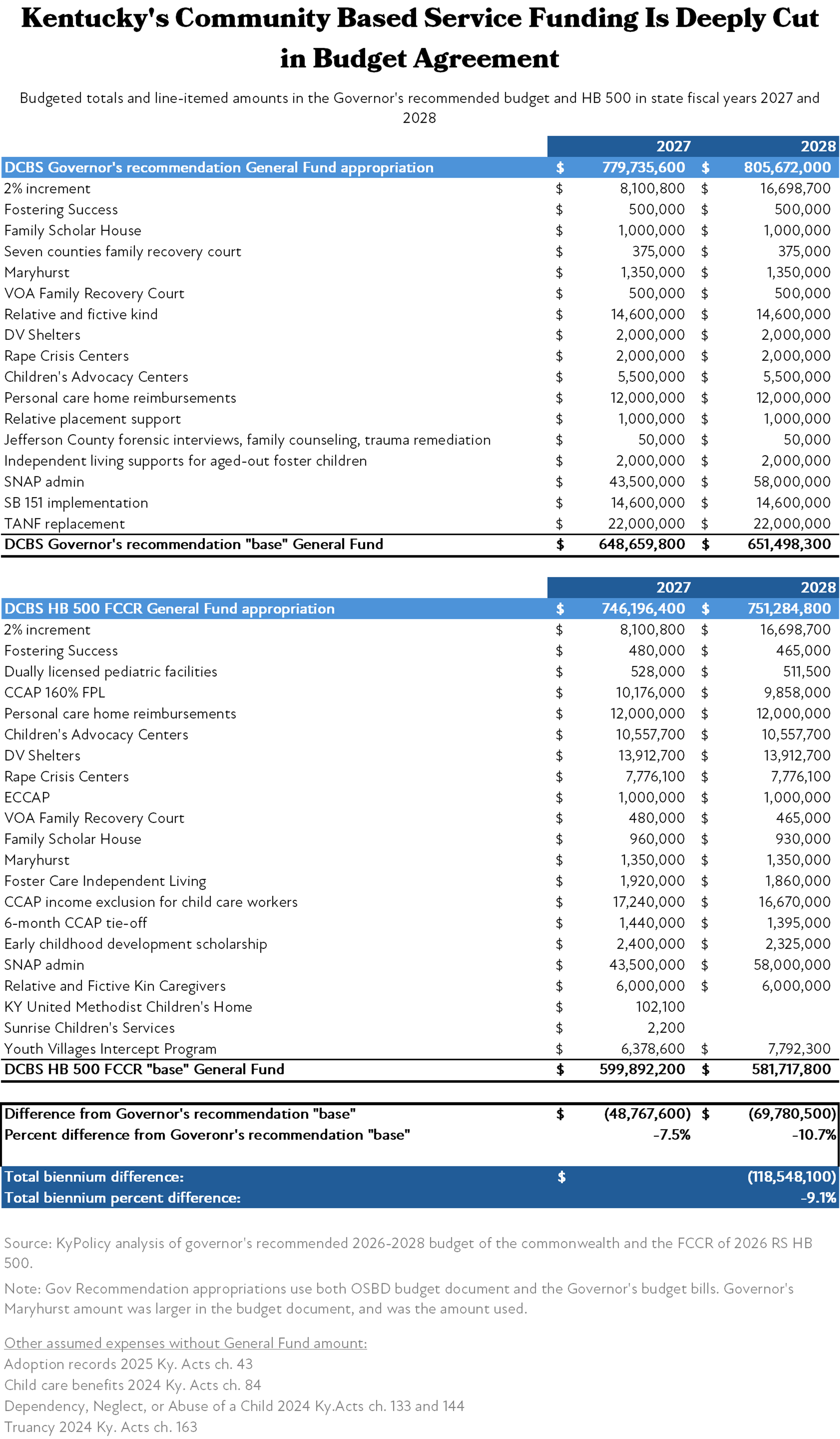
In the final budget agreement, the legislature passed the deepest cuts in over a decade to the Department for Community Based Services (DCBS), which primarily exists to serve Kentucky’s most vulnerable children through foster care, public assistance, child care and more. Across the biennium, funding for DCBS’s base budget will be cut 9.1%, or $118.5 million compared to the cost of providing current services. Agency officials will not be able to sustain this cut without a contraction of its services, harming the Kentuckians it serves and potentially resulting in higher costs to the state down the road.
A cut of this magnitude will force DCBS to make painful decisions in order to fulfill its existing statutory obligations, in addition to those specifically delineated in the budget bill. Those choices may involve no longer implementing previously enacted policies that are not statutorily required (such as the higher income eligibility threshold for child care assistance, which makes child care more affordable for working Kentucky families), ending or reducing contracts with community partners, sweeping funds from flexible federal grants (like the Temporary Assistance for Needy Families block grant that funds basic cash assistance to low-income families with kids), reduced staff pay and/or layoffs.
Taking care of children in out-of-home placement will necessarily, and appropriately, be the top priority for DCBS. But the agency will struggle to do what is needed with fewer resources. That was already the case last year, when DCBS cut basic cash assistance to very low-income families and diverted those funds to support foster care. Cutting basic cash assistance is not just financially harmful to the families who use that assistance but may actually increase the likelihood of a child being involved in the child welfare system, which is more damaging for the child and more expensive for the state. In a recent news story covering a report released by the State Auditor examining children sleeping in state office buildings and nontraditional placement settings, the Auditor stated that, “We probably do need to be paying more money for foster care parents, especially for therapeutic foster care. We need to be doing more to get treatment locations. We absolutely need to be doing more on this.”
DCBS is the single largest employer in state government with over 5,200 employees, and cutting tens of millions each year from the department’s base budget will almost certainly force staff reductions. Only recently has DCBS been able to hire enough social workers to make the child welfare caseloads manageable, having reduced vacancies from 312 in 2023 to 54 in 2025. Reasonable caseloads are not just about improving job quality among social workers, but also about ensuring the accuracy of their assessments and the safety of the children they serve. Additionally, many employees of DCBS are Family Support Specialists who make case determinations for SNAP, Medicaid and other vital public assistance programs. With fewer Family Support Specialists, state payment errors in SNAP and eligibility errors in Medicaid are likely to rise, for which there would be severe financial consequences for the state. That includes up to hundreds of millions of dollars annually in new SNAP costs and lost federal matching dollars due to Kentuckians falling through the cracks who should be receiving Medicaid.
See the below table for a comparison of the Governor’s recommended continuation budget and the final budget agreement in HB 500.