
The recently ended shutdown of the federal government demonstrated just how essential the Supplemental Nutrition Assistance Program (SNAP) is to over 560,000 Kentuckians. Over the last month, as the Trump administration battled states, cities and nonprofits in court over how much SNAP benefits to get out to hungry families, Kentucky managed to get partial benefits to people needing help to refill their pantries. The deal to reopen the government has provided the remainder of the SNAP benefits that households are owed, and continue to fund monthly benefits through next September.
But with the shutdown pain ending, new obstacles are beginning thanks to the largest ever cut to SNAP passed earlier this year in the One Big Beautiful Bill Act (OBBBA or H.R.1). For 114,000 Kentuckians, those cuts begin this month in the form of eligibility changes and paperwork requirements, and the entire program will soon be at risk of cuts in how H.R. 1 shifts funding down to states.
SNAP work reporting requirements expanded in November, putting as many as 114,000 Kentuckians food assistance at risk
While one in nine Kentuckians were bracing for partial benefits or no benefits at all because of the shutdown, the state began implementing OBBBA’s expanded SNAP work reporting requirements in three ways. First, it expanded the requirement to submit paperwork to prove work hours for parents with kids over 13 (previously, having any child in the household exempted parents from reporting work hours), and for older adults 55-64 (previously, only adults up to 54 were required to report work hours), roughly 50,000 Kentuckians. Second, it ended exemptions for veterans, people experiencing homelessness and former foster youth from this requirement, regardless of age, which were in place in acknowledgement of the special difficulties these groups face when it comes to routine work reporting. Third, it ended waivers for areas where finding a job is more difficult. In Kentucky that means 64,000 Kentuckians in 117 counties are newly required to submit additional paperwork to keep their grocery money. In total, as many as 114,000 Kentuckians could fall in one of these three categories.
Another lingering threat to SNAP is the impact these changes will have on error rates – and ultimately costs for states
Kentucky managed to get people some of their November benefits, but SNAP administration has been difficult across the nation over the past two months. As one federal judge noted this week, the Trump Administration’s approach to SNAP during the shutdown “repeatedly shifted the goalposts for States, each time requiring States to rely on incorrect information not in accordance with the law.”
While the fate of SNAP benefits was uncertain during the shutdown, families had questions about just how much in benefits they would receive, if they could still spend what was left over on their EBT cards and if call centers were even open to answer these questions. This uncertainty made it difficult for families and the Cabinet for Health and Family Services that administers SNAP to continue regular operations. This includes processing new applications, handling changes to income or household composition and complying with the newly expanded work reporting requirement.
In addition, the state was required to implement several other federally-required, technical changes to SNAP benefits in October, including an inflation-adjustment to benefit amounts, a recalculation of benefits for the SNAP Simplified Assistance for the Elderly Program and two deduction changes to how a household’s utility bills impact their SNAP eligibility and benefit levels, established in OBBBA.
These federally-triggered disruptions in normal operations are likely to result in some households getting too many or too few benefits, also known as payment errors. Because of OBBBA, increases in Kentucky’s payment error rate will have significant consequences to our next state budget. In 2028, states may have to pay for SNAP benefits for the first time in history and the amount will be determined by our error rate.
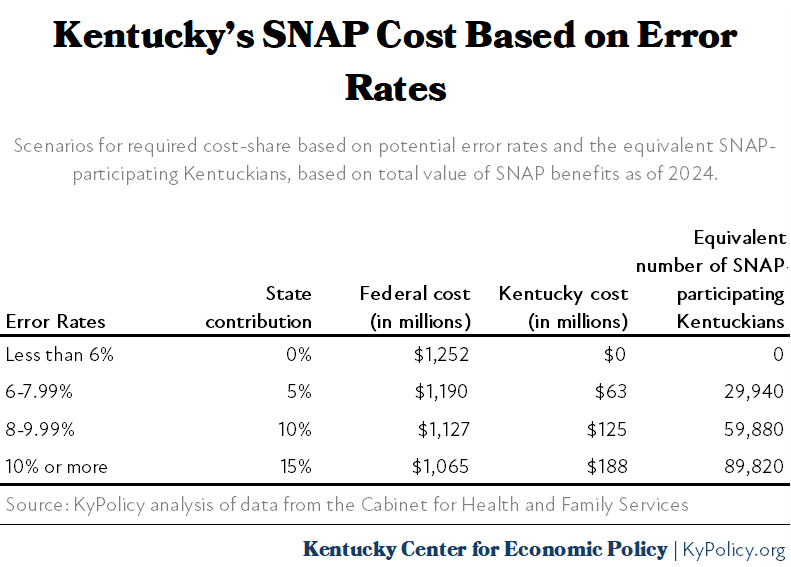
If Kentucky is required to pay tens or even hundreds of millions of dollars in costs for our SNAP program, it will create tremendous pressure on legislators and administrators to cut costs. Because of how SNAP benefits are calculated, the only way to meaningfully reduce SNAP costs is to reduce enrollment. This perverse incentive would likely result in new barriers to prevent or reduce participation in SNAP – something the state legislature has already attempted four times in the past six years.
Up until now, SNAP has been a fully federally-funded program, which is especially important for less prosperous states like Kentucky that need these food benefits the most, and yet can least afford them. But the OBBBA upends 60 years of precedent. Besides rejecting this policy shift, the USDA and Congress can at least hold states harmless for error rates derived from these extremely fast-paced and tumultuous changes when determining error rates, and from implementing OBBBA changes during the shutdown. Congress should explore options to delay these changes and ensure SNAP can keep food on the table during future shutdowns. It is now clear, Kentuckians cannot go without SNAP and Kentucky cannot carry the weight of higher costs and politicized administration of this vital assistance.
The Federal shutdown brought a sharp awareness to the vital role SNAP plays in Kentucky’s fight against hunger. It is an essential tool to meet the basic needs of Kentuckians across the state. This lesson should be recalled as future policy decisions at the federal and state levels are made, and we should continue to take down barriers, including those erected by OBBBA, so that no Kentuckian goes hungry. Unfortunately, for too many Kentuckians participating in SNAP, the shutdown is just beginning.