
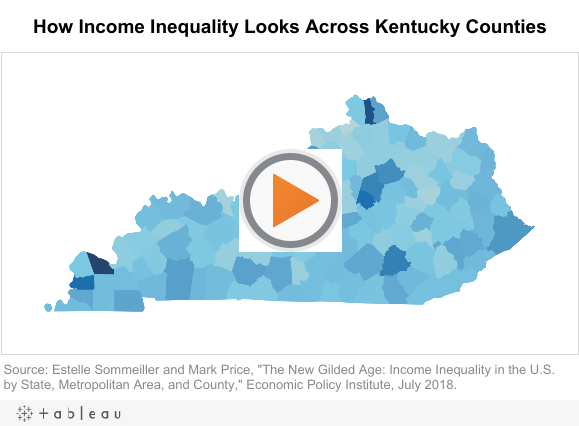
The average income of the top 1 percent of Kentuckians is 18.4 times greater than the average income of everyone else in the state, according to a new report by the Economic Policy Institute. Income for the wealthiest 1 percent of earners in Kentucky was $719,012 on average in 2015 (the most recent year for which IRS data is available), compared to an average income of $38,990 for the remaining 99 percent. High and growing income inequality across the nation is the result of economic policies that have depressed wages at the bottom, contracted the middle class and allowed income at the top to skyrocket.
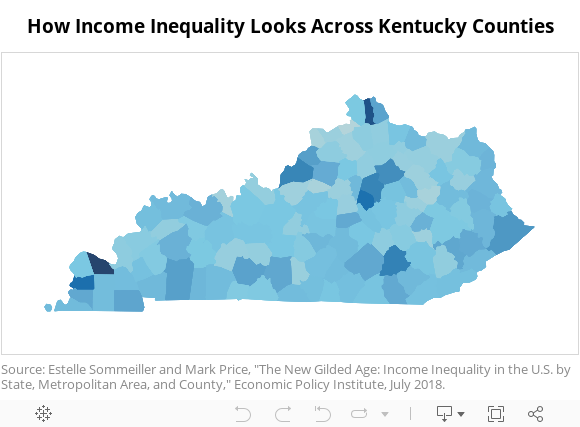
Income inequality is not uniform across Kentucky. At 6.1, Gallatin County in the northern part of the state has the lowest “top to bottom ratio” — the average income of top earners compared to the average income of everyone else. In contrast, McCracken County in western Kentucky has the highest top to bottom ratio at 36.4 — where the wealthiest 1 percent make $1.5 million on average and everyone else makes $39,357. Pike County in the east and Carlisle County in the west — as well as Jefferson, Fayette, and Kenton counties in the state’s “golden triangle” — are among the 10 counties with the highest inequality ratio.
The report also details income inequality in major metropolitan areas, including 25 located at least partially in Kentucky. In these areas, the top 1 percent of earners make a range of 10.5 times more than the rest in Frankfort to 29.9 times more in Paducah.
Income inequality is large, but is also growing rapidly over time. From 1973 to 2007 in Kentucky the top 1 percent’s real income grew 109.4 percent while the remaining 99 percent’s income grew just 18.2 percent. That trend has continued in recent years, where the top 1 percent’s real income in Kentucky grew 23.2 percent between 2009 and 2015 while the bottom 99 percent’s income grew just 7.2 percent.
Soaring income inequality in Kentucky over the last few decades stands in stark contrast to the period in the middle of the 20th century, where prosperity was better shared. Whereas from 1945 to 1973, the top 1 percent in Kentucky captured only 7.2 percent of total income growth, they captured 39 percent from 1973 to 2007 and 34.4 percent from 2009 to 2015.
Among the major drivers of these troubling trends in income inequality are declines in union density and erosion in the value of the minimum wage and other baseline labor standards. Kentucky can work to counter the growth in income inequality by increasing the state’s minimum wage and strengthening worker supports and protections.