
KyPolicy has previously warned that Big Tech companies are seeking to minimize the taxes they pay to local governments and school districts on data centers, even as Kentucky communities debate whether to host them at all. Meta, the parent company of Facebook and Instagram, has now secured an agreement with the Mason County Fiscal Court that will dramatically reduce its tax obligations to the county and local schools for up to six new data centers.
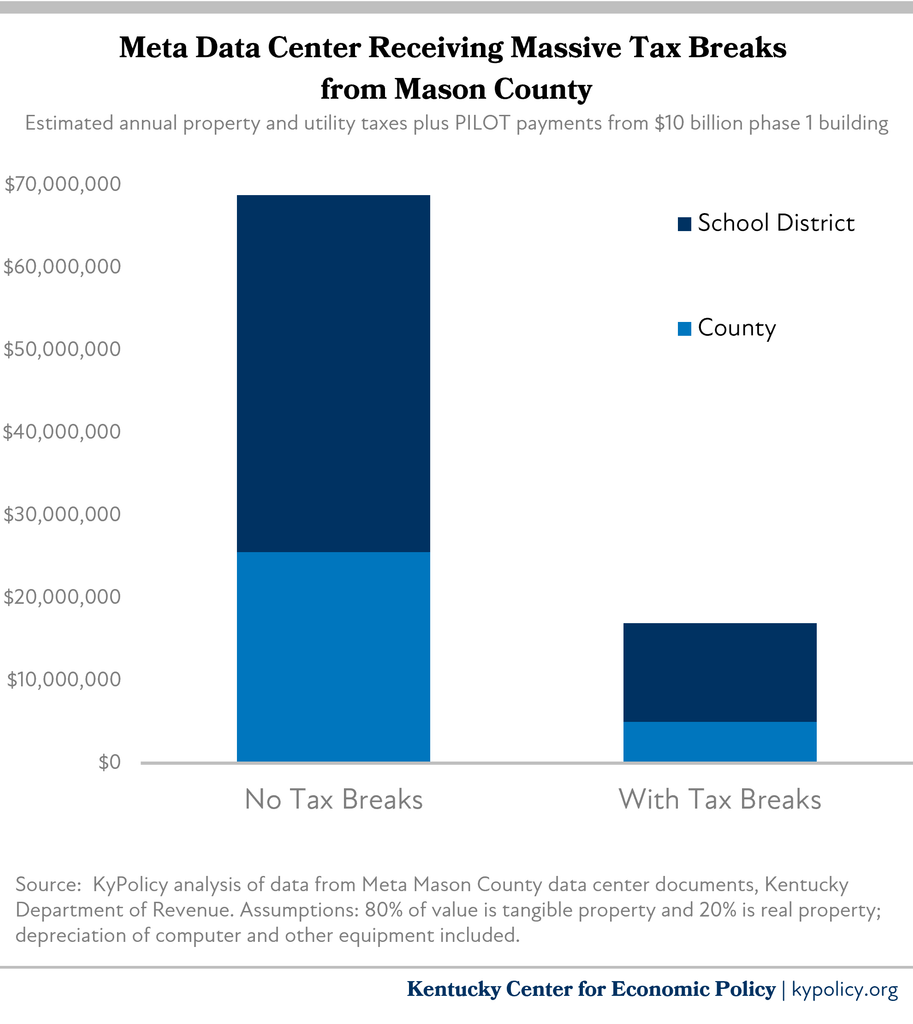
KyPolicy estimates that the deal will eliminate approximately $50 million a year in taxes the company would otherwise pay for the first data center building alone, even after considering the Payments In Lieu of Taxes (PILOTs) the company will make under a separate agreement. The amount of unpaid taxes will grow to roughly $70 million annually if Meta and other tech companies succeed in getting data centers categorized as “manufacturing facilities.” These tax breaks would be in addition to the huge 50-year sales tax exemption for data center equipment that Meta will receive if approved by the state, a subsidy that could easily cost over $400 million just for the initial outfitting of the first facility.
Deal exempts Meta from paying local property taxes
The Mason County Fiscal Court is issuing a 40-year Industrial Revenue Bond (IRB) in support of the project.1 In an IRB, the county “buys” a company’s buildings and equipment and then leases them back to the company. Since property owned by the government is constitutionally exempt from the property tax, the arrangement entirely exempts Meta from paying property taxes to the county and the school district on the land and buildings (known as “real property”) or the equipment (known as “tangible property”).
Given information provided publicly about the data center and assuming current local tax rates and depreciation, Meta should pay approximately $59 million annually in property taxes to Mason County and Mason County Schools once the facility is completed and outfitted. But all those taxes are being excused under this deal.
PILOT payments do not come close to replacing the lost revenue
As part of the deal, Meta will make PILOTs to the county and school district. But those payments are a fraction of the taxes the company otherwise would contribute if the IRB were not used. According to the agreement, Meta will pay $7.94 per square foot in PILOT payments each year to the county and $3.18 per square foot to the school district. That equals approximately $5 million annually to the county and $2 million to the school district, far below the $59 million the company would otherwise pay. The agreement also includes language ensuring that the utility gross receipts tax paid to the school system on electricity purchased will not fall below a floor of $10 million per year.2
Meta could also receive the 50-year sales tax break on equipment purchased if approved by the state, plus additional tax breaks
The state could also approve a sales tax break for the purchase of all equipment in the data center, which is currently available under law. If 80% of the cost of the $10 billion first phase of the data center is for equipment, as is common, that would make the initial tax break worth a massive $480 million. Meta would also receive a tax break each time it refreshed the equipment, estimated at every three to five years for the next 50 years. The sales tax break would have to be approved by the Kentucky Economic Development Finance Authority, which meets monthly.
In addition, if Meta’s lawyers succeed in getting data centers treated as “manufacturing facilities” under Kentucky law (and if the Kentucky legislature does not close that loophole), the company’s taxes could be reduced further. Meta would avoid paying approximately $12 million a year in state tangible property taxes on the first data center building and its state sales tax would only apply to electricity purchases that equal up to 3% of the cost of production, likely cutting the sales tax paid in half.3
Tax breaks violate executive order and are at odds with legislative momentum
Governor Beshear has directed that data centers should pay their “full and fair share of local and school taxes” in an executive order issued in August. That order states that data centers “must not attempt to avoid paying taxes, especially those for our communities and schools.” The governor has also indicated support for repealing the state sales tax break, saying recently “I don’t think data centers need incentives. . . I don’t think we should be providing them, and so I would certainly support rolling back any of that.” In addition, at least three majority-party lawmakers who voted for the sales tax break in 2025 have stated that it should be repealed.
But under the deal that Meta struck with Mason County, one of the world’s richest corporations will contribute much less than it would owe under the laws applying to every other business and resident. That inequity will worsen if the state awards sales tax breaks to Meta and fails to close the loophole that would allow data centers to be treated as manufacturers.
Photo: Flickr, ON BORROWED TIME

- Additional buildings constructed in later years would have their own IRB issued and a new 40-year period over which those buildings and their equipment would also be exempt from local property taxes.
- To the extent that additional buildings are constructed, the floor for utility gross receipts taxes increases by $2.5 million per building.
- In addition, if the state chooses to participate in the IRB, which it has the option to do, Meta’s state property tax rate on the real property will be reduced by 85% (from 10.3 cents to 1.5 cents per $100) and on the equipment by a whopping 97% (from 45 cents to 1.5 cents per $100). The tax breaks from the Mason County deal would then grow to nearly $80 million.