As Kentucky students head back to school this month, state funding for K-12 education continues to fall well below past efforts, preventing overdue investments to shrink class size, increase student supports and hire more teachers and bus drivers. This inadequate and inequitable state funding is accompanied by federal funding losses and uncertainty, making it more difficult for Kentucky kids to get the first class education they all deserve.
State education funding has fallen behind
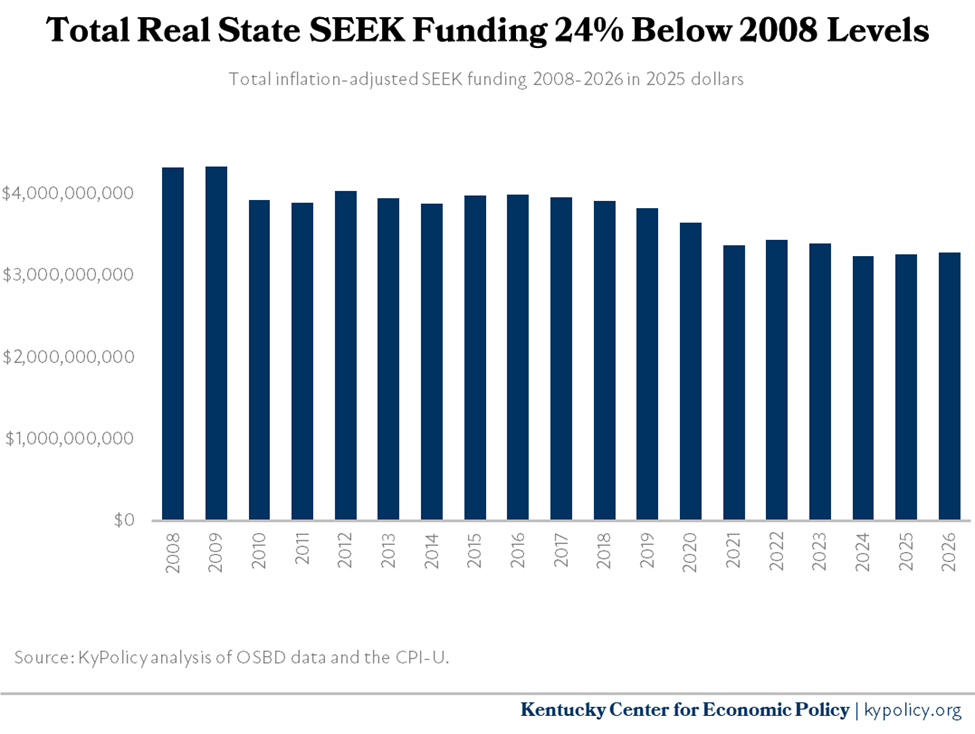
Kentucky uses a funding formula called Support Educational Excellence in Kentucky (SEEK) to distribute core state funding for schools. SEEK funding increased only very modestly in the 2024-2026 state budget, and once inflation is taken into account, SEEK funding levels gained virtually no ground. Real total budgeted state SEEK funding is 24% below 2008 levels for this fiscal year, as shown in the graph below.
The base SEEK “per-pupil guarantee” did increase 9% over the biennium, without adjusting for inflation, going from $4,200 in 2024 to $4,326 in 2025 and now $4,586 in 2026; however, that total includes both state and local funding.
The 2024-2026 state budget did not provide dedicated funding for raises, and this SEEK funding level is not adequate for all districts to provide needed raises and a classroom environment that supports high-quality teaching and learning. Last school year, average district pay for Kentucky teachers was $13,888 less than 2008 once adjusted for inflation, a 19.8% decline.
The state continues to struggle with a teacher shortage, and the new policy restricting communications with students will add to working condition frustrations this school year.
Funding for school transportation (a component of SEEK) is at only 82% of the full statutory amount this school year, despite a law mandating 100% funding. The legislature has suspended this requirement every year since 2005.
Because the SEEK formula involves both state and local funding, when state funding isn’t adequate it puts additional pressure on local school districts to try to make up the difference. This growing shift from state to local funding for public education has increased inequities between poor and wealthy school districts. In current dollars, the 2024 per-pupil funding gap between schools in the top and bottom quintiles was $4,247, which is $508, or 13.6%, more than it was in 1990, when the state passed the Kentucky Education Reform Act (KERA) to address these inequities.

Outside of SEEK funding, preschool funding remains frozen at its 2019 level. Extended school services (afterschool programs) are also at the same level as in 2019. And there are no funds for teacher professional development, which has not been specifically funded since 2018, or for textbooks.
Schools have lost federal funding and face further uncertainty
On top of these state funding challenges, Kentucky schools no longer have federal COVID relief money and have been subject to federal actions in recent months that put other funding in jeopardy. As the federal administration continues to attempt cuts to funding for public education, there is a great deal of uncertainty and the stakes are high. Federal funding makes up a substantial part of public school budgets in Kentucky and is particularly important in rural districts and to kids with the greatest needs.
Schools are still adjusting to last year’s expiration of federal Elementary and Secondary School Emergency Relief (ESSER) , which created a “fiscal cliff” that hit Kentucky particularly hard. Starting in 2020 through the CARES Act, ESSER’s historic $3.1 billion in funding for K-12 education in Kentucky enabled schools to address immediate COVID-specific issues as well as take care of longstanding needs, including hiring staff, raising wages and providing student supports. However, the 2024-2026 state budget did not provide adequate funding to stabilize districts’ financial situations during the post-ESSER transition.
Without the resources to sustain investments that have recurring costs, such as the approximately 2,000 staffing positions newly created with ESSER funds in Kentucky, districts have had to cut staff and services. Several Kentucky school districts are facing budget deficits. Fayette County Public Schools has a $16 million budget shortfall for this year, of which the expiration of federal pandemic relief funds was a major contributing factor. Newport Independent Schools has made massive cuts to address its $3.9 million budget deficit; Berea Community Schools faced a $1.3 million shortfall that led it to cut over 30 positions, resulting in a student walkout; and Woodford County Public Schools has a $2 million deficit for Fiscal Year 2025, which ended June 30.
Actions by the Trump administration have made the school funding situation worse. In March of this year, 14 Kentucky school districts still had a total of $38 million in unspent/unreimbursed ESSER funds allocated for construction projects or school busses — and the state Department of Education had $18 million for programming — when the administration announced its decision to rescind these funds a full year before the extended deadline.
Then on June 30, the administration froze $87 million in U.S. Department of Education grants for Kentucky schools during the 2025-2026 school year for effective instruction, student support and academic enrichment, afterschool and summer programs, migrant education, and English language acquisition services. While the funds were released several weeks later, the administration’s actions create uncertainty about school funding moving forward.
In the next budget, the state should reaffirm its commitment to public education. Significant SEEK funding increases that move the state closer to 2008 funding levels, and full funding for transportation, would better support kids and classrooms, make progress in reducing inequities between poorer and wealthier school districts, and create more stability in the face of federal funding uncertainties.