The state is increasingly diverting lottery revenues from financial aid programs to help shore up the budget, as described in a Lexington Herald-Leader story today. Those dollars are coming from need-based financial aid programs at the same time budget cuts are driving up tuition.
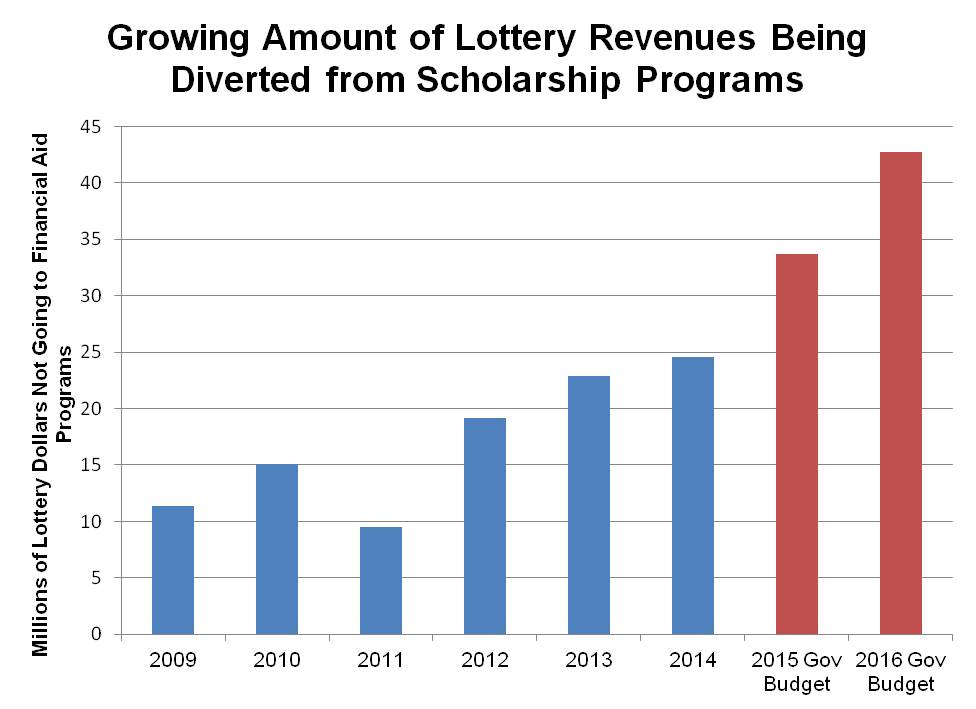
By law, all but $3 million of lottery revenue goes to college financial aid programs (the $3 million is for literacy efforts). But since 2009, the state has diverted lottery revenues to fill in holes in the state budget. The amount diverted was $11 million the first year, and in the governor’s proposed budget climbs to $33.7 million in 2015 and $42.7 million in 2016.

Source: Office of the State Budget Director
Those diversions aren’t hitting all financial aid programs equally. 55 percent of the lottery financial aid money is supposed to go to need-based programs (aid based on an individual or family’s financial resources) and 45 percent to the merit-based Kentucky Educational Excellence Scholarship (KEES) program, which is based primarily on grades. The state has continued to fully fund the KEES program (at a level that’s actually slightly above its statutory requirement) while making big cuts to the need-based programs, the College Access Program (CAP) and the Kentucky Tuition Grant (KTG) program.

Source: KCEP analysis of Office of the State Budget Director data
That makes a big difference in who gets financial aid. As shown in our new report, 46 percent of KEES scholarship money went to students with family incomes over $75,000 in 2013. In contrast, less than 2 percent of CAP and 29 percent of KTG funds were disbursed to students in that income category.

Source: Kentucky Higher Education Assistance Authority. This analysis is based on KEES, CAP and KTG recipients for whom income information is available.
Not only is the state failing to fulfill its own requirements—it is underfunding need-based programs even more once eligibility is taken into account. While KEES is fully funded—meaning all students who qualify will receive their scholarships—CAP and KTG are awarded on a first-come, first-served basis. In 2012-2013, over 76,000 eligible students (67 percent of eligible applicants) were denied CAP scholarships due to lack of funds. Over 10,000 eligible students (46 percent of eligible applicants) were denied KTG. Funds for CAP and KTG are running out earlier and earlier each year.

Source: KCEP analysis of Kentucky Higher Education Assistance Authority data
The state’s financial aid system is not adequately prioritizing need-based financial aid, which is particularly critical in the context of rising tuition at Kentucky’s public universities and community colleges. Reforms to the state’s financial aid programs are needed so that the students with fewer economic resources receive greater assistance in meeting the growing costs of college.