As with states, local governments in Kentucky and nationwide need significant federal relief if they are to continue providing crucial front line and community services through the COVID-19 pandemic. Measures preventing the spread of COVID-19 are deeply suppressing the economic activity that fuels local revenue receipts, and the significant impact on cities and counties is expected to continue over several years. Much more federal aid – as is proposed in the recently introduced HEROES Act – is needed to prevent painful cuts and avoid lengthening and deepening the economic downturn.
Kentucky cities face huge collective deficit this and next year
Earlier this month, the Kentucky League of Cities (KLC) conducted a survey of its members, with results suggesting cities will face a collective budget shortfall of $85 million in the current fiscal year ending June 30, and $180 million in fiscal year 2021. Because local governments are required to balance their budgets every year, face restrictions on issuing debt and have limited ability to levy taxes – and because the state faces its own devastating shortfall, meaning adequate state aid to locals is off the table – without federal help, local governments will be forced to make significant cuts. Reducing police, fire, EMT, social services, public works and other crucial services harms communities during good times. Such cuts will be devastating during the pandemic, including because they create an additional drag on local economies from layoffs and reduced investment.
Many communities in Kentucky face a particularly precarious situation
Before COVID-19, many of the local governments in eastern Kentucky were already struggling financially due to a loss of coal severance funds, significant reductions in property tax bases and increasing pension and jail costs. But even communities that have seen comparatively strong economic growth in recent years are at risk. Data from Brookings identifies Louisville, Lexington and Bowling Green among the U.S. cities that could be most harmed fiscally by COVID-19 job losses and business closures due to their mix of industries and revenue sources.
Shortfalls and cuts that have already been announced by local governments to date include the following:
- Pike County Judge Executive Ray Jones announced $1.4 million in staff reductions – a total of 28 employees.
- Lexington Mayor Linda Gorton announced a projected decrease in revenues of $40 million for the upcoming fiscal year, which represents an overall decrease of 10% in General Fund revenues for the city. Lexington derives 60-65% of its revenues from the occupational tax and the business gross receipts tax.
- Louisville Mayor Greg Fischer expects a $46 million shortfall in the current year and a $69 million shortfall in fiscal year 2021. Overall, 47% of city tax revenues comes from the occupational tax and 11% from business profits taxes. Louisville received $134 million from the CARES Act to use for direct COVID-19 expenses.
Covid-19 relief for local governments in Kentucky so far is extremely limited, but HEROES Act provides more
Given the projected magnitude of local revenue shortfalls, the limited federal assistance provided thus far is inadequate. The state of Kentucky will receive approximately $1.7 billion from the CARES Act but the only local government large enough to receive a direct allocation is Louisville. Any additional relief to local governments must come from the $1.599 billion Coronavirus Relief Fund the state received, and Governor Beshear announced on May 20 that local governments will receive $300 million from that fund. But that amount is not enough, and those funds are restricted in use for pandemic-related expenses and cannot be used to address revenue shortfalls.
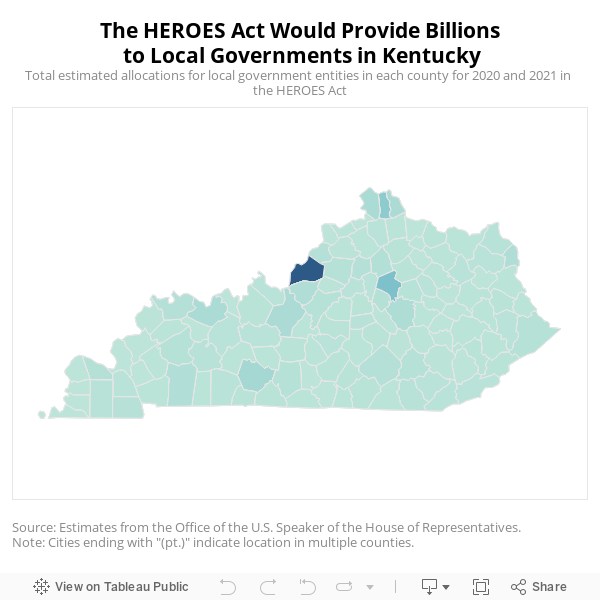
On May 15, the $3 trillion HEROES Act passed the House, with over $1 trillion in flexible relief for state and local governments to be distributed over the next year. Of that amount, $375 billion would be allocated to local governments. Those monies would be allocated to Kentucky localities as follows:
Counties and cities need this kind of direct, flexible aid and they need it to continue until their economies have fully recovered.